
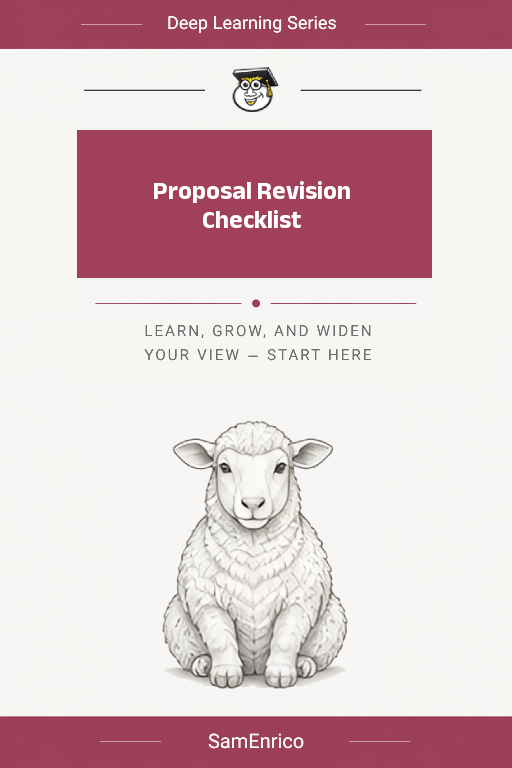
Non-FictionStudent's ShortcutEditing
Proposal Revision Checklist eBook
Self edit grad research proposals using comprehens
by Casey Nettie
Self edit grad research proposals using comprehensive revision checklists. Check alignment, clarity, feasibility, and formatting before committee submission.
Formats
Free sample
Chapter 1: The Reverse Audit–- Most graduate students will spend the next six months writing a proposal that their committee will skim in fifteen minutes and reject in thirty seconds. That is not hyperbole. That is the quiet catastrophe of graduate education. You have been taught how to write—how to form sentences, how to cite sources, how to structure a literature review. But no one has taught you how to revise like a forensic auditor.
No one has taught you that the difference between a funded proposal and a rejected one is rarely the quality of the idea. It is the quality of the execution. And execution begins not with writing, but with reverse engineering.This chapter introduces the single most important revision method you will ever learn: the Reverse Engineering Audit. It is a systematic, checklist-driven approach that flips the entire writing process upside down. Instead of starting with your idea and hoping it matches what the committee wants, you start with what the committee wants and rebuild your proposal around it.
This method has been used successfully by doctoral candidates in the humanities, social sciences, and STEM fields. It works because it replaces hope with evidence, and intuition with a rubric.Most students write forward. They have a research idea. They write a draft. They add sections as they think of them.
They revise by reading from top to bottom, tweaking sentences, and hoping the committee will see the brilliance beneath the disorganization. This is called "forward writing," and it fails for a simple reason: you are writing to satisfy your own sense of completion, not the committee's evaluation criteria. The committee does not care about your writing process. They care about whether you have answered their questions in the order they asked them.The Hard Truth About Committee Reading Habits Before you can revise effectively, you need to understand how your proposal will actually be read. Committees do not read like novelists or even like your advisor.
They read like auditors. They have a stack of proposals—sometimes twenty or thirty—and they have limited time. Most committees allocate between fifteen and thirty minutes per proposal. That is the total time your work will receive from each member. Within that window, they are not searching for your brilliance.
They are searching for reasons to say no.This is not cruelty. It is efficiency. A committee’s job is to separate viable proposals from non-viable ones. They have developed skimming patterns that allow them to make quick judgments. Here is how they actually read:First, they scan the title.
Does it promise something specific? A vague title like “A Study of Educational Outcomes” tells them nothing. A precise title like “The Effect of Flipped Classrooms on Calculus Retention Among First-Generation College Students” tells them everything they need to know about the scope and contribution.Second, they read the first paragraph of the introduction. If the hook is weak, they will assume the rest is weak. They are not being unfair; they are being realistic.
Research shows that the quality of the opening paragraph correlates strongly with the quality of the entire proposal. If you cannot articulate why your research matters in the first two hundred words, you probably cannot articulate it at all.Third, they locate your research question. If it is not visible within the first two pages, they will mark the proposal as unclear and move on. They will not search for it. They will not infer it from context.
You have failed a basic test of organization.Fourth, they check the methods section for feasibility. They are looking for one fatal flaw: an impossible timeline, an unrecruitable sample, a missing ethical approval, a resource you assume but do not possess. A single feasibility error is often enough for rejection.Fifth, they skim the conclusion. Does it answer the question you posed? If the conclusion introduces new claims or shifts the goal posts, they will flag the proposal as inconsistent.Finally, if you survive all of these checks, they may read the literature review in depth.
But most proposals do not survive. They die in the first two minutes because they were written forward instead of reverse-engineered.The Reverse Solicitation Method Defined The Reverse Engineering Audit is built on a simple principle: you cannot write a responsive proposal unless you know exactly what you are responding to. That sounds obvious, but in practice, most students never obtain a copy of the rubric their committee will use. They write from memory or from an outdated handbook. They guess at what matters.
And they lose.The Reverse Solicitation Method works like this. Before you write a single new sentence, you gather every document that contains evaluation criteria. This includes the department’s proposal rubric, the funding agency’s scoring sheet, the call for proposals, and any email from your advisor that lists requirements. You then copy those criteria into a new document. This becomes your skeleton.
For every criterion, you write a placeholder: “Section that addresses [criterion name].” Then you go through your existing draft and highlight every sentence that answers a criterion. If a criterion has no highlighted sentence, you write a new section to address it. If a criterion has multiple highlighted sentences, you keep the strongest and delete the rest.This method forces you to be responsive. It eliminates the possibility that you will forget to address a required element. It prevents you from wasting words on interesting but irrelevant tangents.
And it gives you confidence because you know, before you submit, that every box is checked.How to Obtain and Interpret Rubrics Many students assume that if a rubric exists, it will be handed to them. This is rarely true. Rubrics are often implicit, shared verbally in committee meetings, or hidden in program handbooks that no one reads. You must become a detective.Start by asking your advisor directly: “Is there a written rubric or scoring sheet that the committee uses for proposals? If not, could you describe the top three criteria they prioritize?” Most advisors will give you an honest answer.
If they say “We don’t really use a rubric,” that is itself valuable information. It means the committee evaluates holistically, which makes the other chapters of this book even more important because clarity and feasibility become your only signals of quality.Next, search your program’s online resources. Look for “Ph D handbook,” “dissertation proposal guidelines,” “preliminary exam rubric,” or “graduate student manual.” These documents often contain evaluation criteria buried in appendices. If you find a rubric from three years ago, use it. Committees change slowly, and an old rubric is better than no rubric.If you still cannot find a written rubric, analyze three successful proposals from recently graduated students in your department.
Your advisor can provide anonymized examples. Read each proposal and reverse-engineer the unwritten criteria. What do all three have in common? A clear research question? A detailed timeline?
A specific methodology? Those are your criteria.Mandatory vs. Advisory Sections Not all sections of a proposal are created equal. Some are mandatory: the committee will reject your proposal if they are missing or incomplete. Others are advisory: they…
This is the end of the free sample. Get the eBook to keep going. Buy now
About this book
Details
- Author
- Casey Nettie
- Publisher
- SamEnrico
- Language
- English
- Genre
- Non-Fiction, Student's Shortcut, Editing
- Released
- 2026-06-01
- Pages (approx.)
- 133
- Available as
- eBook, Audiobook

Read better in the ZLOADR app
Your eBooks on your phone or tablet. Sign in with your SamEnrico account and start reading.
More by Casey Nettie
 Harvard Extension School Career OutcomesCasey Nettie$11.99
 Police Nonverbal TrainingCasey Nettie$11.99
 The Furniture Off gassing GuideCasey Nettie$11.99
 Burnout and Creative RecoveryCasey Nettie$11.99
 When the Sky Fell: The Navajo Emergence StoryCasey Nettie$11.99
 How to Produce Bicycle ComputersCasey Nettie$11.99
 How to Start a Nonalcoholic Beverage Bar BusinessCasey Nettie$11.99
 Radiology AssistantCasey Nettie$11.99
You may also like
 Hong Kong Handover 1997Dunn Johnnie$11.99
 Zumba For Postnatal Recovery CourseNeal Christian$11.99
 Zumba for BeginnersLadner Nikia$11.99
 YouTube Comment Mining GuideHumes Pandora$12.99
 Worry Box MeditationCarlin Rudy$11.99
 Workplace Stress MeditationNguyen Lynn$11.99
 Workplace Stress and Sleep RepairHawley Ivory$11.99
 Workplace Perfectionism CureDelaney Jeffry$11.99
 Workplace Injustice Anger GuideWallen Isabelle$11.99
 Work Addiction and Burnout LinkGreenwood Ester$11.99
 Women in Yoga and WellnessBeattie Galina$11.99
 Women in Stand Up ComedyChun Evangeline$11.99