
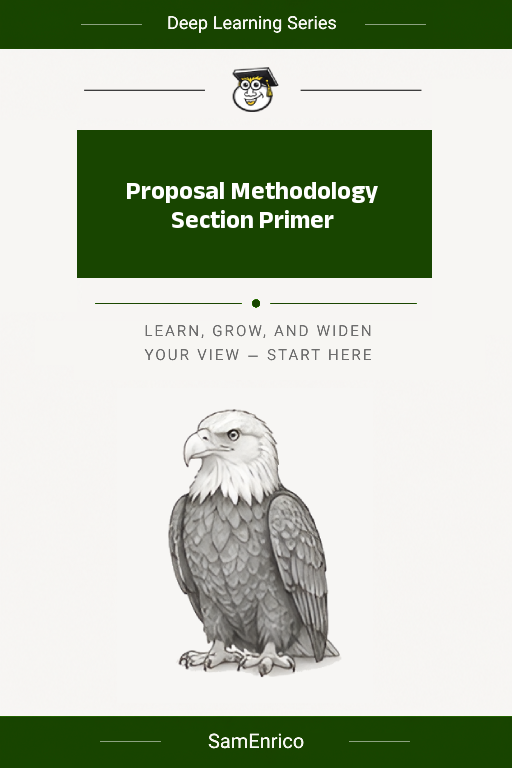
Non-FictionStudent's ShortcutResearch Methods
Proposal Methodology Section Primer
Describe appropriate research methods including sa
by Serrano Luna
Describe appropriate research methods including sampling, data collection, and analysis plans for grad proposals.
Formats
About this book
Free sample
Chapter 1: The Golden Thread--–- Every year, thousands of graduate students submit dissertation and thesis proposals that will be rejected. Not because their research questions are uninteresting. Not because their literature reviews are incomplete. And not because their topics lack significance. Their proposals die in the methodology section.
Specifically, they die because the methodology chapter reads like a receipt—a list of things the student plans to do, stapled together with no evident logic connecting one item to the next.If you are reading this book, you have likely already encountered the blank-page terror of writing the methods chapter. Or perhaps you have written a draft and received feedback that felt simultaneously vague and devastating: "This needs more justification." "Why this approach?" "I don't see the connection between your questions and your methods." These comments all point to the same underlying problem: a missing argument. The methodology section is not a description. It is an argument. And most graduate students have never been taught how to build one.This chapter introduces the single most important concept in this entire book: alignment.
Alignment is the logical, unbroken chain that connects your research question to every single methodological decision you make. When alignment exists, a reviewer can read your proposal and see exactly why you chose your sample, your instruments, your analysis plan, and your trustworthiness strategies. When alignment is missing, the proposal feels like a random collection of methods attached to a research question that could have been answered in a dozen other ways.Consider two hypothetical students. Student A writes: "I will conduct a survey of 200 teachers using a Likert-scale questionnaire. Data will be analyzed using descriptive statistics and t-tests." Student B writes: "Because my research question asks whether there is a statistically significant difference in burnout scores between novice and veteran teachers, I will use a cross-sectional survey design.
The dependent variable, burnout, will be measured using the Maslach Burnout Inventory, a validated instrument with established reliability (Cronbach's alpha = 0.89 in previous studies). The independent variable, teaching experience, will be operationalized as novice (0-3 years) vs. veteran (7+…
This is the end of the free sample. Get the eBook to keep going. Buy now
Contents
- Chapter 1
- Chapter 2
- Chapter 3
- Chapter 4
- Chapter 5
- Chapter 6
- Chapter 7
- Chapter 8
- Chapter 9
- Chapter 10
- Chapter 11
- Chapter 12
Details
- Author
- Serrano Luna
- Publisher
- SamEnrico
- Language
- English
- Genre
- Non-Fiction, Student's Shortcut, Research Methods
- Released
- 2026-06-01
- Pages (approx.)
- 158
- Available as
- eBook, Audiobook

Read better in the ZLOADR app
Your eBooks on your phone or tablet. Sign in with your SamEnrico account and start reading.
More by Serrano Luna
 Nighttime Loneliness RecoverySerrano Luna$11.99
 Solar Temple Victims Memorial HandbookSerrano Luna$11.99
 Natural Testosterone Boosting PlanSerrano Luna$11.99
 Emotional Regulation MaintenanceSerrano Luna$11.99
 Mindfulness for Needle PhobiaSerrano Luna$11.99
 The Silent War: How Microsoft Outmaneuvered IBM in the 1990sSerrano Luna$11.99
 The Turing Test: How AI Learned to Think Like HumansSerrano Luna$11.99
 Understanding Ceroid Lipofuscinois, Neuronal 2, Late InfantileSerrano Luna$17.99
 Dubai Student Legal Rights GuideSerrano Luna$12.99
 How to Become a Buffing-wheel InspectorSerrano Luna$11.99
 Content Marketing InternSerrano Luna$11.99
You may also like
 Hong Kong Handover 1997Dunn Johnnie$11.99
 Zumba For Postnatal Recovery CourseNeal Christian$11.99
 Zumba for BeginnersLadner Nikia$11.99
 YouTube Comment Mining GuideHumes Pandora$12.99
 Worry Box MeditationCarlin Rudy$11.99
 Workplace Stress MeditationNguyen Lynn$11.99
 Workplace Stress and Sleep RepairHawley Ivory$11.99
 Workplace Perfectionism CureDelaney Jeffry$11.99
 Workplace Injustice Anger GuideWallen Isabelle$11.99
 Work Addiction and Burnout LinkGreenwood Ester$11.99
 Women in Yoga and WellnessBeattie Galina$11.99
 Women in Stand Up ComedyChun Evangeline$11.99