
Non-FictionStudent's ShortcutResearch Methods
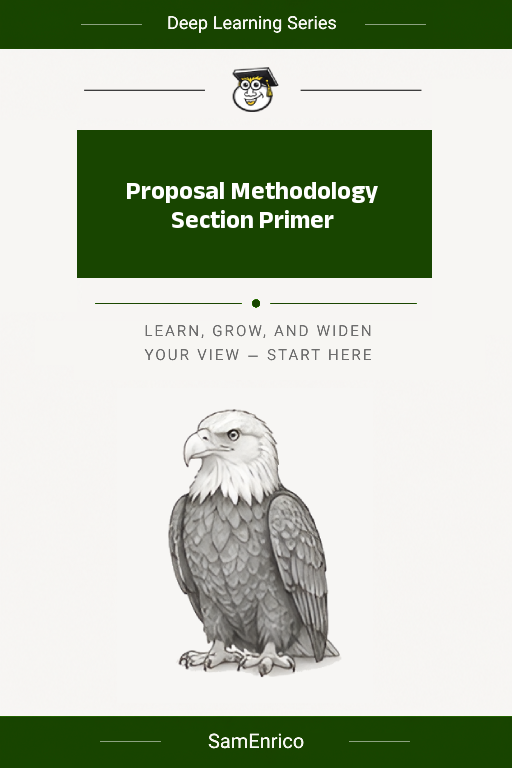
Proposal Methodology Section Primer eBook
Describe appropriate research methods including sa
by Serrano Luna
Describe appropriate research methods including sampling, data collection, and analysis plans for grad proposals.
Formats
Free sample
Chapter 1: The Golden Thread--–- Every year, thousands of graduate students submit dissertation and thesis proposals that will be rejected. Not because their research questions are uninteresting. Not because their literature reviews are incomplete. And not because their topics lack significance. Their proposals die in the methodology section.
Specifically, they die because the methodology chapter reads like a receipt—a list of things the student plans to do, stapled together with no evident logic connecting one item to the next.If you are reading this book, you have likely already encountered the blank-page terror of writing the methods chapter. Or perhaps you have written a draft and received feedback that felt simultaneously vague and devastating: "This needs more justification." "Why this approach?" "I don't see the connection between your questions and your methods." These comments all point to the same underlying problem: a missing argument. The methodology section is not a description. It is an argument. And most graduate students have never been taught how to build one.This chapter introduces the single most important concept in this entire book: alignment.
Alignment is the logical, unbroken chain that connects your research question to every single methodological decision you make. When alignment exists, a reviewer can read your proposal and see exactly why you chose your sample, your instruments, your analysis plan, and your trustworthiness strategies. When alignment is missing, the proposal feels like a random collection of methods attached to a research question that could have been answered in a dozen other ways.Consider two hypothetical students. Student A writes: "I will conduct a survey of 200 teachers using a Likert-scale questionnaire. Data will be analyzed using descriptive statistics and t-tests." Student B writes: "Because my research question asks whether there is a statistically significant difference in burnout scores between novice and veteran teachers, I will use a cross-sectional survey design.
The dependent variable, burnout, will be measured using the Maslach Burnout Inventory, a validated instrument with established reliability (Cronbach's alpha = 0.89 in previous studies). The independent variable, teaching experience, will be operationalized as novice (0-3 years) vs. veteran (7+ years). An independent-samples t-test will compare mean burnout scores between the two groups." Both students are doing similar work. One will pass.
One will fail. The difference is alignment.The purpose of this chapter is to give you the conceptual framework and practical tools to become Student B. You will learn to distinguish methodology from methods—a distinction that transforms how you write. You will master the Golden Thread framework, a recursive process for ensuring every decision answers to your research question. You will create your Alignment Matrix, a one-page tool that will guide every subsequent chapter of this book.
You will learn to write the Methodology Bridge paragraph, which explicitly connects your literature review gap to your chosen methods. And you will meet the Hall of Shame—a collection of proposal phrases that signal alignment failure, which you will learn to recognize and avoid.But before any of that, you need to understand why alignment is so difficult. It is not because you lack intelligence. It is not because you are bad at research. Alignment is difficult because graduate education typically teaches methods in silos.
You take a statistics course taught by a statistician. You take a qualitative methods course taught by a qualitative researcher. You take a survey design workshop. But no one teaches you how to integrate these choices into a coherent defense. No one teaches you that the methodology chapter is not a confession of what you plan to do—it is a justification for why you could not possibly do anything else.By the end of this chapter, you will never again write a methods section that begins with "I will." You will write sections that begin with "Because my research question asks X, I will do Y." That shift—from description to justification—is the difference between a proposal that gets approved and one that gets returned with a frowny face in the margin.
Let us begin.What Methodology Is (And What It Is Not)The first confusion that derails graduate students is the difference between methodology and methods. These terms are not interchangeable, and using them as synonyms announces to your committee that you have not yet mastered the fundamentals.Methods are the specific techniques and procedures you use to collect and analyze data. Surveys, interviews, focus groups, statistical tests, coding schemes, and document analysis are all methods. Methods answer the question: "What tools will I use?"Methodology is the strategic rationale that justifies your choice of those methods. Methodology answers the question: "Why are these tools the right tools for this particular research question, given my assumptions about the nature of knowledge and reality?"Here is a concrete example.
If you say, "I will use semi-structured interviews," you have named a method. If you say, "Because my research aims to understand how teachers make sense of their own emotional labor, I will use semi-structured interviews, which allow for unexpected narratives to emerge while maintaining enough structure to compare across participants," you have articulated your methodology. The method is the tool. The methodology is the argument for the tool.Why does this distinction matter? Because a proposal committee's most important question is not "What will you do?" It is "Why should we believe that what you plan to do will actually answer your research question?" A laundry list of methods does not answer that question.
A methodological argument does.Consider the most common rejection letter a proposal committee writes—the one they never actually send but compose in their heads as they read: "This student seems to have learned about a bunch of methods but has no idea why they are appropriate for this specific study." That is a methodology failure, not a methods failure.Throughout this book, we will use the term "methodology chapter" to refer to the entire chapter that justifies your approach. Within that chapter, you will describe your methods. But the chapter's backbone—its argumentative spine—is methodological. Every time you are tempted to write a sentence that begins with "I will," stop and ask yourself: "Have I just stated a method, or have I justified why that method is necessary?" If you cannot answer the second question, you are not ready to write the sentence.The Golden Thread Framework The Golden Thread is the conceptual backbone of this book. It is a simple but demanding principle: every methodological decision you make must be traceable back to your research question.
If you draw a line from your analysis plan back to your data collection tool, that line should lead to your research question without breaking. If it breaks—if you cannot explain why a particular test or instrument or sampling strategy is the only reasonable response to your question—your thread is broken, and your proposal will unravel.The Golden Thread framework operates recursively. It is not a one-time exercise you complete and forget. You will return to it again and again as you write each section of your methodology chapter. Here is how it works:Step One: State your research question with precision.
Most graduate students write research questions that are too vague to guide methodological decisions. "What are teachers' experiences with burnout?"…
This is the end of the free sample. Get the eBook to keep going. Buy now
About this book
Details
- Author
- Serrano Luna
- Publisher
- SamEnrico
- Language
- English
- Genre
- Non-Fiction, Student's Shortcut, Research Methods
- Released
- 2026-06-01
- Pages (approx.)
- 158
- Available as
- eBook, Audiobook

Read better in the ZLOADR app
Your eBooks on your phone or tablet. Sign in with your SamEnrico account and start reading.
More by Serrano Luna
 Nighttime Loneliness RecoverySerrano Luna$11.99
 Solar Temple Victims Memorial HandbookSerrano Luna$11.99
 Natural Testosterone Boosting PlanSerrano Luna$11.99
 Emotional Regulation MaintenanceSerrano Luna$11.99
 Mindfulness for Needle PhobiaSerrano Luna$11.99
 The Silent War: How Microsoft Outmaneuvered IBM in the 1990sSerrano Luna$11.99
 The Turing Test: How AI Learned to Think Like HumansSerrano Luna$11.99
 Understanding Ceroid Lipofuscinois, Neuronal 2, Late InfantileSerrano Luna$17.99
 Dubai Student Legal Rights GuideSerrano Luna$12.99
 How to Become a Buffing-wheel InspectorSerrano Luna$11.99
 Content Marketing InternSerrano Luna$11.99
You may also like
 Hong Kong Handover 1997Dunn Johnnie$11.99
 Zumba For Postnatal Recovery CourseNeal Christian$11.99
 Zumba for BeginnersLadner Nikia$11.99
 YouTube Comment Mining GuideHumes Pandora$12.99
 Worry Box MeditationCarlin Rudy$11.99
 Workplace Stress MeditationNguyen Lynn$11.99
 Workplace Stress and Sleep RepairHawley Ivory$11.99
 Workplace Perfectionism CureDelaney Jeffry$11.99
 Workplace Injustice Anger GuideWallen Isabelle$11.99
 Work Addiction and Burnout LinkGreenwood Ester$11.99
 Women in Yoga and WellnessBeattie Galina$11.99
 Women in Stand Up ComedyChun Evangeline$11.99