
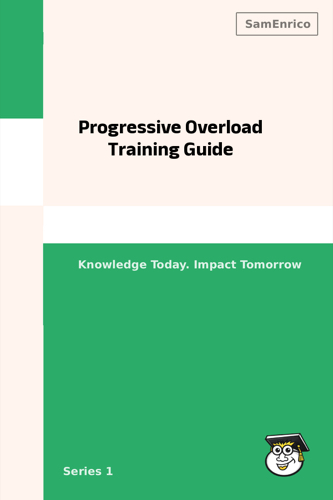
Progressive Overload Training Guide eBook
Apply progressive overload principles to continuou
by Loftin Page
Apply progressive overload principles to continuously build muscle and increase lifting capacity.
Formats
Free sample
Chapter 1: The Universal Law--–- You have been lied to. Not maliciously, perhaps, but lied to nonetheless. The lie sounds like this: "Just work hard, and you will grow." It is whispered in every locker room, shouted in every commercial for pre-workout powder, and repeated ad nauseam by well-meaning gym buddies. The implication is comforting in its simplicity—effort equals results. But if effort alone were the trigger for muscular adaptation, every construction worker would have a Mr.
Olympia physique, every Cross Fit athlete would be built like a prime Ronnie Coleman, and every person who leaves the gym drenched in sweat would walk around looking like a fitness model. They do not. The reason is not a lack of effort. It is a lack of understanding about the single most important principle in all of strength training: progressive overload.This book exists because progressive overload is not merely a "good idea" or a "technique to try." It is the non-negotiable biological trigger for every gram of muscle you will ever build and every pound of strength you will ever gain. Without it, you plateau.
With it, you transform. And yet, for a principle so fundamental, it remains astonishingly misunderstood. Most lifters think they are applying progressive overload when they are, in fact, simply spinning their wheels—adding weight sloppily, accumulating fatigue mindlessly, or confusing volume with progress. This chapter establishes the universal law that governs all muscular adaptation. By the time you finish reading it, you will understand not just what progressive overload is, but why your body has no choice but to respond to it—and why your body will ruthlessly punish you if you ignore it.The Myth of Hard Work Let us begin by dissecting the most pervasive myth in fitness: the idea that "hard work" is the variable that drives growth.
This myth persists because it contains a kernel of truth. Yes, you must work hard. But hard work is a threshold condition, not a progressive driver. Your body does not care if you feel exhausted. It does not care if you are sweating, grunting, or lying on the floor questioning your life choices.
Your body cares about one thing: homeostasis.Homeostasis is the biological term for stability—the tendency of a living organism to maintain a stable internal environment despite external changes. Your body wants to stay exactly the same. It has evolved over millions of years to be extraordinarily efficient, meaning it will never waste energy maintaining capabilities it does not need. If you lift the same weight for the same number of reps every week, your body will eventually say, "I have adapted to this exact demand. I will now stop wasting resources on further adaptation." This is the plateau.
It is not a failure of effort. It is a triumph of efficiency.Consider the office worker who carries the same 20-pound briefcase to work every day for ten years. Why does his trapezius muscle not grow to the size of a bodybuilder's? Because after the first few weeks, his body adapted completely to that 20-pound load. No further overload was applied, so no further growth occurred.
The hard work was consistent, but the stimulus was static. Now consider the novice lifter who adds 5 pounds to their squat every session for three months. Their body is forced to say, "This demand is new. I must build more contractile tissue and improve neural efficiency to meet it." That is progressive overload in its purest form.The hard truth is this: effort without progression is maintenance at best, stagnation at worst. You can exhaust yourself every single workout, but if you are not asking your body to do something it could not do before, you are not growing.
You are merely practicing.Defining Progressive Overload Progressive overload is defined simply as the gradual, systematic increase of stress placed upon the musculoskeletal system over time. That is the textbook definition. But a definition without context is useless, so let us translate it into practical language: Progressive overload means doing more than you did last time, in a way that your body cannot ignore.Notice the two critical components of that translation. First, "more than you did last time" implies measurement. You cannot know if you are progressing unless you are tracking.
This is why every successful lifter keeps a log. Without data, you are guessing. And guessing is not a strategy. Second, "in a way that your body cannot ignore" implies that the increase must be meaningful. Adding 0.1 pounds to the bar is technically more weight, but it is so small that your body may not perceive a difference.
Similarly, adding one rep to a set of 100 is technically a progression, but it is functionally irrelevant.The concept of a minimum effective dose (MED) is crucial here. The MED is the smallest increase in stress that produces a measurable adaptive response. For a novice, adding 5 pounds to a squat is well above the MED. For an advanced lifter, adding 2.5 pounds may barely cross the threshold. Understanding your own MED requires experimentation and honest record-keeping, but the principle is universal: if the increase is too small to challenge homeostasis, it is not overload—it is maintenance disguised as progress.The SAID Principle: Your Body Is Literate Perhaps the most important concept for understanding progressive overload is the SAID Principle, which stands for Specific Adaptation to Imposed Demands.
This principle states that the body adapts specifically to the type of stress placed upon it. In other words, your body is literate. It reads the demand you give it and responds with a precise, tailored adaptation.If you impose a demand of heavy weight for low repetitions (1–5 reps), your body adapts by improving neural efficiency—recruiting more motor units, firing them more rapidly, and synchronizing their activation. The result is increased strength without necessarily much muscle growth. If you impose a demand of moderate weight for moderate repetitions (6–30 reps), your body adapts by increasing muscle cross-sectional area (hypertrophy) through mechanisms like mechanical tension, metabolic stress, and muscle damage.
If you impose a demand of very light weight for very high repetitions (30+ reps), your body adapts by improving muscular endurance—increasing capillary density and mitochondrial content.This specificity has profound implications. You cannot train like a powerlifter (heavy weight, low reps) and expect to look like a bodybuilder. You cannot train like an endurance athlete and expect to gain significant strength. And crucially, you cannot train randomly and expect any meaningful adaptation. The SAID Principle demands intentionality.
Every workout, every set, every rep sends a signal to your body. The question is not whether your body will adapt. It will always adapt. The question is: What signal are you sending?Progressive overload, therefore, is not just about doing more. It is about doing more of the right thing for your specific goal.
If your goal is strength, progressive overload means adding weight to the bar consistently while keeping reps low. If your goal is hypertrophy, progressive overload means adding volume (sets and reps) or density (more work in less time) while keeping weight in the moderate range. If your goal is endurance, progressive overload means increasing time under tension…
This is the end of the free sample. Get the eBook to keep going. Buy now
About this book
Details
- Author
- Loftin Page
- Publisher
- SamEnrico
- Language
- English
- Genre
- Non-Fiction, Health & Wellness, Exercise Science
- Released
- 2026-06-06
- Pages (approx.)
- 146
- Available as
- eBook, Audiobook

Read better in the ZLOADR app
Your eBooks on your phone or tablet. Sign in with your SamEnrico account and start reading.
More by Loftin Page
 Pomodoro for Managers GuideLoftin Page$11.99
 Consulting Team BurnoutLoftin Page$11.99
 Technology Failure AngerLoftin Page$11.99
 Nightmare JournalLoftin Page$11.99
 A Monk's Guide to Monastic RulesLoftin Page$11.99
 The Anti Comparison WorkbookLoftin Page$11.99
 Acupuncture For DigestionLoftin Page$11.99
 Property Management PodcastsLoftin Page$11.99
 The Silk Road Scandal: How a Darknet Kingpin Built an Empire of BlackmailLoftin Page$11.99
 James Watt and the Fire of Progress: The Man Who Ignited the Industrial RevolutionLoftin Page$11.99
 Gears of the Forgotten: The Lost Inventions of ArchimedesLoftin Page$11.99
 The Complete Guide to 7 Secrets to Beauty, Health, and LongevityLoftin Page$11.99
You may also like
 Insulin Resistance Exercise GuideOsgood Gertude$11.99
 High Intensity Interval Training BasicsBroome Wes$11.99
 Progressive Overload HandbookOhara Louie$11.99
 Physical Exercise NeuroprotectionFisk Marcelo$11.99
 Restless Leg Syndrome Exercise ProtocolJobe Jeffie$11.99
 Natural HGH Boost ExerciseSwisher Lacey$11.99
 HIIT Science ExplainedBarba Fausto$11.99
 Progressive Overload Weightlifting GuideForsyth Machelle$11.99
 PCOS High Intensity TrainingWeathers Lona$11.99
 Exercise HGH ResponseHandy Mahalia$11.99
 The Exercise HGH Release GuideVillasenor Catrina$11.99
 Exercise as Medicine for Cannabis DisorderPeeples Marica$11.99