
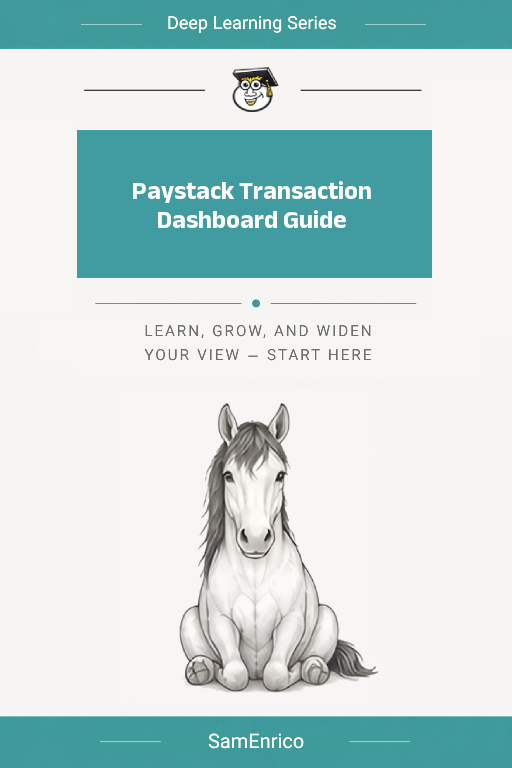
Non-FictionFirst 30 DaysPayment Integration
Paystack Transaction Dashboard Guide eBook
Use Paystack dashboard for reconciliation and repo
Use Paystack dashboard for reconciliation and reporting. Settlements, fees, and transaction search.
Formats
Free sample
Chapter 1: The Money Map...--–- On a Tuesday morning in Lagos, Tunde, the founder of a fast-growing fashion brand, stared at his bank statement with a familiar feeling of dread. His Paystack dashboard showed ₦4,850,000 in "Total Volume" for the month. His bank account showed a deposit of ₦3,210,000. The difference was ₦1,640,000 – nearly 34% of his apparent revenue. He had no idea where that money had gone.
He was not alone. Across Nigeria, Kenya, Ghana, and South Africa, thousands of merchants open their Paystack dashboards every day and ask the same question: Where is my money?The answer is not that Paystack has stolen it, nor that the bank has misplaced it. The answer lies in a fundamental misunderstanding of how online payment processing works. Most merchants believe that when a customer pays ₦10,000, ₦10,000 eventually lands in their bank account. This belief is wrong.
It is wrong in ways that cost businesses time, anxiety, and sometimes actual revenue when they make decisions based on dashboard numbers instead of real cash flow.This chapter is your money map. By the time you finish it, you will understand exactly where every naira, shilling, and cedi goes from the moment a customer clicks "Pay" to the moment it appears in your bank account. You will never again confuse "sales made" with "money received." And you will have a framework for reconciling your Paystack dashboard with your bank statement that works for businesses of any size.The Five Stages of Money Movement Every payment that flows through Paystack passes through five distinct stages before it becomes cash you can spend. Each stage transforms the money in ways that create confusion if you do not understand them. Let us walk through each stage using a real example: a customer named Amara buys a ₦10,000 dress from your online store.Stage One: Authorization Amara enters her card details and clicks "Pay." Paystack sends a request to her bank: "Is this card valid?
Does it have at least ₦10,000 available?" Her bank responds with a hold – the funds are reserved but not yet moved. This is called an authorization. In Paystack's dashboard, this transaction will appear with a status of "pending" or "success" depending on your settings, but critically, the money has not left the customer's bank yet in a way that is irreversible. It is earmarked.Think of authorization like a restaurant calling your bank to check if you have enough money for dinner. The bank says yes and puts a hold on those funds, but the restaurant has not actually been paid until you finish the meal and settle the bill.Stage Two: Capture Once the authorization is confirmed, Paystack captures the funds.
This is the moment the money actually leaves the customer's bank account. For most online transactions, capture happens instantly after authorization. But for some business models – like hotels that authorize upon check-in and capture upon checkout – there can be a delay. During this gap, the customer sees a "pending" charge on their bank statement, but the merchant has not yet received the funds.In Amara's case, capture happens immediately. Her bank deducts ₦10,000 from her account and holds it for transfer.Stage Three: Fee Deduction This is where the confusion begins for most merchants.
Paystack does not transfer the full ₦10,000 to you. It deducts its fees first. In Nigeria, Paystack's standard fee is 1.5% plus ₦100 per transaction. For Amara's ₦10,000 purchase, the calculation is:1.5% of ₦10,000 = ₦150Plus ₦100 fixed fee = ₦250 total fee Net amount = ₦10,000 - ₦250 = ₦9,750That ₦250 never reaches your bank account. It is Paystack's revenue for processing the payment.
But here is the critical point: your Paystack dashboard shows the gross amount – ₦10,000 – under "Total Volume" on the home page. Your bank will eventually show the net amount – ₦9,750 – as part of a larger deposit. The difference is your first reconciliation headache.Stage Four: Settlement After fees are deducted, your net funds enter the settlement queue. Paystack batches multiple transactions together before sending them to your bank. This batching is efficient for the payment system – it is cheaper and faster to send one large transfer than hundreds of tiny ones – but it creates the "lump sum mystery" that haunts finance teams.For example, on a busy day, you might have:Amara's ₦10,000 transaction (net ₦9,750)Chidi's ₦25,000 transaction (net ₦24,375 after fees)Temi's ₦5,000 transaction (net ₦4,875 after fees)Instead of sending three separate transfers, Paystack combines them into one settlement batch of ₦39,000 and sends that single amount to your bank.
Your bank statement will show one deposit of ₦39,000 from "Paystack." There is no line item for Amara, Chidi, or Temi individually.Stage Five: Payout The final stage is when the settlement batch actually arrives in your bank account. Paystack calls this a "payout" in the dashboard. The timing depends on your settlement cycle. Most merchants are on T+1 settlement – meaning transactions that happen on Monday settle on Tuesday, and the payout arrives in your bank on Tuesday or Wednesday. Some merchants are on T+3 or weekly settlements depending on their risk profile and negotiation with Paystack.When you look at your bank statement, you will see a single credit entry for the settlement batch.
When you look at your Paystack dashboard, you will see the same batch listed on the Payouts page. The challenge – which Chapter 6 solves completely – is matching that single bank entry back to the individual customer transactions that created it.Why "Total Volume" Is a Lie Paystack's home page displays a prominent number labeled "Total Volume." This number is the sum of every successful transaction processed through your account, measured at the moment of capture, before any fees are deducted. It is a sales figure, not a cash flow figure.Here is why calling it "Total Volume" is dangerously misleading for financial planning. Imagine you run a business with:₦10,000,000 in Total Volume for the month Paystack fees of approximately 1.5% + ₦100 per transaction (roughly ₦250,000 total fees)Refunds issued to customers totaling ₦500,000A rolling reserve of 5% (Paystack holds back ₦500,000 for 30 days as risk protection)Your Total Volume is ₦10,000,000. But your actual cash available is roughly ₦8,750,000 – a difference of 12.5%.
If you plan your expenses based on Total Volume, you will overspend. If you report Total Volume as revenue to your tax authority without adjusting for fees and refunds, you will overpay taxes. If you promise investors revenue growth based on Total Volume when they care about net cash, you will mislead them.The correct mental model is this: Total Volume is marketing. Net Settlement is accounting.Throughout this book, when you see a number on the dashboard home page, treat it as a starting point, not an ending point. The real work of reconciliation happens on the Transactions, Payouts, and Settlements pages – not on the home page.The Core Identifiers You Must Memorize Paystack uses specific terms to identify different objects in its system.
Confusing these terms is a common source of errors when talking to support, reading API documentation, or reconciling data. Memorize this table:Term What It Means Where You See It Example Authorization A card token stored for future charges. Not money. Not a transaction. Just permission to charge later.Customer page, Transaction detail page under "Analytics" tab AUTH_abc123xyz Charge An attempt to capture funds.
Every transaction in your dashboard is a charge.Transactions page Transaction ID TXN_789Transfer Movement of funds from Paystack to your bank…
This is the end of the free sample. Get the eBook to keep going. Buy now
About this book
Details
- Author
- Merrill Stephenie
- Publisher
- SamEnrico
- Language
- English
- Genre
- Non-Fiction, First 30 Days, Payment Integration
- Released
- 2026-05-30
- Pages (approx.)
- 141
- Available as
- eBook, Audiobook

Read better in the ZLOADR app
Your eBooks on your phone or tablet. Sign in with your SamEnrico account and start reading.
More by Merrill Stephenie
 HRT Non Oral Routes Benefits GuideMerrill Stephenie$11.99
 Highway Hostility HandbookMerrill Stephenie$11.99
 The Sleeping Position Back GuideMerrill Stephenie$11.99
 Long Duration Storage GuideMerrill Stephenie$11.99
 Bloodline of the Sun King: The Forgotten HeirMerrill Stephenie$11.99
 How to Become a Tumbler TenderMerrill Stephenie$11.99
 NYC Pop Up TikTok StrategyMerrill Stephenie$12.99
 SudokuMerrill Stephenie$11.99
 Understanding Periventricular Laminar HeterotopiaMerrill Stephenie$17.99
You may also like
 Hong Kong Handover 1997Dunn Johnnie$11.99
 Zumba For Postnatal Recovery CourseNeal Christian$11.99
 Zumba for BeginnersLadner Nikia$11.99
 YouTube Comment Mining GuideHumes Pandora$12.99
 Worry Box MeditationCarlin Rudy$11.99
 Workplace Stress MeditationNguyen Lynn$11.99
 Workplace Stress and Sleep RepairHawley Ivory$11.99
 Workplace Perfectionism CureDelaney Jeffry$11.99
 Workplace Injustice Anger GuideWallen Isabelle$11.99
 Work Addiction and Burnout LinkGreenwood Ester$11.99
 Women in Yoga and WellnessBeattie Galina$11.99
 Women in Stand Up ComedyChun Evangeline$11.99