
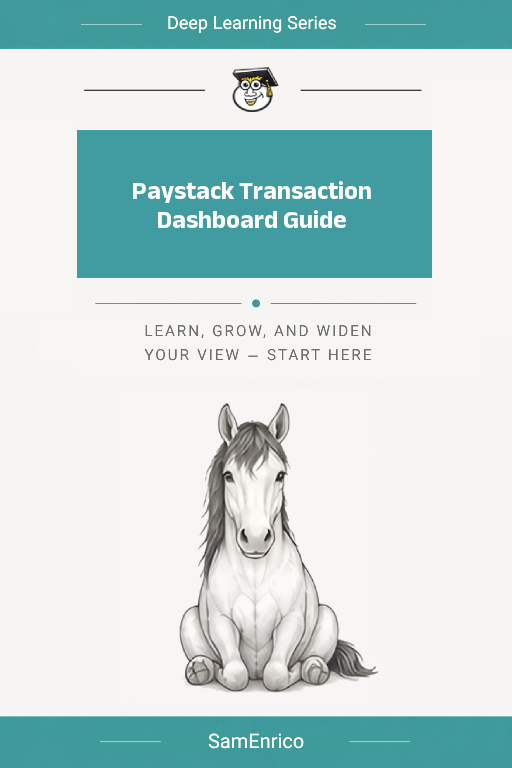
Paystack Transaction Dashboard Guide Audiobook
Use Paystack dashboard for reconciliation and repo
Use Paystack dashboard for reconciliation and reporting. Settlements, fees, and transaction search.
Formats
Free sample
Chapter 1: The Money Map...--–- On a Tuesday morning in Lagos, Tunde, the founder of a fast-growing fashion brand, stared at his bank statement with a familiar feeling of dread. His Paystack dashboard showed ₦4,850,000 in "Total Volume" for the month. His bank account showed a deposit of ₦3,210,000. The difference was ₦1,640,000 – nearly 34% of his apparent revenue. He had no idea where that money had gone.
He was not alone. Across Nigeria, Kenya, Ghana, and South Africa, thousands of merchants open their Paystack dashboards every day and ask the same question: Where is my money?The answer is not that Paystack has stolen it, nor that the bank has misplaced it. The answer lies in a fundamental misunderstanding of how online payment processing works. Most merchants believe that when a customer pays ₦10,000, ₦10,000 eventually lands in their bank account. This belief is wrong.
It is wrong in ways that cost businesses time, anxiety, and sometimes actual revenue when they make decisions based on dashboard numbers instead of real cash flow.This chapter is your money map. By the time you finish it, you will understand exactly where every naira, shilling, and cedi goes from the moment a customer clicks "Pay" to the moment it appears in your bank account. You will never again confuse "sales made" with "money received." And you will have a framework for reconciling your Paystack dashboard with your bank statement that works for businesses of any size.The Five Stages of Money Movement Every payment that flows through Paystack passes through five distinct stages before it becomes cash you can spend. Each stage transforms the money in ways that create confusion if you do not understand them. Let us walk through each stage using a real example: a customer named Amara buys a ₦10,000 dress from your online store.Stage One: Authorization Amara enters her card details and clicks "Pay." Paystack sends a request to her bank: "Is this card valid?
Does it have at least ₦10,000 available?" Her bank responds with a hold – the funds are reserved but not yet moved. This is called an authorization. In Paystack's dashboard, this transaction will appear with a status of "pending" or "success" depending on your settings, but critically, the money has not left the customer's bank yet in a way that is irreversible. It is earmarked.Think of authorization like a restaurant calling your bank to check if you have…
This is the end of the free sample. Get the Audiobook to keep going. Buy now
About this book
Details
- Author
- Merrill Stephenie
- Publisher
- SamEnrico
- Language
- English
- Genre
- Non-Fiction, First 30 Days, Payment Integration
- Released
- 2026-05-30
- Pages (approx.)
- 141
- Available as
- eBook, Audiobook

Listen in the VoxFlicks app
Audiobooks and audio dramas wherever you go. Sign in with your SamEnrico account and press play.
More by Merrill Stephenie
 HRT Non Oral Routes Benefits GuideMerrill Stephenie$11.99
 Highway Hostility HandbookMerrill Stephenie$11.99
 The Sleeping Position Back GuideMerrill Stephenie$11.99
 Long Duration Storage GuideMerrill Stephenie$11.99
 Bloodline of the Sun King: The Forgotten HeirMerrill Stephenie$11.99
 How to Become a Tumbler TenderMerrill Stephenie$11.99
 NYC Pop Up TikTok StrategyMerrill Stephenie$12.99
 SudokuMerrill Stephenie$11.99
 Understanding Periventricular Laminar HeterotopiaMerrill Stephenie$17.99
You may also like
 Stripe Webhook Configuration GuideMartindale Keva$12.99
 Stripe Subscription Billing GuideWorkman Emerald$12.99
 Stripe Payout Scheduling GuideArthur Sherita$12.99
 Stripe Payment Intent API GuideGavin Vada$12.99
 Stripe Dispute Management GuideJaynes Shakia$12.99
 Stripe Connect Platform GuideShoemaker Dennis$12.99
 Paystack Transaction API GuideLarry Letitia$12.99
 Paystack Split Payments GuideHaskell Jefferey$12.99
 Paystack KYC Verification GuideMayberry Cori$12.99
 PayPal Withdrawal Methods GuidePacheco Farrah$12.99
 PayPal Seller Protection GuideBabin Elfrieda$12.99
 Payment Gateway Monitoring GuideDowney Queenie$12.99