
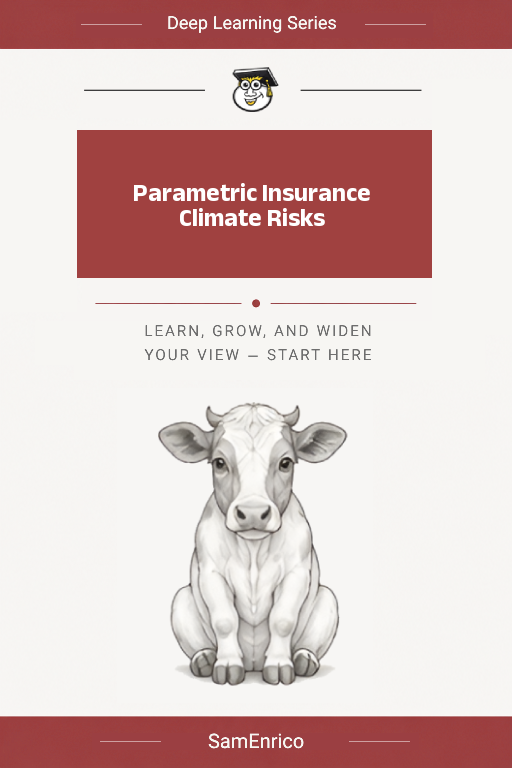
Parametric Insurance Climate Risks Audiobook
Use parametric insurance for rapid payouts based o
Use parametric insurance for rapid payouts based on weather triggers like rainfall or wind speed.
Formats
Free sample
Chapter 1: The Waiting Season...--–- The rain stopped three weeks ago, but Maria Villanueva still cannot start the repairs on her family's coffee farm in the highlands of Nicaragua. Her roof remains patched with blue tarps donated by a relief agency that arrived forty-seven days after Hurricane Julia tore through the region. Her bank account holds exactly eighty-three dollars. Her traditional insurance policy, which she has paid into for eleven years, is still "under review." An adjuster from Managua has promised to come "when the roads are better." Maria looks at the sky, where new storm clouds are gathering, and wonders how many more waiting seasons her family can survive.This is not a story about insurance. This is a story about time.Across the world, in the boardrooms of Singapore, the farmlands of Kenya, the energy corridors of Texas, and the coastal cities of Bangladesh, millions of people and businesses are discovering a terrifying truth: the traditional insurance system, built over three hundred years of careful actuarial science, was never designed for the climate of the twenty-first century.
It was designed for a world where disasters were rare enough to investigate, slow enough to measure, and predictable enough to price with confidence. That world is gone.The Great Decoupling The statistics are staggering, but they are not the point of this chapter. The point is what the statistics represent. In 2022, global economic losses from natural disasters reached 313billion.Traditionalinsurancecoveredjust313 billion. Traditional insurance covered just 313billion.Traditionalinsurancecoveredjust132 billion of that total.
The remaining $181 billion—a sum larger than the GDP of Portugal—simply evaporated. It was absorbed by governments through emergency borrowing, by businesses through depleted cash reserves, by families through lost savings, or, most commonly, by no one at all, becoming pure economic waste that slowed recovery for years.This gap between economic losses and insured losses has a name: the protection gap. And it is growing faster than almost anyone anticipated.A decade ago, the protection gap was concerning but manageable. Today, it is a crisis. By 2050, according to Swiss Re, the gap could exceed $1 trillion annually if current trends continue.
But numbers like these obscure a more fundamental problem. The protection gap is not merely a shortfall in coverage. It is a failure of design.Traditional insurance, for all its sophistication, operates on a model that assumes three things that are no longer true. First, it assumes…
This is the end of the free sample. Get the Audiobook to keep going. Buy now
About this book
Details
- Author
- Beaulieu Letitia
- Publisher
- SamEnrico
- Language
- English
- Genre
- Non-Fiction, Business Brief
- Released
- 2026-06-01
- Pages (approx.)
- 154
- Available as
- eBook, Audiobook

Listen in the VoxFlicks app
Audiobooks and audio dramas wherever you go. Sign in with your SamEnrico account and press play.
More by Beaulieu Letitia
 Breaking the Paycheck to Paycheck CycleBeaulieu Letitia$11.99
 Sleep Hygiene Meditation RoutineBeaulieu Letitia$11.99
 Healthcare Provider Empathy GuideBeaulieu Letitia$11.99
 The Governor's Death Row DecisionsBeaulieu Letitia$11.99
 Proteobacteria DysbiosisBeaulieu Letitia$11.99
 Sleep Apnea TipsBeaulieu Letitia$11.99
 Pomodoro For PlanningBeaulieu Letitia$11.99
 Apple Calendar Memory GuideBeaulieu Letitia$11.99
 Miyazaki SpiritedBeaulieu Letitia$11.99
 The Iron Crown and the Spice Roads: How the British Empire Forged Global TradeBeaulieu Letitia$11.99
 Seeds of the Future: How a Farmer’s Rebellion Sparked a Global Food RevolutionBeaulieu Letitia$11.99
 Bloodline of the Sun: The Unseen Dynasty of the Axumite QueensBeaulieu Letitia$11.99
You may also like
 Hong Kong Handover 1997Dunn Johnnie$11.99
 Zumba For Postnatal Recovery CourseNeal Christian$11.99
 Zumba for BeginnersLadner Nikia$11.99
 YouTube Comment Mining GuideHumes Pandora$12.99
 Worry Box MeditationCarlin Rudy$11.99
 Workplace Stress MeditationNguyen Lynn$11.99
 Workplace Stress and Sleep RepairHawley Ivory$11.99
 Workplace Perfectionism CureDelaney Jeffry$11.99
 Workplace Injustice Anger GuideWallen Isabelle$11.99
 Work Addiction and Burnout LinkGreenwood Ester$11.99
 Women in Yoga and WellnessBeattie Galina$11.99
 Women in Stand Up ComedyChun Evangeline$11.99