
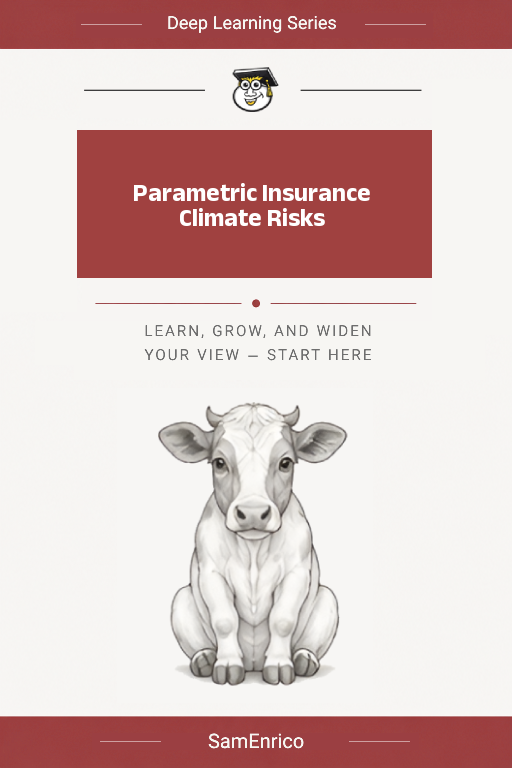
Parametric Insurance Climate Risks eBook
Use parametric insurance for rapid payouts based o
Use parametric insurance for rapid payouts based on weather triggers like rainfall or wind speed.
Formats
Free sample
Chapter 1: The Waiting Season...--–- The rain stopped three weeks ago, but Maria Villanueva still cannot start the repairs on her family's coffee farm in the highlands of Nicaragua. Her roof remains patched with blue tarps donated by a relief agency that arrived forty-seven days after Hurricane Julia tore through the region. Her bank account holds exactly eighty-three dollars. Her traditional insurance policy, which she has paid into for eleven years, is still "under review." An adjuster from Managua has promised to come "when the roads are better." Maria looks at the sky, where new storm clouds are gathering, and wonders how many more waiting seasons her family can survive.This is not a story about insurance. This is a story about time.Across the world, in the boardrooms of Singapore, the farmlands of Kenya, the energy corridors of Texas, and the coastal cities of Bangladesh, millions of people and businesses are discovering a terrifying truth: the traditional insurance system, built over three hundred years of careful actuarial science, was never designed for the climate of the twenty-first century.
It was designed for a world where disasters were rare enough to investigate, slow enough to measure, and predictable enough to price with confidence. That world is gone.The Great Decoupling The statistics are staggering, but they are not the point of this chapter. The point is what the statistics represent. In 2022, global economic losses from natural disasters reached 313billion.Traditionalinsurancecoveredjust313 billion. Traditional insurance covered just 313billion.Traditionalinsurancecoveredjust132 billion of that total.
The remaining $181 billion—a sum larger than the GDP of Portugal—simply evaporated. It was absorbed by governments through emergency borrowing, by businesses through depleted cash reserves, by families through lost savings, or, most commonly, by no one at all, becoming pure economic waste that slowed recovery for years.This gap between economic losses and insured losses has a name: the protection gap. And it is growing faster than almost anyone anticipated.A decade ago, the protection gap was concerning but manageable. Today, it is a crisis. By 2050, according to Swiss Re, the gap could exceed $1 trillion annually if current trends continue.
But numbers like these obscure a more fundamental problem. The protection gap is not merely a shortfall in coverage. It is a failure of design.Traditional insurance, for all its sophistication, operates on a model that assumes three things that are no longer true. First, it assumes that losses can be verified through physical inspection within a reasonable timeframe. Second, it assumes that the policyholder can afford to wait for that verification.
Third, it assumes that the delay between loss and payment does not itself cause additional losses. In the climate era, all three assumptions have collapsed.Consider the timeline. A standard commercial property insurance claim, from first notice of loss to final payment, averages one hundred eighty to five hundred forty days. This is not because insurers are lazy or malicious. It is because the process—damage assessment, claim submission, adjuster validation, repair estimation, negotiation, and finally payment—is inherently sequential and labor-intensive.
An adjuster must physically visit the damaged property. Documentation must be gathered, often from overwhelmed local authorities. Estimates must be reviewed. Disputes must be resolved.In a world where hurricanes arrive every few years, this timeline is acceptable. In a world where a Cat 5 storm makes landfall somewhere on the planet every eighteen months, it is not.The Liquidity Paradox Here is the cruel irony at the heart of traditional disaster insurance: the people who need money most urgently are the ones who wait longest to receive it.After a major disaster, immediate cash needs are overwhelming.
A business must make payroll. A family must buy food, water, and medicine. A farmer must purchase seeds for the next planting season before the window closes. A hospital must rent generators. A government must fund evacuations, shelter, and debris removal.
These needs are measured in days, sometimes hours. Traditional insurance pays out in months, sometimes years.This is the liquidity paradox. Insurance is supposed to provide financial security, but the very mechanism that makes it reliable—the careful verification of actual losses—makes it slow. And in a climate-disrupted world, slow insurance is not insurance at all. It is a promise that arrives after the need has passed.Maria Villanueva understands this paradox better than any actuary.
Her family's coffee farm sustained genuine damage during Hurricane Julia. The roof of the drying facility collapsed. Two acres of young coffee plants were buried under mudslides. A retaining wall washed away, taking a quarter acre of planted hillside with it. Her traditional policy, held with a reputable insurer through a cooperative purchasing program, covers these perils.
But the adjuster has not come. The roads are bad. The insurer is processing claims from four other countries affected by the same storm system. Maria's claim is in a queue, and the queue is moving at the speed of mud.Meanwhile, the planting season is ending. If she cannot buy new seedlings and repair the retaining wall within the next thirty days, her farm will produce nothing next year.
No harvest. No income. No school fees for her children. No way to pay back the micro-loan she took out before the storm.Maria does not need an adjuster to tell her that she lost her crop. She knows.
She was there.The False Promise of Accuracy Traditional insurers will tell you that their slow process is justified by accuracy. They will argue that paying claims without verification would invite fraud, moral hazard, and eventual insolvency. They will point to centuries of actuarial science that demand loss adjustment before indemnification. These arguments are not wrong. They are simply incomplete.Accuracy matters.
No responsible risk transfer system should pay claims without some assurance that a loss actually occurred. But accuracy is not a binary state. It exists on a spectrum. At one end of the spectrum is the traditional insurance model: exhaustive, individualized, and slow. At the other end is no insurance at all.
Somewhere in between lies a different approach: fast, probabilistic, and sufficient.This is the fundamental insight that gives rise to parametric insurance. What if we paid not based on actual losses measured after the fact, but on objective triggers that correlate strongly with losses? What if we accepted a small amount of "basis risk"—the risk that the trigger does not perfectly match actual losses—in exchange for dramatically faster payouts? What if we prioritized liquidity over accuracy in the immediate aftermath of disaster, knowing that perfect accuracy could come later?The answer, as this book will demonstrate, is that parametric insurance is not a replacement for traditional coverage. It is a complement.
Traditional insurance remains essential for large, complex, long-tail losses where individualized assessment is genuinely necessary. But parametric insurance fills a different role: providing immediate, predictable, no-questions-asked liquidity when speed matters most.Think of it as first aid versus surgery. When a patient arrives at an emergency room with a traumatic injury, the first priority is not a perfect diagnosis. The first priority is stopping the bleeding, maintaining blood pressure, and keeping the patient alive long enough for surgery. The emergency physician accepts a certain amount…
This is the end of the free sample. Get the eBook to keep going. Buy now
About this book
Details
- Author
- Beaulieu Letitia
- Publisher
- SamEnrico
- Language
- English
- Genre
- Non-Fiction, Business Brief
- Released
- 2026-06-01
- Pages (approx.)
- 154
- Available as
- eBook, Audiobook

Read better in the ZLOADR app
Your eBooks on your phone or tablet. Sign in with your SamEnrico account and start reading.
More by Beaulieu Letitia
 Breaking the Paycheck to Paycheck CycleBeaulieu Letitia$11.99
 Sleep Hygiene Meditation RoutineBeaulieu Letitia$11.99
 Healthcare Provider Empathy GuideBeaulieu Letitia$11.99
 The Governor's Death Row DecisionsBeaulieu Letitia$11.99
 Proteobacteria DysbiosisBeaulieu Letitia$11.99
 Sleep Apnea TipsBeaulieu Letitia$11.99
 Pomodoro For PlanningBeaulieu Letitia$11.99
 Apple Calendar Memory GuideBeaulieu Letitia$11.99
 Miyazaki SpiritedBeaulieu Letitia$11.99
 The Iron Crown and the Spice Roads: How the British Empire Forged Global TradeBeaulieu Letitia$11.99
 Seeds of the Future: How a Farmer’s Rebellion Sparked a Global Food RevolutionBeaulieu Letitia$11.99
 Bloodline of the Sun: The Unseen Dynasty of the Axumite QueensBeaulieu Letitia$11.99
You may also like
 Franchising Your Local Brand Across Borders Child Labor LawsWilson Ida$11.99
 Franchising Your Local Brand Across Borders Beneficial OwnershipGordon Debbie$11.99
 Franchising Your Local Brand Across Borders Trade SecretsKeener Tatum$11.99
 Franchising Your Local Brand Across Borders Performance DashboardsCota Lisette$11.99
 Franchising Your Local Brand Across Borders Parallel ImportsBailey Wallace$11.99
 Franchising Your Local Brand Across Borders Packaging RegulationsRandle Adaline$11.99
 Franchising Your Local Brand Across Borders Know Your CustomerMyers Adam$11.99
 Franchising Your Local Brand Across Borders Human TraffickingFranklin Lee$11.99
 Franchising Your Local Brand Across Borders Government IncentivesLogsdon Beckie$11.99
 Franchising Your Local Brand Across Borders Carbon FootprintMcfarlane Margot$11.99
 Franchising Your Local Brand Across Borders Bribery LawsStarr Cortney$11.99
 Franchising Your Local Brand Across Borders Best Practice SharingBryson Vernia$11.99