
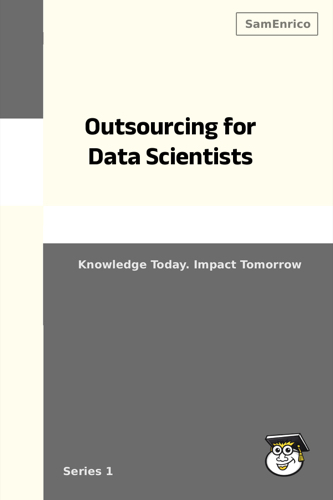
Outsourcing for Data Scientists eBook
Uses freelancers for data cleaning.
by Gilson Dara
Uses freelancers for data cleaning.
Formats
Free sample
Chapter 1: The $200,000 Mop–- The first time Elena ran her weekly cleaning script, she felt a small thrill of satisfaction. The second time, she felt efficient. By the fiftieth time, as she watched the same pandas commands scroll past for the four hundredth consecutive Tuesday, she felt something else entirely: the slow, creeping realization that she had become the world’s most expensive janitor.Elena was a senior data scientist at a mid-sized logistics company. She had a master’s degree in statistics, had published a paper on Bayesian optimization, and could explain the difference between L1 and L2 regularization in her sleep. Yet every Monday morning, without fail, she spent four hours doing exactly the same work: removing duplicates from the customer database, standardizing date formats from three different ERP systems, and flagging outliers in the shipping logs.
She told herself this was necessary. She told herself no one else could do it. She told herself that cleaning data was just part of the job.She was wrong on all three counts.This book exists to help you avoid Elena’s fate. Not because data cleaning is unimportant—it is critically important—but because you are currently paying a catastrophic opportunity cost every time you open a CSV file and start fixing commas. If you are a data scientist who spends more than twenty percent of your week wrangling data, you are not being diligent.
You are being economically irrational. And this chapter will prove it to you with numbers so stark that you will never look at your Monday morning to-do list the same way again.The Arithmetic of Self-Sabotage Let us begin with a simple exercise. Pull out a calculator, or open a spreadsheet, or just follow along on paper. We are going to calculate your true hourly rate as a data scientist. Take your annual salary.
If you are uncomfortable sharing exact numbers, use the industry average for your title and location. For the sake of this example, we will use $120,000 per year, which is conservative for a mid-level data scientist in a major metropolitan area but reasonable for our purposes.Now divide that number by 2,000. That is the number of working hours in a standard year if you take two weeks of vacation and ignore unpaid overtime (which we all know you work anyway). $120,000 divided by 2,000 equals $60 per hour. That is your hourly rate.
Every hour you spend on any task costs your employer $60 in your time alone, not counting benefits, software licenses, or the opportunity cost of the work you are not doing.Now answer this question honestly: how many hours per week do you spend cleaning data? Not analyzing it, not modeling it, not visualizing it. Cleaning it. Removing nulls, fixing formats, renaming columns, merging messy tables, imputing missing values, wrangling Excel exports that were clearly designed by someone who has never seen a database. If you are like most data scientists I have surveyed, the answer is somewhere between fifteen and twenty-five hours per week.
Let us take twenty hours as a conservative midpoint.Twenty hours per week times $60 per hour equals $1,200 per week. Multiply by fifty working weeks per year, and you arrive at $60,000. Sixty thousand dollars. That is what your employer is paying every year for you to perform work that is, in its essence, janitorial. You are not building models.
You are not discovering insights. You are not presenting findings to stakeholders or designing experiments or optimizing hyperparameters. You are scrubbing spreadsheets. You are a $60,000 janitor.I want you to sit with that number for a moment. $60,000.Now consider the alternative.
A top-tier freelance data cleaner—someone who specializes exclusively in data wrangling, who has cleaned thousands of datasets, who works in pandas and SQL eight hours a day—charges between $30 and $50 per hour on platforms like Upwork, Toptal, or through direct contracts. Let us take the high end of that range: $50 per hour. For the same twenty hours of weekly cleaning, you could hire that freelancer for $1,000 per week, or $50,000 per year. That is ten thousand dollars less than what you are currently costing your employer. And that is before we account for the fact that you would gain back twenty hours per week to do the work only you can do.Twenty hours.
An entire half-time job. What could you build with twenty extra hours every week? A new recommendation engine? A real-time anomaly detection system? A mentorship program for junior data scientists?
A side project that turns into a promotion? The answer, for most readers, is: almost anything more valuable than removing duplicate rows.This is not a hypothetical thought experiment. This is the arithmetic of self-sabotage. Every hour you spend on mechanical cleaning is an hour you steal from your highest-leverage work. And the refusal to outsource that cleaning is not diligence.
It is not perfectionism. It is not even good craftsmanship. It is a poverty mindset dressed up in workaholic clothing.The Three Lies You Tell Yourself Before we go any further, we need to clear out the cognitive cobwebs. In my years of consulting with data scientists about outsourcing, I have encountered exactly three arguments against letting go of the mop. They sound reasonable.
They feel true. They are, upon examination, complete nonsense.Lie Number One: “No one understands this data like I do.”This is the most common objection, and it is also the most revealing. It reveals that you have confused domain knowledge with mechanical execution. Yes, you understand that a “churned customer” means something different in your business than it does in your competitor’s business. Yes, you know that the customer_status column has three possible values while the documentation claims there are four.
Yes, you know that the outlier in the purchase_amount column from December 2022 is actually a legitimate transaction because of a one-time promotion. That is domain knowledge. That is precious. That is absolutely worth protecting and keeping in-house.But removing duplicate rows? Fixing the date format from MM/DD/YYYY to YYYY-MM-DD?
Renaming the column called “Cust_Name” to “customer_name” so your downstream scripts will work? None of that requires understanding. It requires pattern recognition and basic programming. A freelance data analyst who has never heard of your company can look at a date column, see that some entries are 01/02/2023 and others are 2023-01-02, and write a script to standardize them. They do not need to know what the dates mean.
They do not need to know that January 2nd is when your fiscal year starts. They just need to make them consistent.The belief that “no one understands this data like I do” is actually a belief that no one can follow instructions. But you are not asking them to understand. You are asking them to execute. And execution can be taught, documented, and verified in ways that understanding never can.Lie Number Two: “It’s faster to do it myself.”This lie survives because it contains a sliver of truth.
For a one-off task—a single CSV file that you will never see again—it genuinely is faster to clean it yourself than to write a brief, post a job, interview freelancers, and…
This is the end of the free sample. Get the eBook to keep going. Buy now
About this book
Details
- Author
- Gilson Dara
- Publisher
- SamEnrico
- Language
- English
- Genre
- Non-Fiction, Self-Help, Data
- Released
- 2026-06-05
- Pages (approx.)
- 139
- Available as
- eBook, Audiobook

Read better in the ZLOADR app
Your eBooks on your phone or tablet. Sign in with your SamEnrico account and start reading.
More by Gilson Dara
 Road Rage Breathing TechniquesGilson Dara$11.99
 Growth Mindset Language ShiftGilson Dara$11.99
 Collaborative Problem SolvingGilson Dara$11.99
 The Wage Garnishment GuideGilson Dara$11.99
 Blockchain in Supply ChainsGilson Dara$11.99
 The OKR for Startups GuideGilson Dara$11.99
 Mindfulness for Insomnia BeginnersGilson Dara$11.99
 Lutfi Hashim: Iraq's Forgotten Olympic PioneerGilson Dara$11.99
 Embers of the Forgotten: The Last Pyromancers of PompeiiGilson Dara$11.99
 The Essential Guide to Gangsta RapGilson Dara$11.99
 Satsuma: Seedless MandarinGilson Dara$11.99
 How to Produce Electronics ManualsGilson Dara$11.99
You may also like
 Personal Branding for Data ScientistsKroll Terra$11.99
 OKRs for Data ScienceMarino Leora$11.99
 Imposter Syndrome for Data ScientistsToler Elenora$11.99
 Pomodoro for Data ScientistsGrove Alanna$11.99
 The Trigger Diary MethodHeadrick Kandi$11.99
 Delegation for Data ScientistsTownes Wei$11.99
 Fear of Failure for Data ScientistsHumphreys Carina$11.99
 Growth Mindset for Data ScientistsBarraza Adrianne$11.99
 Remote Work for Data ScientistsPearce Bari$11.99
 Persuasion for Data ScientistsMoses Katia$11.99
 Pomodoro For Data AnalysisGaddy Janiece$11.99
 Palace For Facts And FiguresLu Alexa$11.99