
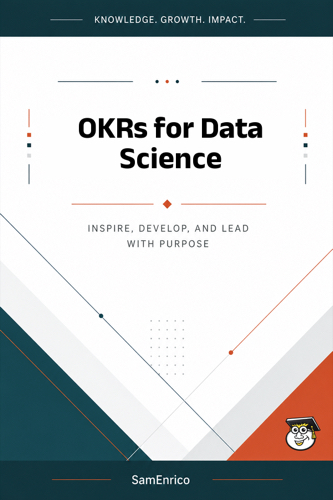
OKRs for Data Science
Sets model accuracy and insight goals.
by Marino Leora
Sets model accuracy and insight goals.
Formats
About this book
Free sample
Chapter 1: The Certainty Trap--–- Maryam stared at the quarterly OKRs her VP had just circulated. "Increase customer retention by 15% using the new churn model." It looked reasonable. It looked ambitious. It looked exactly like every other OKR she had seen in her ten years as a data scientist.But something gnawed at her. The model she was being asked to build would predict which customers were likely to leave.
She could build that. She could even make it accurate. But the OKR assumed something that no one had said out loud: that a more accurate prediction would automatically lead to higher retention.What if the sales team ignored the predictions? What if the interventions cost more than the retained revenue? What if the data was so noisy that 70% accuracy was the theoretical maximum, and the VP expected 95%?Maryam had learned, through painful experience, that traditional OKRs were designed for确定性—for shipping features, launching marketing campaigns, and building software.
But data science was different. Data science was probabilistic. It was exploratory. And often, the most valuable thing a data scientist could do was prove that a widely held belief was wrong.The VP's OKR didn't accommodate that. It didn't accommodate failure, learning, or uncertainty.
And that, Maryam knew, was a recipe for disaster.This chapter is about why generic OKRs fail for data science, why the gap between "activity" and "impact" is wider in DS than in any other function, and how a specialized framework can save your team from the Certainty Trap.The Dirty Secret of Most Data Science Teams Let us begin with an uncomfortable truth: most data science teams are failing to deliver measurable business value. Not because they lack talent. Not because they lack data. But because they are measured the wrong way.Consider the evidence. Studies consistently show that 60-80% of machine learning models never make it to production.
Of those that do, a significant fraction are used briefly and then abandoned. And yet, when you ask a data science team how their quarter went, they will often say "great" because they built three models…
This is the end of the free sample. Get the eBook to keep going. Buy now
Contents
- Chapter 1
- Chapter 2
- Chapter 3
- Chapter 4
- Chapter 5
- Chapter 6
- Chapter 7
- Chapter 8
- Chapter 9
- Chapter 10
- Chapter 11
- Chapter 12
Details
- Author
- Marino Leora
- Publisher
- SamEnrico
- Language
- English
- Genre
- Non-Fiction, Self-Help, Data
- Released
- 2026-06-10
- Pages (approx.)
- 144
- Available as
- eBook, Audiobook

Read better in the ZLOADR app
Your eBooks on your phone or tablet. Sign in with your SamEnrico account and start reading.
More by Marino Leora
 Inpatient vs Outpatient Stimulant RehabMarino Leora$11.99
 Dog Walk Mindfulness GuideMarino Leora$11.99
 Sibling LGBTQ ReconciliationMarino Leora$11.99
 Digital Dream Journal AppMarino Leora$11.99
 Storage Unit Cost Benefit AnalysisMarino Leora$11.99
 Conflict De escalation GuideMarino Leora$11.99
 Compulsive Spending And EnvyMarino Leora$11.99
 The Glitch That Stole ChristmasMarino Leora$11.99
 The Beirut Bank Heist: The Victorian-Era Fraud That Shook the LevantMarino Leora$11.99
 How to Produce Used ShoesMarino Leora$11.99
 Cooperative Savings MobilizationMarino Leora$12.99
 Invoice Factoring ExportsMarino Leora$12.99
You may also like
 Personal Branding for Data ScientistsKroll Terra$11.99
 Imposter Syndrome for Data ScientistsToler Elenora$11.99
 Pomodoro for Data ScientistsGrove Alanna$11.99
 The Trigger Diary MethodHeadrick Kandi$11.99
 Delegation for Data ScientistsTownes Wei$11.99
 Fear of Failure for Data ScientistsHumphreys Carina$11.99
 Growth Mindset for Data ScientistsBarraza Adrianne$11.99
 Remote Work for Data ScientistsPearce Bari$11.99
 Persuasion for Data ScientistsMoses Katia$11.99
 Pomodoro For Data AnalysisGaddy Janiece$11.99
 Palace For Facts And FiguresLu Alexa$11.99
 Morning Routine for Data ScientistsMarcus Wai$11.99