
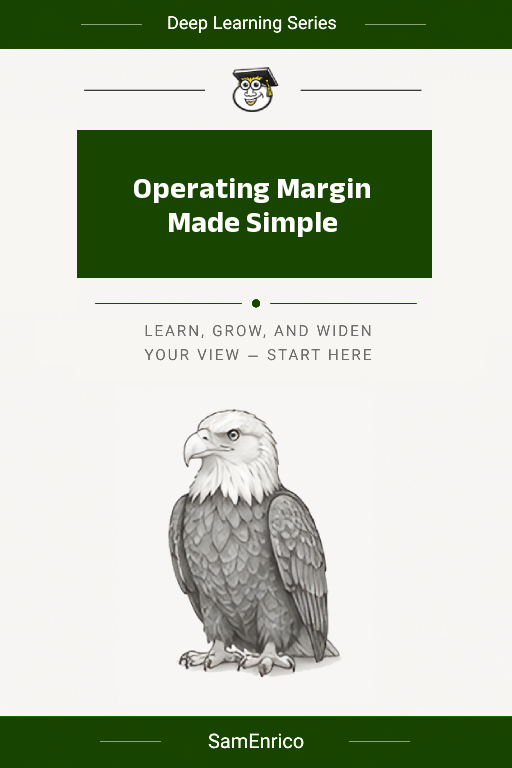
Operating Margin Made Simple eBook
Divide operating income by revenue to measure core
Divide operating income by revenue to measure core business profitability, excluding one-time items and interest expenses.
Formats
Free sample
Chapter 1: The Bottom Line Mirage--Every business owner remembers the exact moment they realized revenue was not the same as profit. For Alex Chen, founder of a premium coffee roastery that had grown from a single cart to twelve locations in six years, that moment came at 3:47 PM on a Tuesday. His accountant had just emailed the year-end financials. Revenue had grown 34% to 8.2million.Netincomewaspositiveforthefourthyearinarow.Byeveryexternalmeasure,Alexhadbuiltathrivingbusiness.Banksofferedhimcreditlines.Localbusinessawardsnominatedhim.Employeescelebratedthegrowthwithaholidaypartythatcostnearly8.2 million. Net income was positive for the fourth year in a row.
By every external measure, Alex had built a thriving business. Banks offered him credit lines. Local business awards nominated him. Employees celebrated the growth with a holiday party that cost nearly 8.2million.Netincomewaspositiveforthefourthyearinarow.Byeveryexternalmeasure,Alexhadbuiltathrivingbusiness.Banksofferedhimcreditlines.Localbusinessawardsnominatedhim.Employeescelebratedthegrowthwithaholidaypartythatcostnearly40,000. Then Alex did something most founders never do.
He looked past the bottom line. He calculated his operating margin by dividing operating income by revenue. The number was 2.8%. In the coffee roasting industry, where peers averaged 8-12%, Alex was not thriving. He was one bad month away from disaster.
A 10% drop in sales would wipe out his entire profit. A single broken roaster would require debt he could not service. A minimum wage increase would push him into the red. Alex had built a revenue machine that looked impressive from the outside but generated almost no real profit from its core operations. The bottom line had been lying to him for years.
This chapter will ensure the same thing never happens to you.The Three Layers of Profitability To understand why the bottom line lies, you must first understand that profitability is not a single number. It is three distinct layers stacked on top of each other, each telling a different story about a different aspect of your business. Most business owners and investors look only at the top layer—net income, or the "bottom line"—and assume it represents the health of the entire business. This is like judging the safety of a building by looking only at the roof while ignoring the foundation and the frame. The three layers, from bottom to top, are gross margin, operating margin, and net margin.
Each layer excludes different costs to reveal a different truth.Gross margin is revenue minus Cost of Goods Sold (COGS). COGS includes the direct costs of producing your product or service: raw materials, factory labor, shipping from suppliers, and manufacturing overhead. Gross margin tells you how efficiently you produce what you sell. A high gross margin means you have pricing power, efficient production, or both. A low gross margin means your costs are too high relative to your prices, or your industry is simply low-margin by nature.
Grocery stores have low gross margins (20-30%) because they sell commodities. Software companies have high gross margins (70-90%) because the cost of producing one more copy is near zero. Gross margin is the foundation. If it is broken, nothing above it can be healthy for long.Operating margin is revenue minus COGS minus all operating expenses. Operating expenses include selling, general, and administrative costs (SG&A): salaries for non-production staff, marketing and advertising, rent for offices and retail spaces, utilities, research and development, depreciation of equipment, legal fees, accounting costs, and software subscriptions.
In short, operating expenses are everything you spend to run the business that is not directly tied to making the product. Operating margin tells you how efficiently you manage the business. It answers the most important question for long-term survival: After paying for both production and day-to-day operations, how much profit does your core business generate? This is the number that matters. This is the number we will spend the rest of this book teaching you to master.Net margin is revenue minus COGS minus operating expenses minus interest minus taxes.
Net margin tells you how much profit remains after the bank and the government take their cuts. It is the number that appears on your tax return and the number most business owners check first. It is also the most distorted number of all. Interest expense depends entirely on how much debt you have taken on, not on how well you run your operations. Tax expense depends on your legal structure, your location, and the creativity of your accountant, not on the quality of your products or management.
A company can have excellent operating margins—meaning it runs a tight, efficient, profitable core business—but terrible net margins because it borrowed too much money. The reverse is also possible: a company can have terrible operating margins but decent net margins because of a one-time insurance payout or the sale of a division. Net margin tells you what is left after everyone else gets paid. It does not tell you whether your business model actually works.The Clean Metric: Why Operating Margin Wins Operating margin is often called the "clean" metric because it excludes the three things that distort true profitability: financing decisions (interest), government obligations (taxes), and one-time events (asset sales, lawsuit settlements, disaster insurance payouts). By excluding these, operating margin focuses exclusively on the core question: Does your business generate profit from its everyday activities?
Can you make money selling your product or service without relying on debt, tax strategies, or luck? This is the difference between a sustainable business and a house of cards. A business with healthy operating margins can survive higher interest rates, tax increases, and the occasional bad quarter. A business with poor operating margins cannot, regardless of how good its net income looks in a given year.Consider two businesses. Business A has a 15% operating margin.
They pay 5% in interest and 25% in taxes on their operating income, leaving a net margin of approximately 8-10% depending on deductions. Business B has a 4% operating margin. They also pay interest and taxes, leaving a net margin of 1-2%. In a good year, both show a profit. But in a bad year—when sales dip 10% or costs rise unexpectedly—Business A can absorb the shock.
Their 15% operating margin provides a cushion. Business B falls into the red immediately. Their 4% operating margin leaves no room for error. Both businesses may report positive net income in the good year. Only one is actually healthy.
Operating margin is the difference.Throughout this book, we will emphasize excluding one-time items to get a truly clean view of operating margin. A one-time legal settlement, a pandemic relief grant, or the sale of a piece of real estate does not belong in operating income. These events are not repeatable. They do not reflect your core business. Including them gives a false impression of profitability.
We will revisit this topic in depth in Chapter 10, where we will also discuss how companies abuse the concept of "one-time" exclusions to hide recurring problems. For now, understand the principle: legitimate one-time items should be removed from operating income to see the true, repeatable profitability of your core operations.The Two Restaurant Case Study Nothing illustrates the difference between net margin and operating margin better than two seemingly identical restaurant chains. Both opened the same year. Both grew to fifty locations. Both reported positive net income every year for five years.
Then both faced a 10% decline in same-store sales. One survived. The other went bankrupt within eight months. The difference…
This is the end of the free sample. Get the eBook to keep going. Buy now
About this book
Details
- Author
- Shull Phylicia
- Publisher
- SamEnrico
- Language
- English
- Genre
- Non-Fiction, Student's Shortcut
- Released
- 2026-05-29
- Pages (approx.)
- 142
- Available as
- eBook, Audiobook

Read better in the ZLOADR app
Your eBooks on your phone or tablet. Sign in with your SamEnrico account and start reading.
More by Shull Phylicia
 Stress and Microbiome DisruptionShull Phylicia$11.99
 Commercial Voice Double LifeShull Phylicia$11.99
 Postpartum Sleep GuideShull Phylicia$11.99
 Endometriosis Pelvic RehabShull Phylicia$11.99
 The Growth Mindset for RelationshipsShull Phylicia$11.99
 Vacuum Erection Device GuideShull Phylicia$11.99
 Salary Negotiation UnemployedShull Phylicia$11.99
 Creative Habits JournalShull Phylicia$11.99
 The Sound of Soul: How Motown Shaped the Civil Rights MovementShull Phylicia$11.99
 The Frozen Frontier: Amundsen’s Race to the South PoleShull Phylicia$11.99The Frozen Frontier: Amundsen’s Race to the South PoleShull Phylicia$11.99
 Fire-bellied Toads: Care, Habitat & Vibrant ColorsShull Phylicia$11.99
You may also like
 LSE Online Program LengthAgee Letisha$11.99
 Harvard Extension School for Working AdultsRoush Yer$11.99
 LSE Online Reading ListAshford Ludivina$11.99
 LSE Online Language RequirementsWhitten Daphine$11.99
 LSE Online Class SizeHughey Garret$11.99
 LSE Online Alumni MentorshipWild Lyla$11.99
 London School of Economics Alumni NetworkDutton Chantal$11.99
 Harvard Extension School Student SupportCantrell Christene$11.99
 Harvard Extension School Library AccessSantana Adah$11.99
 Harvard Extension School Degree CompletionBray Wyatt$11.99
 Harvard Extension School Course AuditingAbbott Craig$11.99
 Harvard Extension School Extension DiplomaNew Joane$11.99