
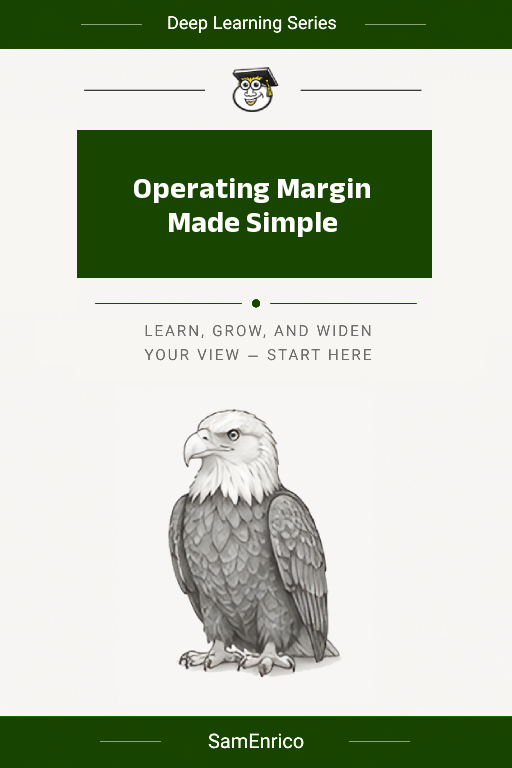
Operating Margin Made Simple
Divide operating income by revenue to measure core
Divide operating income by revenue to measure core business profitability, excluding one-time items and interest expenses.
Formats
About this book
Free sample
Chapter 1: The Bottom Line Mirage--Every business owner remembers the exact moment they realized revenue was not the same as profit. For Alex Chen, founder of a premium coffee roastery that had grown from a single cart to twelve locations in six years, that moment came at 3:47 PM on a Tuesday. His accountant had just emailed the year-end financials. Revenue had grown 34% to 8.2million.Netincomewaspositiveforthefourthyearinarow.Byeveryexternalmeasure,Alexhadbuiltathrivingbusiness.Banksofferedhimcreditlines.Localbusinessawardsnominatedhim.Employeescelebratedthegrowthwithaholidaypartythatcostnearly8.2 million. Net income was positive for the fourth year in a row.
By every external measure, Alex had built a thriving business. Banks offered him credit lines. Local business awards nominated him. Employees celebrated the growth with a holiday party that cost nearly 8.2million.Netincomewaspositiveforthefourthyearinarow.Byeveryexternalmeasure,Alexhadbuiltathrivingbusiness.Banksofferedhimcreditlines.Localbusinessawardsnominatedhim.Employeescelebratedthegrowthwithaholidaypartythatcostnearly40,000. Then Alex did something most founders never do.
He looked past the bottom line. He calculated his operating margin by dividing operating income by revenue. The number was 2.8%. In the coffee roasting industry, where peers averaged 8-12%, Alex was not thriving. He was one bad month away from disaster.
A 10% drop in sales would wipe out his entire profit. A single broken roaster would require debt he could not service. A minimum wage increase would push him into the red. Alex had built a revenue machine that looked impressive from the outside but generated almost no real profit from its core operations. The bottom line had been lying to him for years.
This chapter will ensure the same thing never happens to you.The Three Layers of Profitability To understand why the bottom line lies, you must first understand that profitability is not a single number. It is three distinct layers stacked on top of each other, each telling a different story about a different aspect of your business. Most business owners and investors look only at the top layer—net income, or the "bottom line"—and assume it represents the health of the entire business. This is like judging the safety of a building by looking only at the roof while ignoring the foundation and the frame. The three layers, from bottom to top, are gross margin, operating margin, and net margin.…
This is the end of the free sample. Get the eBook to keep going. Buy now
Contents
- Chapter 1
- Chapter 2
- Chapter 3
- Chapter 4
- Chapter 5
- Chapter 6
- Chapter 7
- Chapter 8
- Chapter 9
- Chapter 10
- Chapter 11
- Chapter 12
Details
- Author
- Shull Phylicia
- Publisher
- SamEnrico
- Language
- English
- Genre
- Non-Fiction, Student's Shortcut
- Released
- 2026-05-29
- Pages (approx.)
- 142
- Available as
- eBook, Audiobook

Read better in the ZLOADR app
Your eBooks on your phone or tablet. Sign in with your SamEnrico account and start reading.
More by Shull Phylicia
 Stress and Microbiome DisruptionShull Phylicia$11.99
 Commercial Voice Double LifeShull Phylicia$11.99
 Postpartum Sleep GuideShull Phylicia$11.99
 Endometriosis Pelvic RehabShull Phylicia$11.99
 The Growth Mindset for RelationshipsShull Phylicia$11.99
 Vacuum Erection Device GuideShull Phylicia$11.99
 Salary Negotiation UnemployedShull Phylicia$11.99
 Creative Habits JournalShull Phylicia$11.99
 The Sound of Soul: How Motown Shaped the Civil Rights MovementShull Phylicia$11.99
 The Frozen Frontier: Amundsen’s Race to the South PoleShull Phylicia$11.99The Frozen Frontier: Amundsen’s Race to the South PoleShull Phylicia$11.99
 Fire-bellied Toads: Care, Habitat & Vibrant ColorsShull Phylicia$11.99
You may also like
 LSE Online Program LengthAgee Letisha$11.99
 Harvard Extension School for Working AdultsRoush Yer$11.99
 LSE Online Reading ListAshford Ludivina$11.99
 LSE Online Language RequirementsWhitten Daphine$11.99
 LSE Online Class SizeHughey Garret$11.99
 LSE Online Alumni MentorshipWild Lyla$11.99
 London School of Economics Alumni NetworkDutton Chantal$11.99
 Harvard Extension School Student SupportCantrell Christene$11.99
 Harvard Extension School Library AccessSantana Adah$11.99
 Harvard Extension School Degree CompletionBray Wyatt$11.99
 Harvard Extension School Course AuditingAbbott Craig$11.99
 Harvard Extension School Extension DiplomaNew Joane$11.99