
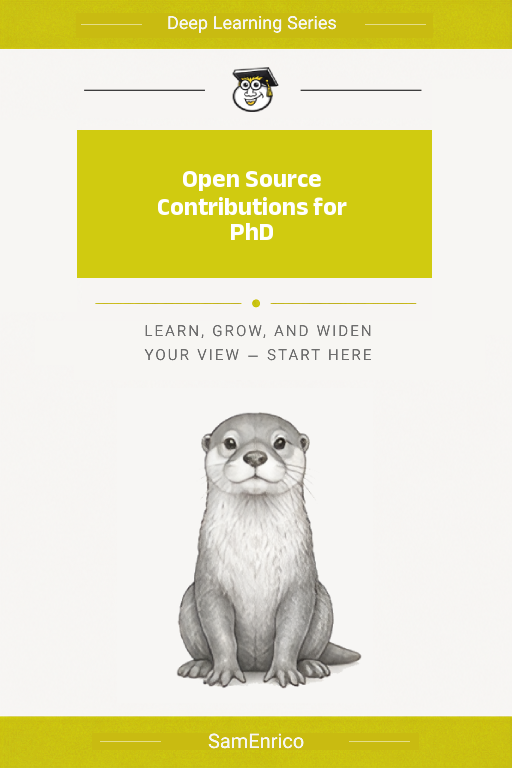
Non-FictionStudent's ShortcutOpen Science
Open Source Contributions for PhD
List software packages, data tools, and reproducib
by Spann Sunny
List software packages, data tools, and reproducible analysis scripts as research products equivalent to publications.
Formats
About this book
Free sample
Chapter 1: The Broken Pipeline...--–- The email arrived at 11:47 PM on a Tuesday. Dr. Sarah Chen, a third-year computational biology Ph D student, had just finished debugging a simulation that took six months to build. Her results were beautiful—a clear signal cutting through the noise, something her field had been chasing for a decade. She attached the figures, wrote a triumphant message to her advisor, and hit send.
The reply came twelve hours later: "Great work, Sarah. Now write it up and send it to Journal of Computational Biology. Also, can you put the code on a lab server somewhere?"That "somewhere" was the moment the pipeline broke.Sarah's story is not unique. It is the story of computational science in the twenty-first century: brilliant minds producing groundbreaking results through code, only to have that code treated as an afterthought—a "supplement," a "resource," a "data availability statement" footnote. The PDF gets the glory.
The repository gets the shrug.This book exists because that pipeline is broken. And you, as a Ph D student, are going to help fix it.The Two-Product Fallacy Every Ph D student in a computational field produces two things. The first is their dissertation: a PDF, formatted according to university guidelines, reviewed by a committee, deposited in a library or online repository. The second is their code: thousands of lines of R, Python, Julia, or MATLAB that actually did the work—cleaned the data, ran the simulations, generated the figures, tested the hypotheses.The fallacy is that only the first counts.Walk into any department chair's office and ask what "counts" for graduation, for a postdoc, for a tenure-track job. They will list peer-reviewed publications.
They will list conference presentations. If you are lucky, they will mention "research products" without defining them. But they will almost never say "well-maintained, well-documented, openly licensed software with an active user community and measurable citation impact."And yet, the history of modern science is written in code.The Algorithm That Changed Biology Consider the case of BLAST (Basic Local Alignment Search Tool), published in 1990 by Altschul and colleagues…
This is the end of the free sample. Get the eBook to keep going. Buy now
Contents
- Chapter 1
- Chapter 2
- Chapter 3
- Chapter 4
- Chapter 5
- Chapter 6
- Chapter 7
- Chapter 8
- Chapter 9
- Chapter 10
- Chapter 11
- Chapter 12
Details
- Author
- Spann Sunny
- Publisher
- SamEnrico
- Language
- English
- Genre
- Non-Fiction, Student's Shortcut, Open Science
- Released
- 2026-05-29
- Pages (approx.)
- 118
- Available as
- eBook, Audiobook

Read better in the ZLOADR app
Your eBooks on your phone or tablet. Sign in with your SamEnrico account and start reading.
More by Spann Sunny
 Acceptance Commitment Therapy OCDSpann Sunny$11.99
 Nonverbal Cues In Financial Advising CourseSpann Sunny$11.99
 Call Center Anger TechniquesSpann Sunny$11.99
 Random Stimulus TechniqueSpann Sunny$11.99
 Survey Margin of Error AI CalculatorSpann Sunny$11.99
 Unbroken: The Comeback of the 'Miracle on Ice'Spann Sunny$11.99
 The Silent Plague: Uncovering the Medieval Underwater Mystery of the Sulu SeaSpann Sunny$11.99
 Croatian Master Degree GuideSpann Sunny$12.99
 FootbagSpann Sunny$11.99
 Understanding Canga's Bead SymptomSpann Sunny$17.99
You may also like
 Hong Kong Handover 1997Dunn Johnnie$11.99
 Zumba For Postnatal Recovery CourseNeal Christian$11.99
 Zumba for BeginnersLadner Nikia$11.99
 YouTube Comment Mining GuideHumes Pandora$12.99
 Worry Box MeditationCarlin Rudy$11.99
 Workplace Stress MeditationNguyen Lynn$11.99
 Workplace Stress and Sleep RepairHawley Ivory$11.99
 Workplace Perfectionism CureDelaney Jeffry$11.99
 Workplace Injustice Anger GuideWallen Isabelle$11.99
 Work Addiction and Burnout LinkGreenwood Ester$11.99
 Women in Yoga and WellnessBeattie Galina$11.99
 Women in Stand Up ComedyChun Evangeline$11.99