
Non-FictionStudent's ShortcutOpen Science
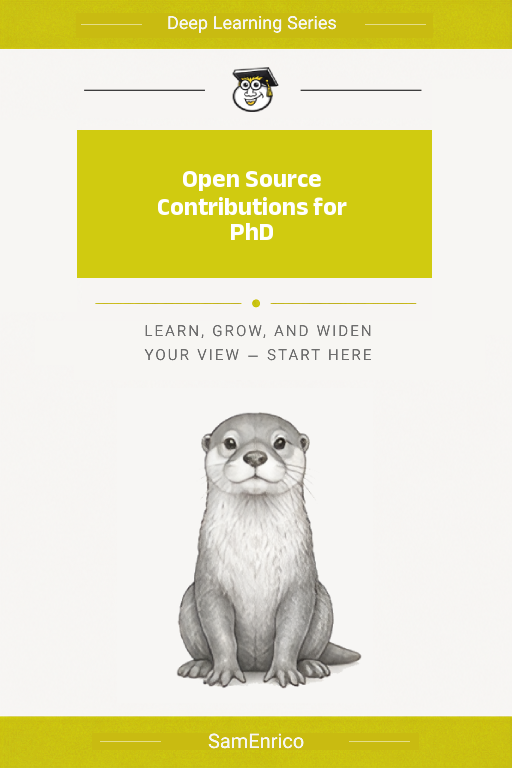
Open Source Contributions for PhD eBook
List software packages, data tools, and reproducib
by Spann Sunny
List software packages, data tools, and reproducible analysis scripts as research products equivalent to publications.
Formats
Free sample
Chapter 1: The Broken Pipeline...--–- The email arrived at 11:47 PM on a Tuesday. Dr. Sarah Chen, a third-year computational biology Ph D student, had just finished debugging a simulation that took six months to build. Her results were beautiful—a clear signal cutting through the noise, something her field had been chasing for a decade. She attached the figures, wrote a triumphant message to her advisor, and hit send.
The reply came twelve hours later: "Great work, Sarah. Now write it up and send it to Journal of Computational Biology. Also, can you put the code on a lab server somewhere?"That "somewhere" was the moment the pipeline broke.Sarah's story is not unique. It is the story of computational science in the twenty-first century: brilliant minds producing groundbreaking results through code, only to have that code treated as an afterthought—a "supplement," a "resource," a "data availability statement" footnote. The PDF gets the glory.
The repository gets the shrug.This book exists because that pipeline is broken. And you, as a Ph D student, are going to help fix it.The Two-Product Fallacy Every Ph D student in a computational field produces two things. The first is their dissertation: a PDF, formatted according to university guidelines, reviewed by a committee, deposited in a library or online repository. The second is their code: thousands of lines of R, Python, Julia, or MATLAB that actually did the work—cleaned the data, ran the simulations, generated the figures, tested the hypotheses.The fallacy is that only the first counts.Walk into any department chair's office and ask what "counts" for graduation, for a postdoc, for a tenure-track job. They will list peer-reviewed publications.
They will list conference presentations. If you are lucky, they will mention "research products" without defining them. But they will almost never say "well-maintained, well-documented, openly licensed software with an active user community and measurable citation impact."And yet, the history of modern science is written in code.The Algorithm That Changed Biology Consider the case of BLAST (Basic Local Alignment Search Tool), published in 1990 by Altschul and colleagues at the NIH. BLAST was software—a search algorithm for comparing biological sequences. It was published in the Journal of Molecular Biology, a traditional paper.
But the paper was just the announcement. The real contribution was the code.Within five years, BLAST had been downloaded tens of thousands of times. It became the most cited paper in biology. The citation count reflected not just the idea but the implementation—the fact that researchers could run the algorithm themselves, on their own data, without needing to reimplement anything. BLAST's code was the contribution.
The paper was the wrapper.Fast forward three decades. The same pattern holds for tools like scikit-learn (machine learning in Python), ggplot2 (visualization in R), and Tensor Flow (deep learning). Each of these is a software package first and a paper second. Their citation counts dwarf those of most traditional research articles because they are used, not just read.So why is the Ph D student of today still told that code is a "supplement"?The PDF Prison The answer lies in a historical accident: for three hundred years, the only way to share scientific knowledge was through static, printed text. Journals were physical objects.
Peer review required paper. The library was a building full of shelves.That world no longer exists.We now have version control (Git), persistent identifiers (DOIs), containerization (Docker), computational notebooks (Jupyter, Quarto), and archiving services (Zenodo, Software Heritage). A code repository today is more durable, more searchable, and more reproducible than any PDF. A PDF rots—fonts break, links decay, references go stale. A code repository with a DOI is forever.And yet, the culture lags.
Department chairs like Sarah's advisor were trained in the PDF era. They advanced through the PDF economy. They evaluate junior colleagues by counting PDFs. The pipeline remains broken because the incentives are misaligned.This book is about realigning them.What This Book Will Do for You If you are a Ph D student in any computational field—bioinformatics, economics, psychology, physics, engineering, linguistics, public health, computer science—this book will teach you to treat your code as a first-class research output.We will cover, across thirteen chapters:Why your Git Hub repository belongs on your CV alongside your publications (this chapter)How to choose a license that protects your work while maximizing adoption (Chapter 2)Where to find contribution opportunities that yield high academic impact (Chapter 3)How to build reusable analysis scripts that others can run with one command (Chapter 4)The architecture of high-impact packages that survive beyond graduation (Chapter 5)Documentation as scholarship—why your vignette is a methods paper (Chapter 6)The citation economy for code—DOIs, CITATION.cff, and software journals (Chapter 7)Data tools as research products—because cleaning data is real work (Chapter 8)Building community around your tool—issue triage as peer review (Chapter 9)The network perspective—dependencies, centrality, and maintaining the commons (Chapter 10)The academic job market—translating code into CV currency (Chapter 11)The executable thesis—where the source code is the dissertation (Chapter 12)Your future—RSE, professor, or something else entirely (Chapter 13)Every chapter includes concrete examples, case studies from real open-source projects, and actionable checklists. Where appropriate, we provide code templates and configuration files in the book's companion repository.The FAIR Principles for Research Software Before we go further, we need a shared vocabulary for what makes software a legitimate research output.
The FAIR principles—originally designed for data—have been adapted for research software as FAIR4RS. Understanding these will help you evaluate your own work and defend it to skeptical committees.Findable means that someone can locate your software without knowing you personally. Practically, this requires a persistent identifier (DOI) for each release, rich metadata in a CITATION.cff file, and registration in searchable indexes like CRAN, Py PI, or Conda-Forge. A repository with a DOI but no metadata is like a paper with a title but no author list.Accessible means that once someone finds your software, they can actually get it. This means no login walls, no request forms, no "email the author for access." For open source, accessible means git clone just works.
It also means an unambiguous license (see Chapter 2 for selection guidance). A repository without a license is effectively closed—copyright law defaults to "all rights reserved," meaning no one can legally use your code.Interoperable means your software plays well with others. This requires using community-standard formats for input and output (CSV, HDF5, Net CDF—not custom binary formats), communicating via standard APIs, and being packaged in standard formats. It also means being cross-platform or clearly documenting platform requirements.Reusable is the most complex pillar. Reusable software is not just available; it is ready to be used.
This requires extensive documentation (Chapter 6), provenance metadata (what versions of what dependencies), usage examples, and clear citation instructions. A reusable package includes a README with a minimal working example that a user can copy-paste.These four principles are not optional. They are the foundation of software as research output.The Objections You Will Hear (And How to Answer Them)You will encounter skepticism. Your advisor, your committee members, your…
This is the end of the free sample. Get the eBook to keep going. Buy now
About this book
Details
- Author
- Spann Sunny
- Publisher
- SamEnrico
- Language
- English
- Genre
- Non-Fiction, Student's Shortcut, Open Science
- Released
- 2026-05-29
- Pages (approx.)
- 118
- Available as
- eBook, Audiobook

Read better in the ZLOADR app
Your eBooks on your phone or tablet. Sign in with your SamEnrico account and start reading.
More by Spann Sunny
 Acceptance Commitment Therapy OCDSpann Sunny$11.99
 Nonverbal Cues In Financial Advising CourseSpann Sunny$11.99
 Call Center Anger TechniquesSpann Sunny$11.99
 Random Stimulus TechniqueSpann Sunny$11.99
 Survey Margin of Error AI CalculatorSpann Sunny$11.99
 Unbroken: The Comeback of the 'Miracle on Ice'Spann Sunny$11.99
 The Silent Plague: Uncovering the Medieval Underwater Mystery of the Sulu SeaSpann Sunny$11.99
 Croatian Master Degree GuideSpann Sunny$12.99
 FootbagSpann Sunny$11.99
 Understanding Canga's Bead SymptomSpann Sunny$17.99
You may also like
 Hong Kong Handover 1997Dunn Johnnie$11.99
 Zumba For Postnatal Recovery CourseNeal Christian$11.99
 Zumba for BeginnersLadner Nikia$11.99
 YouTube Comment Mining GuideHumes Pandora$12.99
 Worry Box MeditationCarlin Rudy$11.99
 Workplace Stress MeditationNguyen Lynn$11.99
 Workplace Stress and Sleep RepairHawley Ivory$11.99
 Workplace Perfectionism CureDelaney Jeffry$11.99
 Workplace Injustice Anger GuideWallen Isabelle$11.99
 Work Addiction and Burnout LinkGreenwood Ester$11.99
 Women in Yoga and WellnessBeattie Galina$11.99
 Women in Stand Up ComedyChun Evangeline$11.99