
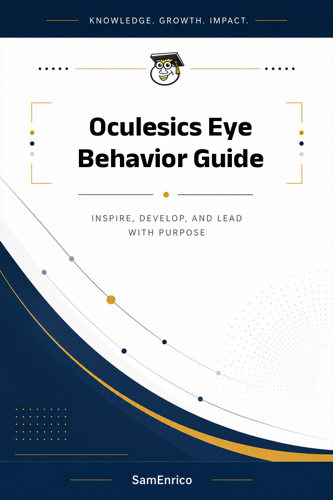
Non-FictionSelf-HelpOculesicsEye Contact
Oculesics Eye Behavior Guide eBook
Master pupil response, blink rate, and gaze direct
by Mears Nubia
Master pupil response, blink rate, and gaze direction as communication tools.
Formats
Free sample
Chapter 1: The Honest Liars--You are sitting across from someone who is telling you a story. Their words are confident, their tone is steady, and their smile seems genuine. But something feels off. You cannot name it. There is no obvious contradiction, no stammer, no nervous fidgeting.
And yet, a quiet alarm is ringing somewhere in the back of your mind.You are not imagining it. You are reading their eyes.Long before humans developed spoken language, we were communicating with our eyes. The eyes are the oldest communication channel in the human repertoire, predating words by hundreds of thousands of years. They evolved to signal threat, to invite bonding, to establish dominance, and to express emotion with a speed and honesty that words can never match. The eyes are not merely windows to the soul—they are broadcasters of real-time cognitive and emotional data, constantly transmitting information that most people never learn to decode.This book is about learning to decode that information.
It is about becoming fluent in the silent, ancient, and powerful language of the eyes.The science of eye behavior is called oculesics. It is a formal subfield of nonverbal communication, and it encompasses everything from the involuntary dilation of the pupils to the unconscious rhythm of blinking to the deliberate direction of gaze. For decades, researchers have studied how the eyes reveal cognitive load, emotional arousal, deception, attraction, and social status. The findings are consistent and powerful: the eyes are honest in ways that words are not.But there is a problem. Popular culture has filled our heads with myths.
Liars look away. Pupils dilate only when telling the truth. Eye contact always signals honesty. These myths are not just wrong—they are dangerous. They lead us to trust the wrong people and doubt the right ones.
They cause us to miss the subtle clusters of signals that actually reveal what someone is thinking and feeling.This chapter is the foundation for everything that follows. You will learn what oculesics is, why the eyes are uniquely honest compared to other communication channels, and how to distinguish between voluntary eye signals (which people can control) and involuntary signals (which they cannot). You will learn the evolutionary history of gaze signaling, from predator detection to pair bonding. You will take the first step toward oculesic fluency by completing an Oculesics Self-Assessment to understand your own baseline eye behavior. And crucially, you will learn the Context Principle: no eye signal means anything without context.Before we begin, two important notes.First, this book is written primarily from a neurotypical perspective.
If you are autistic, have ADHD, or are otherwise neurodivergent, your own eye behavior and your reading of others' eye behavior may differ from the patterns described here. A dedicated section later in this chapter addresses neurodivergent oculesics, and adaptations are noted throughout the book. You are not broken if your eyes do not follow these patterns. These patterns are averages, not rules.Second, if you have a history of trauma, especially interpersonal trauma, your gaze patterns may be shaped by survival mechanisms rather than social signaling. Gaze avoidance, hypervigilance, and atypical blink rates are common in trauma survivors and are not signs of deception or disinterest.
This book's tools are for connection, not diagnosis. If reading about eye behavior triggers distress, please prioritize your well-being over learning these techniques. A disclaimer section at the end of this chapter offers adaptations for trauma-informed oculesics.Now, let us begin.The Science of Oculesics Oculesics is the formal study of eye behavior as a communicative channel. The term was first codified by nonverbal communication researchers Hickson, Stacks, and Moore in their foundational textbook "Nonverbal Communication: An Integrated Approach." They identified oculesics as one of several core subcodes of nonverbal behavior, alongside kinesics (body movement), proxemics (space), and haptics (touch).The scope of oculesics is broad. It includes:Pupil response: The involuntary dilation and constriction of the pupils in response to cognitive effort, emotional arousal, and lighting conditions.Blink rate: The frequency of eyelid closure, which varies with stress, concentration, and cognitive load.Gaze direction: Where a person points their eyes, revealing attention, intention, and cognitive processing.Eye contact patterns: The duration, frequency, and reciprocity of mutual gaze between two people.Each of these components will receive its own chapter later in this book.
For now, the key takeaway is that these are distinct but interacting channels. A person's pupils might dilate while their blink rate increases and their gaze direction shifts. Learning to read oculesics means learning to read the whole constellation, not just one signal in isolation.Why the Eyes Are Different The eyes are not like other parts of the body when it comes to communication. Here is why.The eyes are directly connected to the limbic system, the ancient part of the brain responsible for emotion, memory, and threat detection. There is a direct neural pathway from the retina to the amygdala, bypassing the conscious, rational parts of the brain.
This means that emotional reactions often appear in the eyes before the person is even aware of feeling anything.This is why the eyes are harder to control than the mouth. You can choose your words carefully. You can practice your smile in the mirror. But your pupils will dilate when you see something you want, and they will constrict when you see something you fear. Your blink rate will accelerate when you are stressed, whether you want it to or not.
Your gaze will linger on a person you find attractive before your conscious mind has caught up.In oculesics, we distinguish between voluntary signals and involuntary signals. Voluntary signals are culturally learned, consciously controlled, and can be faked. A deliberate wink is voluntary. A forced smile that does not reach the eyes is voluntary. Involuntary signals are neurologically driven, nearly impossible to fake, and therefore more honest.
Pupil dilation is involuntary. The micro-movements of the eyes during emotional arousal are involuntary. The real-time tracking of a person's gaze as they process a difficult question is largely involuntary.The distinction between voluntary and involuntary is the bedrock of oculesic reading. When you want to know what someone is really feeling, you look for the involuntary signals. When you want to project confidence or interest, you learn to control your voluntary signals.
The rest of this book will teach you both.The Evolutionary Origins of Gaze Why do we have such expressive eyes in the first place? The answer lies in our evolutionary history.Human eyes are unique among primates. We have a large, highly visible sclera—the white part of the eye—which makes it easy to see where another person is looking. Most primates have dark sclera, which conceals gaze direction. The leading theory is that the white sclera evolved to support cooperative communication.
When early humans began hunting in groups, it became advantageous to know where your hunting partner was looking. A subtle shift in gaze could signal the location of prey or danger without making a sound.This is called the cooperative eye hypothesis, and it helps explain why gaze direction is so important in human communication. We are hardwired to follow another person's gaze.…
This is the end of the free sample. Get the eBook to keep going. Buy now
About this book
Details
- Author
- Mears Nubia
- Publisher
- SamEnrico
- Language
- English
- Genre
- Non-Fiction, Self-Help, Oculesics, Eye Contact
- Released
- 2026-06-07
- Pages (approx.)
- 126
- Available as
- eBook, Audiobook

Read better in the ZLOADR app
Your eBooks on your phone or tablet. Sign in with your SamEnrico account and start reading.
More by Mears Nubia
 Workplace Smoking Ban SurvivalMears Nubia$11.99
 Religious Pilgrimage BoothsMears Nubia$11.99
 Gacy Sexuality and ViolenceMears Nubia$11.99
 The Vanishing Billions: The Inside Job That Shook IndiaMears Nubia$11.99
 How to Start a Carpentry (structural) Business (Beginners Guide)Mears Nubia$11.99
 Executive Team AssistantMears Nubia$11.99
 Learn to Play the SopilaMears Nubia$11.99
 AI Glossary Management GuideMears Nubia$12.99
You may also like
 Hong Kong Handover 1997Dunn Johnnie$11.99
 Zumba For Postnatal Recovery CourseNeal Christian$11.99
 Zumba for BeginnersLadner Nikia$11.99
 YouTube Comment Mining GuideHumes Pandora$12.99
 Worry Box MeditationCarlin Rudy$11.99
 Workplace Stress MeditationNguyen Lynn$11.99
 Workplace Stress and Sleep RepairHawley Ivory$11.99
 Workplace Perfectionism CureDelaney Jeffry$11.99
 Workplace Injustice Anger GuideWallen Isabelle$11.99
 Work Addiction and Burnout LinkGreenwood Ester$11.99
 Women in Yoga and WellnessBeattie Galina$11.99
 Women in Stand Up ComedyChun Evangeline$11.99