
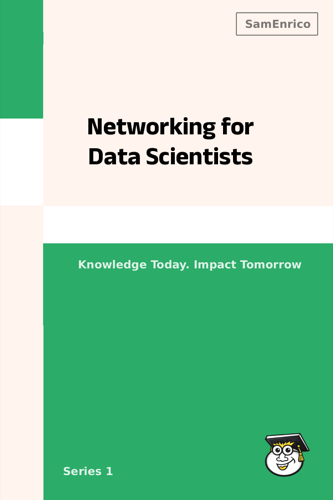
Networking for Data Scientists eBook
Builds industry and collaboration relationships.
by Bolt Huey
Builds industry and collaboration relationships.
Formats
Free sample
Chapter 1: The Visibility Gap--–- Dr. Maya Chen had spent six months building a demand forecasting model for a retail giant. The model was elegant—a hybrid architecture combining gradient-boosted trees with a custom time-series decomposition that outperformed the company’s legacy system by 34 percent. She had documented every assumption, validated every feature, and stress-tested the thing against three years of historical anomalies, including the week a competitor’s warehouse burned down. At the final review, her manager nodded, said “nice work,” and then assigned her to build a dashboard for the marketing team’s weekly report.
Six months. Thirty-four percent improvement. And she was making bar charts.The model never saw production. Not because it failed technically, but because no one with decision authority knew it existed. The head of supply chain had never heard Maya’s name.
The VP of operations didn’t know there was an alternative to the legacy system. And Maya, despite being the smartest person in the room on every technical dimension, had never told them. She assumed her work would speak for itself.It didn’t. It never does.This is the Visibility Gap—the distance between how good you actually are and how much your organization, industry, or community recognizes that goodness. It is the single largest career limiter for data scientists, and it has almost nothing to do with technical skill.
You can build models that would make a Stanford Ph D weep with envy, and if no one knows who you are or why your work matters, you will remain what Maya became: a very smart person making bar charts for people who don’t know what they’re missing.The Uncomfortable Truth About Technical Excellence Let’s get something straight. You became a data scientist because you love solving problems with data. You like the clean logic of a well-specified model, the satisfaction of watching loss curves descend, the quiet thrill of finding a signal where others saw only noise. These are noble pursuits. But somewhere along the way, someone convinced you that being good at the math was enough.
That if you just built better models, faster pipelines, more elegant solutions, the recognition would follow automatically.It won’t.Here’s why. Organizations are not meritocracies—they are attention economies. Decisions are made by people who are overwhelmed, distracted, and operating with incomplete information. When a promotion committee meets, they do not review every line of code you wrote. They remember conversations.
They recall who spoke up in meetings, who solved cross-functional problems, who seemed to know things before anyone else did. Technical excellence is table stakes. It gets you in the door. But what gets you promoted, funded, and sought out for collaboration is something else entirely: relationship fluency.This is not a feel-good observation. It is a structural reality of how work gets done in every organization larger than about ten people.
Information flows along trust networks, not org charts. Decisions are made in hallways and Slack DMs, not just in formal review meetings. The data scientist who understands this—who networks not as a transactional chore but as a form of systems thinking—will consistently outperform the technically superior hermit. Every time.Redefining Networking for the Data Scientist The word “networking” probably made you cringe. It conjures images of crowded conference halls, awkward small talk, and people handing out business cards like they’re dispensing painkillers.
For many data scientists—a population disproportionately drawn to the field because they prefer working with data to working with people—the very idea feels exhausting, inauthentic, and vaguely manipulative.Good. Throw that version away.Networking, as this book defines it, is not selling yourself. It is not collecting contacts. It is not pretending to be interested in someone’s weekend plans so you can later ask for a job referral. Those approaches fail because they violate a fundamental principle of human interaction: people can smell transactional intent from across the room.Instead, consider a different model.
Think of professional relationships as a knowledge graph—a network of nodes (people) connected by edges (shared context, mutual trust, reciprocal value). Your goal as a data scientist is not to maximize the number of nodes. It is to increase the quality and informational flow along the edges. You want to become a node that others naturally route important information through, because you have demonstrated that you give value before you take it.This is the principle of reciprocity, and it is the engine of every successful professional network you have ever observed. The senior data scientist who always seems to know about interesting projects before they are announced?
People tell her because she has a track record of sharing useful papers, making thoughtful introductions, and offering help without being asked. The junior analyst who gets tapped for high-visibility collaborations? He built a reputation for reviewing others’ code with genuine curiosity rather than performative criticism.Notice what’s missing from these examples: self-promotion. Hustle. The relentless “personal branding” that Linked In influencers recommend.
Those tactics work for a small subset of personality types, and if you are one of them, you probably aren’t reading this book. For the rest of us, networking succeeds when it stops feeling like networking and starts feeling like what you already do well: understanding systems, finding patterns, and creating value.The Systems Thinking Approach to Relationships Here is a reframe that has worked for hundreds of data scientists who swore they could never network. You already spend your days modeling complex systems. You think about dependencies, feedback loops, hidden variables, and emergent behavior. An organization is just another complex system.
The “variables” are people with goals, constraints, information asymmetries, and emotional responses. Your job is to understand how information and trust flow through that system, then position yourself as a helpful node.Consider how you would approach a new dataset. You would not immediately start running regressions. First, you would explore: what are the columns? Which variables are correlated?
Where are the missing values? Who created this data, and what assumptions did they bake into it?Professional relationships demand the same curiosity. Before you can collaborate effectively with someone, you need to understand their incentives, their pain points, and the constraints they operate under. The finance director cares about accuracy and auditability because she gets yelled at when numbers are wrong. The product manager cares about shipping features because his bonus depends on quarterly releases.
The data engineer cares about pipeline reliability because she is the one paged at 3 AM when jobs fail. None of these people are irrational. They are rational actors responding to the incentives and pressures of their roles.When you approach relationship-building as a mapping exercise rather than a performance, something shifts. You stop worrying about saying the right thing and start getting genuinely curious about how the system works. And curiosity, it turns out, is deeply attractive.
People want to talk to someone who asks good questions, listens carefully, and offers insights that help them solve their actual problems.Why Traditional Networking Advice Fails Data Scientists Before we go further, let’s name the elephant in the room. Most networking advice was written…
This is the end of the free sample. Get the eBook to keep going. Buy now
About this book
Details
- Author
- Bolt Huey
- Publisher
- SamEnrico
- Language
- English
- Genre
- Non-Fiction, Self-Help, Data
- Released
- 2026-06-05
- Pages (approx.)
- 142
- Available as
- eBook, Audiobook

Read better in the ZLOADR app
Your eBooks on your phone or tablet. Sign in with your SamEnrico account and start reading.
More by Bolt Huey
 Asking Clarifying Questions EffectivelyBolt Huey$11.99
 Fear of Failure Affirmation DeckBolt Huey$11.99
 Mindful Social Media ScrollBolt Huey$11.99
 Fertility Benefit ComplianceBolt Huey$11.99
 Overcoming Remote ProcrastinationBolt Huey$11.99
 SAD And Music TherapyBolt Huey$11.99
 De escalation JournalBolt Huey$11.99
 The Portrait That Broke the Curse: Peter Graham and the All Blacks' RedemptionBolt Huey$11.99
 How to Produce Wall Plates and CoversBolt Huey$11.99
 US Virtual Address for LLC FormationBolt Huey$12.99
 Angel Investor Non-Disclosure AgreementsBolt Huey$12.99
 How to Produce LeisBolt Huey$11.99
You may also like
 Personal Branding for Data ScientistsKroll Terra$11.99
 OKRs for Data ScienceMarino Leora$11.99
 Imposter Syndrome for Data ScientistsToler Elenora$11.99
 Pomodoro for Data ScientistsGrove Alanna$11.99
 The Trigger Diary MethodHeadrick Kandi$11.99
 Delegation for Data ScientistsTownes Wei$11.99
 Fear of Failure for Data ScientistsHumphreys Carina$11.99
 Growth Mindset for Data ScientistsBarraza Adrianne$11.99
 Remote Work for Data ScientistsPearce Bari$11.99
 Persuasion for Data ScientistsMoses Katia$11.99
 Pomodoro For Data AnalysisGaddy Janiece$11.99
 Palace For Facts And FiguresLu Alexa$11.99