
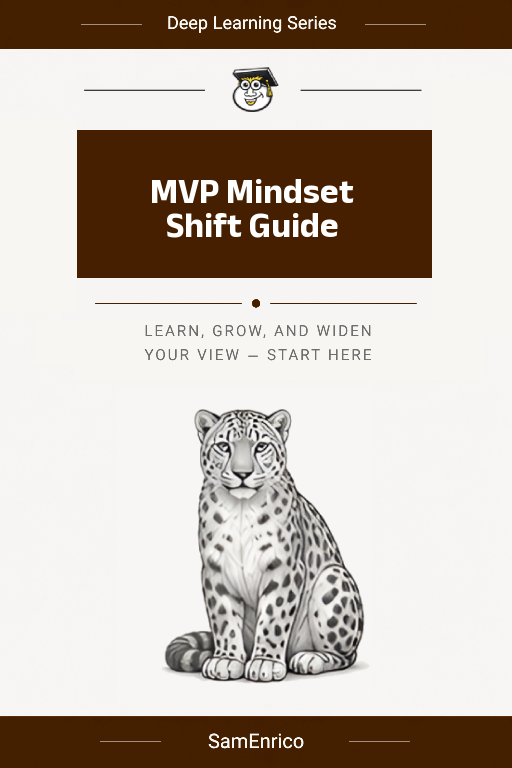
Non-FictionMental WealthAction BiasLaunch Guide
MVP Mindset Shift Guide eBook
Launch minimum viable products without shame in bu
Launch minimum viable products without shame in business, creative work, or personal projects. Covers good-enough criteria, feedback integration loops, and iterative improvement after release.
Formats
Free sample
Chapter 1: The Someday Spiral--Have you ever caught yourself saying any of these phrases?"I'll launch it as soon as I add just one more feature.""It's not ready yet. Give me another month.""What if people think it's amateur?""I just need to polish the design first.""Once I get this last piece perfect, then I'll show it to the world."If you have, you are not alone. You are not lazy. You are not undisciplined. And you are certainly not a fraud.
You are trapped in what I call The Someday Spiral — a psychological pattern that has killed more promising ideas than bad execution ever could.Here is the brutal truth that most productivity books are too polite to say: Most products fail not because they are bad, but because they never truly launch. They die not in the market, not in the hands of disappointed users, but in the quiet solitude of "almost ready." They suffocate under the weight of features added not because users needed them, but because the creator was afraid.I know because I lived this spiral for eighteen months.The Eighteen Months That Cost Me Everything Let me tell you a story I have never shared publicly before. Six years ago, I had an idea for a simple scheduling tool. Nothing revolutionary — just a way for freelancers to book clients without the endless back-and-forth of "Does Tuesday at 3pm work for you?" The market was crowded. I knew that.
But I believed I could make something cleaner, faster, and more delightful.I gave myself three months to build version one. Three months of nights and weekends. A minimal product. A test. A learning experiment.Three months turned into six.
Then nine. Then twelve. Then eighteen.What happened? I fell into The Someday Spiral, and I didn't even know I was spinning.Month 1-3: I built the core functionality. You could log in, set your availability, and share a booking link.
It was ugly. The buttons were misaligned. The color scheme looked like a 1990s dentist's office. But it worked. My wife used it to book a dinner reservation with me.
It took four seconds.I should have launched that week.Month 4-6: I redesigned the interface. Twice. I watched You Tube tutorials on color theory. I agonized over the shade of blue for the primary button. (It was #2A6DFF, then #2979FF, then #1E88E5 — I still remember the hex codes.
That's how deep I went.) I added animations. I wrote "polish" on my to-do list and checked it off twelve times without shipping anything.Month 7-12: I started adding features that no one asked for. A calendar sync with Google Calendar. A calendar sync with Outlook. A calendar sync with i Cloud.
(Do you see the pattern? I was avoiding launch by building.) I added team accounts even though my target user was solo freelancers. I added payment processing even though I had no idea if anyone would book anything.Month 13-18: I burned out. I opened my code editor less and less. I started new side projects — fresh starts where the shame of not launching hadn't accumulated yet.
I told friends "it's almost ready" so many times that they stopped asking. Finally, I abandoned the project entirely. Eighteen months. Zero users. Zero revenue.
Zero learning.The worst part? In that same eighteen months, a competitor launched a much uglier, much simpler tool. They had a landing page, a Typeform, and a human being manually sending calendar links via email. They launched in seven days. Within a year, they had fifteen thousand paying customers.They were not smarter than me.
They were not better engineers. They were not better designers. They were simply willing to feel the embarrassment of launching something unfinished. I was not.That gap — between their willingness to launch and my need for perfection — was worth fifteen thousand customers.What Is The Someday Spiral?The Someday Spiral is a four-stage psychological trap that looks like productivity but functions as procrastination. It is the single greatest enemy of anyone building something new — whether a software product, a creative portfolio, a career change, or a personal project.Here is how it works, and I want you to see if this pattern feels familiar.Stage 1: Excitement and Ideation You have a brilliant idea.
It feels alive. It feels important. You tell a few trusted friends, and they say, "That sounds amazing." Dopamine floods your system. You start sketching, planning, dreaming. This stage feels incredible — and that is exactly why it is dangerous.
The excitement of having an idea is chemically similar to the satisfaction of executing an idea. Your brain gets confused. It rewards you for the idea itself, which reduces your motivation to do the hard work of launching.Stage 2: Fear of Judgment You start building. The initial excitement fades as you encounter real problems. Your beautiful idea meets ugly reality.
And then the fear arrives: What if people think this is stupid? What if I show it to someone and they laugh? What if my reputation is ruined forever? This fear is not irrational. People might indeed judge your early work.
Some people might laugh. But here is what your brain hides from you: the judgment of strangers is temporary, shallow, and almost never catastrophic. The shame of never launching, however, lasts forever.Stage 3: Feature Creep as Safety Behavior This is the most deceptive stage. You look at your unfinished product and feel a familiar discomfort. Instead of launching — which would expose you to judgment — you decide to add "just one more feature." That feature feels productive.
You are technically making progress. But you are also delaying the moment of exposure. Feature creep is not a quality strategy. It is a safety behavior. It is the psychological equivalent of cleaning your apartment instead of writing the difficult email.
You add a login screen. You redesign the logo. You rewrite the documentation. All of these feel like work. None of them test whether anyone actually wants what you are building.Stage 4: Abandonment or Burnout Eventually, the gap between your now-feature-rich product and the market becomes unbearable.
You have invested so much time that launching feels terrifying — if people reject this, they are rejecting years of your life. So you do nothing. You close the project folder. You start a new idea. And you carry the quiet shame of unfinished work into your next attempt.
This is The Someday Spiral. It has a 100% success rate at producing nothing.The Data That Will Haunt You (In a Useful Way)Let me share three numbers that fundamentally changed how I think about launching.Number 1: 73%According to CB Insights, 73% of startups fail. The most common reason? Not competition. Not pricing.
Not technology. The most common reason was "no market need" — which is a polite way of saying they built something no one wanted. But here is the crucial detail that most analysts miss: the vast majority of those products could have discovered "no market need" within two weeks of launch, not two years of building. The failure was not building the wrong thing. The failure was waiting too long to discover that it was wrong.Number…
This is the end of the free sample. Get the eBook to keep going. Buy now
About this book
Details
- Author
- Winchester Sigrid
- Publisher
- SamEnrico
- Language
- English
- Genre
- Non-Fiction, Mental Wealth, Action Bias, Launch Guide
- Released
- 2026-06-01
- Pages (approx.)
- 151
- Available as
- eBook, Audiobook

Read better in the ZLOADR app
Your eBooks on your phone or tablet. Sign in with your SamEnrico account and start reading.
More by Winchester Sigrid
 Humorous Persuasion TechniquesWinchester Sigrid$11.99
 Affirmations for Financial StressWinchester Sigrid$11.99
 Governor's Farm CrisisWinchester Sigrid$11.99
 The Retirement Housing Repair Reserve FundWinchester Sigrid$11.99
 Influencer Disclosure For NetworksWinchester Sigrid$11.99
 The Quantum Leap: How a 20-Year-Old Coder Cracked AI in a GarageWinchester Sigrid$11.99
 IoT-Based Product Business LaunchWinchester Sigrid$11.99
 China Capital Flows OutlookWinchester Sigrid$12.99
 Understanding Japanese EncephalitisWinchester Sigrid$17.99
 How to Become a Tubing-machine TenderWinchester Sigrid$11.99
You may also like
 Hong Kong Handover 1997Dunn Johnnie$11.99
 Zumba For Postnatal Recovery CourseNeal Christian$11.99
 Zumba for BeginnersLadner Nikia$11.99
 YouTube Comment Mining GuideHumes Pandora$12.99
 Worry Box MeditationCarlin Rudy$11.99
 Workplace Stress MeditationNguyen Lynn$11.99
 Workplace Stress and Sleep RepairHawley Ivory$11.99
 Workplace Perfectionism CureDelaney Jeffry$11.99
 Workplace Injustice Anger GuideWallen Isabelle$11.99
 Work Addiction and Burnout LinkGreenwood Ester$11.99
 Women in Yoga and WellnessBeattie Galina$11.99
 Women in Stand Up ComedyChun Evangeline$11.99