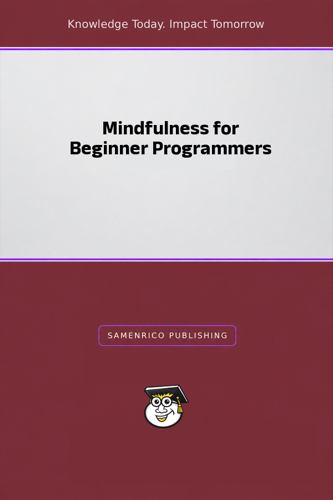
Mindfulness for Beginner Programmers eBook
Debug with patience and less frustration.
by Orozco Vince
Debug with patience and less frustration.
Formats
Free sample
Chapter 1: The Red Text Rage Loop--–- The red text appears.You have been staring at your screen for forty-seven minutes. The cursor blinks at you with mechanical indifference. Your program, which you were sure was correct, has thrown another error. The terminal is a Christmas tree of crimson warnings. Your jaw is clenched so tightly that your molars ache.
Your breathing has become shallow and fast, the kind of breathing that belongs in a horror movie right before someone opens the door they were told never to open. Your left hand has drifted toward your hair, pulling at it without your conscious permission. And somewhere in the back of your skull, a voice is whispering the same three words over and over: I am so stupid.Stop. Right there. That voice, that whisper, that feeling—that is not a personality flaw.
That is not evidence that you chose the wrong career. That is not proof that you lack the "programmer gene" (which does not exist, by the way; it is a myth told by people who want to feel superior). That voice is a biological event, as measurable and predictable as a fever. And like a fever, it has a cause, a mechanism, and a cure.This is the Red Text Rage Loop. It is the single greatest obstacle between you and becoming the programmer you want to be.
It is not about syntax. It is not about logic. It is about biology. And once you understand it, you can break it.The Physiology of Frustration Let us conduct a small experiment together. Read the following sentence, and pay close attention to what happens inside your body:The compiler just told you that line twenty-three has an unexpected token, but you have checked line twenty-three seven times and it looks perfect, and now you want to throw your laptop out a window.What did you feel?
Did your shoulders lift slightly? Did your breath catch? Did your eyes narrow? That reaction is not imaginary. It is your sympathetic nervous system—the "fight or flight" network—activating in response to a perceived threat.
The key word there is perceived. Your laptop is not a predator. The compiler is not a rival tribe attacking your village. The missing semicolon is not a venomous snake. But your brain, which evolved on the African savanna hundreds of thousands of years ago, has not yet learned the difference between a physical threat to your survival and an abstract threat to your competence.Here is what happens inside your skull the moment that red text appears.First, your amygdala—two small almond-shaped clusters of neurons deep in the temporal lobes—detects the error.
It does not read the error message. It does not analyze the syntax. It merely registers a mismatch between expectation (the program should run) and reality (the program crashed). To your ancient brain, a mismatch of expectation and reality is a danger signal. On the savanna, if you expected the path to be safe and a lion appeared instead, your survival depended on an immediate, automatic response.
No thinking. No deliberation. Just reaction.So your amygdala sends an emergency signal to your hypothalamus, which activates your sympathetic nervous system. Within seconds, your adrenal glands release cortisol and adrenaline. Your heart rate accelerates.
Your blood pressure rises. Your breathing becomes rapid and shallow. Blood flows away from your digestive system (you do not need to digest food while running from a lion) and toward your large muscle groups. Your pupils dilate. Your non-essential systems—including, crucially, your higher cognitive functions—are deprioritized.This is the amygdala hijack, a term coined by the neuroscientist Daniel Goleman.
It is called a hijack because your conscious, rational mind is literally taken hostage by your automatic, reactive brain. The hijack lasts anywhere from a few seconds to several minutes, depending on the intensity of the perceived threat and your previous training in emotional regulation. During that window, your prefrontal cortex—the part of your brain responsible for logical reasoning, working memory, impulse control, and long-term planning—is significantly impaired.How impaired? Researchers have measured cognitive performance during acute stress. The findings are sobering: when the amygdala hijack is active, your effective IQ can drop by anywhere from ten to thirty points.
Thirty points. That is the difference between scoring in the 90th percentile and the 40th percentile. That is the difference between seeing the missing semicolon and staring directly at it while thinking where is it, where is it, why can't I see it.You are not stupid when the red text appears. You are chemically, neurologically, temporarily less intelligent. There is a profound difference.The Three-Second Window The amygdala hijack is fast.
From the moment the red text appears to the moment your cortisol levels spike is less than a second. But here is the good news: you have a window. Approximately three seconds. In those three seconds, before the full hijack takes over, you have an opportunity to intervene.Think of it like a fire alarm. When a fire alarm goes off, your instinct is to panic.
But if you are a trained firefighter, your instinct has been reprogrammed. You have practiced remaining calm, checking your equipment, assessing the situation. The alarm still rings. The adrenaline still flows. But your response is different because you have installed a new neural pathway that bypasses the panic loop.The Red Text Rage Loop is the same.
The error message will still appear. The amygdala will still fire. But in the three-second window, you can choose a different path. This entire book is about installing that new pathway. But we have to start with the very first step, the simplest intervention, the one that requires no special equipment, no meditation cushion, no change of lifestyle.
It takes one second.Name the emotion.Affect Labeling: The One-Second Hack There is a well-replicated finding in cognitive neuroscience called affect labeling. It is a fancy term for a very simple action: putting words to your emotional state. When you are frustrated, say "I am frustrated." When you are anxious, say "I notice anxiety." When you are angry, say "This is anger."It sounds too simple to work. It is not. The research is overwhelming.In a landmark study by Matthew Lieberman and his colleagues at UCLA, participants viewed emotionally charged images while their brains were scanned using functional magnetic resonance imaging (f MRI).
When participants simply looked at the images, their amygdala activity was high. When they were asked to label the emotion they were feeling—to say "sad" or "fearful" aloud—their amygdala activity decreased significantly. Simultaneously, activity increased in the right ventrolateral prefrontal cortex, a region associated with cognitive control and emotional regulation. The act of naming the emotion shifted neural processing from the automatic, reactive system to the deliberate, regulatory system.Other studies have shown that affect labeling reduces physiological arousal (heart rate, skin conductance), decreases rumination, and improves problem-solving performance under stress. In one study, participants who labeled their emotions before taking a math test performed significantly better than those who did not, even when both groups reported the same level of subjective anxiety.Why does this work?…
This is the end of the free sample. Get the eBook to keep going. Buy now
About this book
Details
- Author
- Orozco Vince
- Publisher
- SamEnrico
- Language
- English
- Genre
- Non-Fiction, Self-Help, Coding
- Released
- 2026-06-06
- Pages (approx.)
- 155
- Available as
- eBook, Audiobook

Read better in the ZLOADR app
Your eBooks on your phone or tablet. Sign in with your SamEnrico account and start reading.
More by Orozco Vince
 Life Insurance Broker RegisterOrozco Vince$11.99
 Recovery Routines WorkbookOrozco Vince$11.99
 Metta for Work Stress CourseOrozco Vince$11.99
 Busy Beginner Fitness GuideOrozco Vince$11.99
 Silent Witness: The Unseen Trial of the Boston StranglerOrozco Vince$11.99
 Deep Dive: The Autonomous Robots Charting the Atlantic's Last SecretsOrozco Vince$11.99
 Understanding Dengue FeverOrozco Vince$17.99
 Turkish Student DiscountsOrozco Vince$12.99
 CFPB Supervision For FintechOrozco Vince$12.99
 Performance Marketing SpecialistOrozco Vince$11.99
 How to Become a Spider AssemblerOrozco Vince$11.99