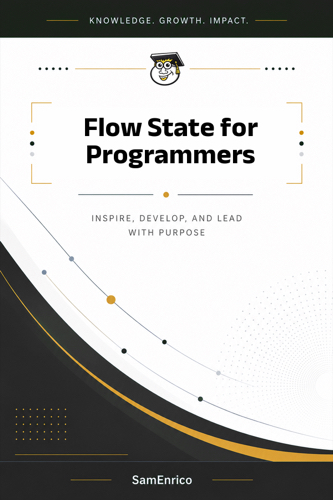
Flow State for Programmers
Code for hours without fatigue using environment a
Code for hours without fatigue using environment and mindset optimizations.
Formats
About this book
Free sample
Chapter 1: The 23-Minute Tax--The screen glows. Your fingers hover over the keyboard. Inside your head, a recursive function unwinds perfectly—nine variables balanced like spinning plates, each dependent on the last, the solution just three keystrokes away. Then Slack chirps. Your eyes flick to the corner of the screen.
Someone has posted a GIF in #watercooler. You look away for one second. When you look back, the plates have shattered. The variables scatter. The recursive chain dissolves into fog.
You stare at the cursor blinking on line 47 and think: What was I doing?This is not a failure of willpower. It is not a sign that you lack discipline or that you are not a "real" programmer. It is cognitive physics. Every interruption, no matter how small, burns a measurable amount of your brain's limited fuel. And the recovery time is far longer than anyone admits.The Myth of the Uninterrupted Hour Most developers believe they can multitask.
They believe that a quick glance at a notification, a two-minute reply to a message, or a thirty-second context switch to check Jira costs them nothing more than those thirty seconds. This belief is demonstrably, provably false.The human brain does not switch contexts like a computer. A computer can pause one process, save its state to memory, load another process, and later reload the first process exactly where it left off, all in milliseconds. Your brain cannot do this. When you switch from coding to Slack and back, you are not pausing and resuming.
You are destroying one cognitive state and rebuilding another from scratch.Consider what happens inside your head when you are deep in code. You are holding a mental model of the system: which functions call which, which variables carry what state, which edge cases remain unhandled. This mental model is not stored as a neat file on a hard drive. It is a fragile web of activated neurons, held together by a continuous stream of attention. Interrupt that attention for even a few seconds, and the web begins to collapse.
The neurons that were firing in synchrony drift apart. The associations that felt obvious become opaque.This is why you can…
This is the end of the free sample. Get the eBook to keep going. Buy now
Contents
- Chapter 1
- Chapter 2
- Chapter 3
- Chapter 4
- Chapter 5
- Chapter 6
- Chapter 7
- Chapter 8
- Chapter 9
- Chapter 10
- Chapter 11
- Chapter 12
Details
- Author
- Hogg Germaine
- Publisher
- SamEnrico
- Language
- English
- Genre
- Non-Fiction, Self-Help, Coding
- Released
- 2026-06-10
- Pages (approx.)
- 124
- Available as
- eBook, Audiobook

Read better in the ZLOADR app
Your eBooks on your phone or tablet. Sign in with your SamEnrico account and start reading.
More by Hogg Germaine
 Construction Startup PlanHogg Germaine$11.99
 Gambling Addiction and DivorceHogg Germaine$11.99
 Financial Stress Coping WorkbookHogg Germaine$11.99
 The Angel Maker of Victorian London: The Poisonous Legacy of Sarah FreemanHogg Germaine$11.99
 How to Start a Box Pallet Business (Beginners Guide)Hogg Germaine$11.99
 Montessori In Home EducatorHogg Germaine$11.99
 Mentoring Success StoriesHogg Germaine$12.99Mentoring Success StoriesHogg Germaine$12.99Mentoring Success StoriesHogg Germaine$12.99Mentoring Success StoriesHogg Germaine$12.99
 Learn to Play the OctobassHogg Germaine$11.99