
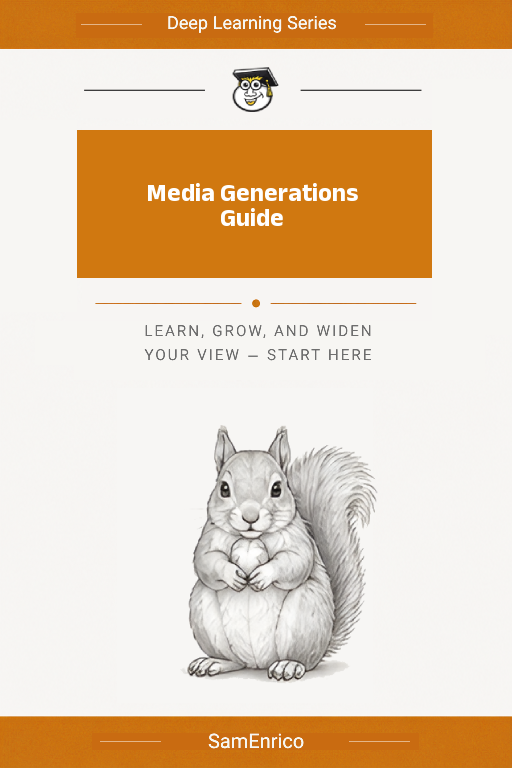
Non-FictionConsumer Mind ReportMedia Behavior
Media Generations Guide eBook
Analyze broadcast vs streaming, linear TV vs on-de
Analyze broadcast vs streaming, linear TV vs on-demand, news sources, and podcast listening habits.
Formats
Free sample
Chapter 1: The Schedule’s Ghost--The last genuine watercooler moment in American history might have been the 2015 Game of Thrones finale, when 8.1 million people watched the same episode at the same time and talked about it the next morning. But even that was a funeral in disguise—the death rattle of an era when a single broadcast could unite a continent in simultaneous attention.Today, a 75-year-old watching six hours of linear television and a 25-year-old watching ninety minutes of You Tube are not simply watching different shows on different screens. They are inhabiting different realities, following different rules, and placing their trust in different gods. The older viewer lives in a world of appointments, schedules, and institutional authority. The younger viewer lives in a world of algorithms, infinite choice, and peer-authenticated truth.
These two universes coexist in the same households, sometimes in the same rooms, but they rarely touch.This chapter introduces the foundational framework that will guide this entire book: Parallel Media Realities and the Active-Passive Consumption Spectrum. Understanding this framework is not an academic exercise. It is the difference between reaching your audience and shouting into a void. It is the difference between building a brand that spans generations and becoming irrelevant to everyone under thirty-five.The Funeral of the Schedule For most of broadcast history, media consumption was a shared, time-bound ritual. Families gathered at 8:00 PM for Cheers or 60 Minutes.
Appointment viewing meant that twenty million people watched the same thing at the same moment, creating what media scholars call the "watercooler moment"—a shared conversational currency that bonded coworkers, families, and strangers. The schedule was a social contract. Everyone agreed to be in the same place at the same time, and in return, everyone had something to talk about.That world is gone. It did not die in a single dramatic collapse. It was eroded, byte by byte, by the VCR, then the DVR, then Netflix, then You Tube, then Tik Tok.
Each innovation gave the viewer a little more control over when and what they watched. And with each increment of control, the shared experience frayed a little more.The data is stark. According to Ofcom's 2024 Media Nations report, the average Gen Z viewer watches content in twelve to fifteen distinct sessions per day, averaging six to eight minutes per session. The average Boomer watches in two to three sessions, averaging forty-five to ninety minutes per session. These are not different habits.
They are different species of behavior.The Boomer sits down with intention. They have decided to watch television. They turn on the set, navigate to a channel, and settle in for a duration. The Gen Z viewer never "decides to watch television." They check Tik Tok while waiting for coffee. They scroll Instagram Reels during a work break.
They put on a You Tube video while eating lunch. They open Netflix on their laptop before bed. Each session is a micro-interaction, a brief dip into a stream that never stops flowing.This fragmentation has profound consequences. The watercooler has been replaced by algorithmic micro-communities. Your Tik Tok For You Page is not my Tik Tok For You Page.
Your Netflix recommendations are not mine. Your You Tube homepage is algorithmically tailored to your exact viewing history, mood, and even the time of day. Five people can watch five completely different versions of the "same" platform and never know it.Even within the same household, media realities diverge. A father watching cable news in the living room and his daughter watching Tik Tok in her bedroom are not just in different rooms. They are in different information ecosystems with different standards of evidence, different pacing, different commercial interruptions, and different notions of who is credible.
When they come to the dinner table, they are speaking different languages.Defining the Active-Passive Consumption Spectrum To understand these parallel realities, we need a common vocabulary. This book introduces the Active-Passive Consumption Spectrum as its central organizing framework.At one end of the spectrum lies passive consumption. This is the traditional model of media engagement that dominated the twentieth century. The viewer is receptive rather than searching. They trust in curation—whether from a TV guide, a network programmer, or an anchor's authority.
Interruptions such as commercials are expected and tolerated. The experience is scheduled and linear. The viewer surrenders control to a trusted institution in exchange for predictability and shared experience.Passive consumption is not inferior. It offers something that active consumption cannot: closure. When the evening news ends at 6:30 PM, the day's information intake has a boundary.
When a drama concludes after sixty minutes, the story has a resolution. Passive consumption respects the viewer's time by telling them when to start and when to stop.At the other end of the spectrum lies active consumption. This is the dominant model for digital natives. The viewer is searching rather than receptive. They trust in discovery—algorithmic recommendations that learn their preferences.
Interruptions are tolerated only if they are brief, skippable, or disguised as content. The experience is on-demand and algorithmic. The viewer retains control, choosing exactly what to watch, when to watch it, and when to abandon it.Active consumption offers something that passive consumption cannot: personalization. The algorithm knows that you like true crime but hate courtroom drama. It knows that you prefer twenty-minute videos before bed and hour-long documentaries on weekend afternoons.
It serves you a feed that is uniquely yours.Most people do not live exclusively at one end of this spectrum. They move along it depending on context, mood, and available time. A Gen Z viewer might actively search for a specific recipe on You Tube (active mode) and then passively accept whatever the algorithm recommends next (passive mode). A Boomer might passively watch the evening news (passive mode) and then actively search for a specific movie on Netflix (active mode).The key insight—and the one that will recur throughout this book—is that different generations have different default positions on this spectrum. Boomers default to passive consumption.
Gen Z defaults to active consumption. Millennials and Gen X sit in the middle, comfortable with both but favoring one depending on the context.Parallel Media Realities: Two Worlds, One Household When a passive consumer and an active consumer share a household, they are not simply choosing different content. They are experiencing fundamentally different media realities. Let us name them.Reality One: The Scheduled Universe (Passive Default)In this reality, television is the primary screen. It is large, fixed, and shared.
It sits in the living room, the heart of the home. The viewer uses a remote control, not a touchscreen. They navigate by channel numbers, not by search bars. They know what day and time their favorite shows air. They watch commercials because commercials are the price of admission.The news comes from an anchor.
That anchor has credentials—a journalism degree, decades of experience, a professional demeanor. The viewer trusts the anchor not because they know them personally but because the institution behind them has been around for fifty years. The anchor's authority is assumed. When they say "We have confirmed," the viewer stops questioning.The schedule provides structure. Morning news tells you what…
This is the end of the free sample. Get the eBook to keep going. Buy now
About this book
Details
- Author
- Halstead Herschel
- Publisher
- SamEnrico
- Language
- English
- Genre
- Non-Fiction, Consumer Mind Report, Media Behavior
- Released
- 2026-05-29
- Pages (approx.)
- 130
- Available as
- eBook, Audiobook

Read better in the ZLOADR app
Your eBooks on your phone or tablet. Sign in with your SamEnrico account and start reading.
More by Halstead Herschel
 Chunking Legal Cases GuideHalstead Herschel$11.99
 The Memory Palace FallacyHalstead Herschel$11.99
 Secoya Ayahuasca CuracaHalstead Herschel$11.99
 Lifestyle Counseling NaturopathyHalstead Herschel$11.99
 The Prostate Hormone Therapy GuideHalstead Herschel$11.99
 The Jade Phoenix and the Celestial WeaverHalstead Herschel$11.99
 How to Become a Static BalancerHalstead Herschel$11.99
 Understanding ScleromyxedemaHalstead Herschel$17.99
 Cross Border Franchising Your Brand GuideHalstead Herschel$12.99
 Python DeveloperHalstead Herschel$11.99
You may also like
 Hong Kong Handover 1997Dunn Johnnie$11.99
 Zumba For Postnatal Recovery CourseNeal Christian$11.99
 Zumba for BeginnersLadner Nikia$11.99
 YouTube Comment Mining GuideHumes Pandora$12.99
 Worry Box MeditationCarlin Rudy$11.99
 Workplace Stress MeditationNguyen Lynn$11.99
 Workplace Stress and Sleep RepairHawley Ivory$11.99
 Workplace Perfectionism CureDelaney Jeffry$11.99
 Workplace Injustice Anger GuideWallen Isabelle$11.99
 Work Addiction and Burnout LinkGreenwood Ester$11.99
 Women in Yoga and WellnessBeattie Galina$11.99
 Women in Stand Up ComedyChun Evangeline$11.99