
Non-FictionSelf-HelpMechanical Engineering
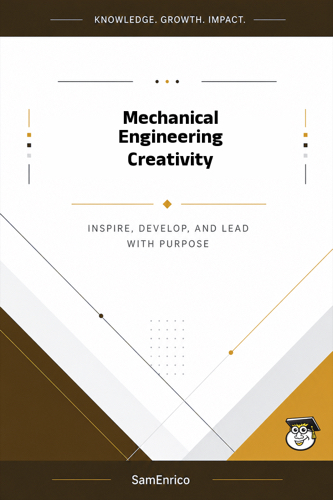
Mechanical Engineering Creativity eBook
Apply creative mechanisms and motion solutions to
by Platt Rudolf
Apply creative mechanisms and motion solutions to engineering challenges.
Formats
Free sample
Chapter 1: The Kinematic Lie--–- Every year, thousands of freshly minted mechanical engineers walk across graduation stages, diplomas in hand, believing they have been trained to invent. They have solved hundreds of textbook problems, optimized countless beam deflections, and calculated gear ratios in their sleep. They can tell you the fatigue life of a bolt under cyclic loading to three significant figures. And yet, when they enter the workforce and face a novel motion challenge—a mechanism that has never existed before, a kinematic problem with no precedent—most of them freeze. They reach for catalogs, not creativity.
They search for existing solutions to modify, rather than generating new ones from first principles. They have been trained as calculators, not as inventors. This is the Kinematic Lie: the false belief that engineering education prepares you to create novel mechanisms.The truth is more uncomfortable. Most mechanical engineering curricula emphasize analysis over synthesis. Students spend hundreds of hours learning how to prove that an existing mechanism works, but almost no time learning how to conceive a new one.
They can analyze a four-bar linkage’s velocity and acceleration profiles, but they cannot generate a six-bar linkage that produces a specific dwell motion. They can size a spring for a given load, but they cannot invent a compliant mechanism that replaces five rigid parts with one monolithic flexure. The educational system treats creativity as a mysterious byproduct of genius—something you either have or you don't—rather than a systematic discipline that can be taught, practiced, and mastered.This book exists to kill that lie.The Mythology of the Eureka Moment Let us begin by examining the most persistent and damaging myth in mechanical engineering: the Eureka moment. You have heard the stories. Archimedes leaps from his bath, shouting "Eureka!" having supposedly solved the crown problem through sudden inspiration.
Newton sees an apple fall and instantly grasps universal gravitation. James Watt watches a kettle boil and conceives the separate condenser that will power the Industrial Revolution. These stories are charming, memorable, and almost entirely fictional.The historical record tells a different story. Archimedes did not solve the crown problem in a bathtub. He spent months developing the principle of buoyancy through systematic experimentation with displaced water volumes—the bathtub story was a dramatic embellishment added centuries later.
Newton worked on planetary motion for nearly twenty years before publishing the Principia, and the apple anecdote (which he himself told only as an illustration of sustained thinking, not sudden revelation) appeared decades after the fact. James Watt spent two years of focused, frustrating work on the Newcomen engine before conceiving the separate condenser, and even then, the idea came not as a flash but as the gradual crystallization of countless failed experiments.The Eureka myth is harmful because it teaches engineers to wait for inspiration rather than to systematically generate ideas. It suggests that creativity is passive—something that happens to you—rather than an active, structured process you can initiate at will. Engineers who believe in the Eureka myth spend hours staring at whiteboards, hoping for lightning to strike. Engineers who understand creativity as a discipline spend those same hours applying systematic methods: enumerating kinematic chains, building morphological matrices, resolving contradictions with TRIZ.
One group waits. The other works. And the working group produces novel, patentable mechanisms on a predictable schedule, while the waiting group produces excuses.Redefining Engineering Creativity If creativity is not mystical inspiration, what is it? This book defines mechanical engineering creativity as the systematic generation of novel, useful kinematic structures that satisfy specified motion and force constraints. Let us unpack each component of that definition.Systematic means repeatable.
If your creativity method only works when you are well-rested, caffeinated, and under no deadline pressure, it is not a method—it is a mood. True creative methodologies produce ideas whether you feel inspired or not. They are algorithms for thinking. They can be taught to a junior engineer in an afternoon and applied in a structured way regardless of emotional state.Novel means new to the problem context. A mechanism does not have to be unprecedented in all of human history to be creative.
It only has to be new relative to the existing solution space for your specific challenge. If every other team at your company has used a slider-crank for a particular motion, and you develop a Scotch yoke that works better, that is creative—even if Scotch yokes have existed for centuries. Novelty is contextual.Useful means the mechanism actually works. Creative engineering is not art. A kinematic structure that is elegant on paper but cannot be manufactured, lubricated, or assembled is not creative—it is wasteful.
Usefulness includes manufacturability, reliability, cost-effectiveness, and maintainability. The most inventive mechanism ever conceived is worthless if it requires a CNC machine that does not exist or a lubricant that decomposes at operating temperature.Kinematic structures are the subject of this book: the arrangement of links and joints that produces motion. This book is not about materials science, thermodynamics, or fluid dynamics. It is about the geometry of motion. If your problem involves heat transfer or pressure drop, put this book down and pick up another.
But if your problem involves getting something to move in a desired way—to translate, rotate, reciprocate, or dwell—you are in the right place.Finally, motion and force constraints are the boundaries within which creativity operates. Many engineers mistakenly believe that constraints inhibit creativity. The opposite is true. Constraints focus creativity. A blank page is paralyzing.
A page with a clear set of requirements—"the output link must dwell for 30 degrees of input rotation while withstanding 500 Newtons of force"—gives the creative mind something to push against. The most creative mechanisms in history emerged not from unlimited freedom but from severe constraints: the Wright brothers' need for wing warping with limited materials, Tesla's need for an AC motor without sliding electrical contacts, the Apollo engineers' need for a docking mechanism that worked in vacuum without human hands. Constraints are not the enemy of creativity. They are its engine.From Parts to Motion: The Fundamental Shift The single most important cognitive shift this book will teach you is this: stop seeing machines as collections of parts and start seeing them as systems of motion.Most engineers, especially early in their careers, look at a mechanism and see components. They see gears and shafts.
They see bearings and fasteners. They see housings and seals. This is natural—these are the tangible objects you touch, specify, and order from suppliers. But this parts-centric view is a trap. It anchors you to existing solutions.
When you see a gear, you think "a gear is how you transmit torque." When you see a bearing, you think "a bearing is how you support a rotating shaft." These associations become mental ruts that are difficult to escape.The motion-centric view is different. When you look at a mechanism, you see trajectories, velocities, accelerations, and force vectors. You see a linkage rotating about a fixed pivot, a slider translating along a guided path, a cam imposing a specific displacement profile on a follower. The parts are merely the physical implementation of these motion…
This is the end of the free sample. Get the eBook to keep going. Buy now
About this book
Details
- Author
- Platt Rudolf
- Publisher
- SamEnrico
- Language
- English
- Genre
- Non-Fiction, Self-Help, Mechanical Engineering
- Released
- 2026-06-09
- Pages (approx.)
- 158
- Available as
- eBook, Audiobook

Read better in the ZLOADR app
Your eBooks on your phone or tablet. Sign in with your SamEnrico account and start reading.
More by Platt Rudolf
 The France Follow Up EtiquettePlatt Rudolf$11.99
 Administrative Burden Anger GuidePlatt Rudolf$11.99
 Creating a Relapse Prevention ToolboxPlatt Rudolf$11.99
 Even A Penny Helps TechniquePlatt Rudolf$11.99
 The Lioness of Sheba: The Queen Who Shaped a KingdomPlatt Rudolf$11.99
 Understanding Trisomy 6Platt Rudolf$17.99
 How to Become a Pipe-smoker-machine OperatorPlatt Rudolf$11.99
 African Hardware YC GuidePlatt Rudolf$12.99
 Cross-Border VAT Recovery GuidePlatt Rudolf$12.99
 Commission AnalystPlatt Rudolf$11.99
You may also like
 Hong Kong Handover 1997Dunn Johnnie$11.99
 Zumba For Postnatal Recovery CourseNeal Christian$11.99
 Zumba for BeginnersLadner Nikia$11.99
 YouTube Comment Mining GuideHumes Pandora$12.99
 Worry Box MeditationCarlin Rudy$11.99
 Workplace Stress MeditationNguyen Lynn$11.99
 Workplace Stress and Sleep RepairHawley Ivory$11.99
 Workplace Perfectionism CureDelaney Jeffry$11.99
 Workplace Injustice Anger GuideWallen Isabelle$11.99
 Work Addiction and Burnout LinkGreenwood Ester$11.99
 Women in Yoga and WellnessBeattie Galina$11.99
 Women in Stand Up ComedyChun Evangeline$11.99