
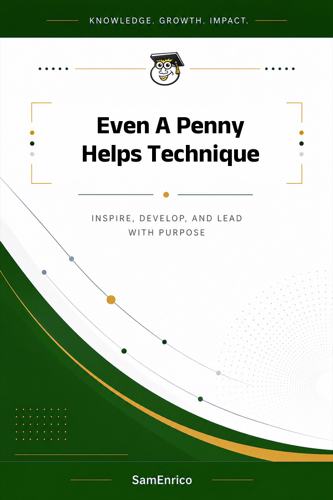
Non-FictionSelf-HelpFundraising Psychology
Even A Penny Helps Technique
Small requests overcome initial resistance to givi
by Platt Rudolf
Small requests overcome initial resistance to giving.
Formats
About this book
Free sample
Chapter 1: The Asymmetry of Yes--–- The rejection came before noon. Not the dramatic kind, with slammed doors or raised voices. The quiet kind. The polite "no, thank you" that closes a conversation like a door clicking shut. The fundraiser on the porch had asked for twenty dollars.
The homeowner had twenty dollars. She had given twenty dollars to three other charities that month. But something about the request—the weight of it, the implied judgment, the unspoken question of how much is enough—made her say no.That moment, repeated millions of times every day, is the central puzzle of persuasion. Why do people who have the resources, the inclination, and even the history of giving say no to requests they might otherwise say yes to? The answer is not about stinginess.
It is not about apathy. It is about a fundamental asymmetry in how the human mind evaluates requests—an asymmetry that, once understood, can be completely reversed with a single, almost absurdly simple phrase.The Two Doors Problem Imagine standing before two doors. Behind the first door is a request so small it barely registers: "Would you be willing to sign this petition?" Behind the second door is a request of meaningful size: "Would you be willing to donate twenty dollars to support our cause?" Most people, asked to choose which door they would prefer to open, would choose the first. The small request feels safe. It costs nothing in resources and little in mental energy.
The large request feels risky. It requires calculation, comparison, and the courage to potentially seem inadequate if the contribution is judged as too small.This is the dilemma that every persuader faces. The small request reliably produces compliance, but the compliance itself seems trivial. A signature on a petition does not fund a program. A click on a link does not build a school.
The large request produces meaningful outcomes, but it reliably produces rejection. The fundraiser who asks for twenty dollars hears "no" far more often than "yes." The salesperson who asks for the full price upfront loses most prospects…
This is the end of the free sample. Get the eBook to keep going. Buy now
Contents
- Chapter 1
- Chapter 2
- Chapter 3
- Chapter 4
- Chapter 5
- Chapter 6
- Chapter 7
- Chapter 8
- Chapter 9
- Chapter 10
- Chapter 11
- Chapter 12
Details
- Author
- Platt Rudolf
- Publisher
- SamEnrico
- Language
- English
- Genre
- Non-Fiction, Self-Help, Fundraising Psychology
- Released
- 2026-06-06
- Pages (approx.)
- 151
- Available as
- eBook, Audiobook

Read better in the ZLOADR app
Your eBooks on your phone or tablet. Sign in with your SamEnrico account and start reading.
More by Platt Rudolf
 Mechanical Engineering CreativityPlatt Rudolf$11.99
 The France Follow Up EtiquettePlatt Rudolf$11.99
 Administrative Burden Anger GuidePlatt Rudolf$11.99
 Creating a Relapse Prevention ToolboxPlatt Rudolf$11.99
 The Lioness of Sheba: The Queen Who Shaped a KingdomPlatt Rudolf$11.99
 Understanding Trisomy 6Platt Rudolf$17.99
 How to Become a Pipe-smoker-machine OperatorPlatt Rudolf$11.99
 African Hardware YC GuidePlatt Rudolf$12.99
 Cross-Border VAT Recovery GuidePlatt Rudolf$12.99
 Commission AnalystPlatt Rudolf$11.99
You may also like
 Hong Kong Handover 1997Dunn Johnnie$11.99
 Zumba For Postnatal Recovery CourseNeal Christian$11.99
 Zumba for BeginnersLadner Nikia$11.99
 YouTube Comment Mining GuideHumes Pandora$12.99
 Worry Box MeditationCarlin Rudy$11.99
 Workplace Stress MeditationNguyen Lynn$11.99
 Workplace Stress and Sleep RepairHawley Ivory$11.99
 Workplace Perfectionism CureDelaney Jeffry$11.99
 Workplace Injustice Anger GuideWallen Isabelle$11.99
 Work Addiction and Burnout LinkGreenwood Ester$11.99
 Women in Yoga and WellnessBeattie Galina$11.99
 Women in Stand Up ComedyChun Evangeline$11.99