
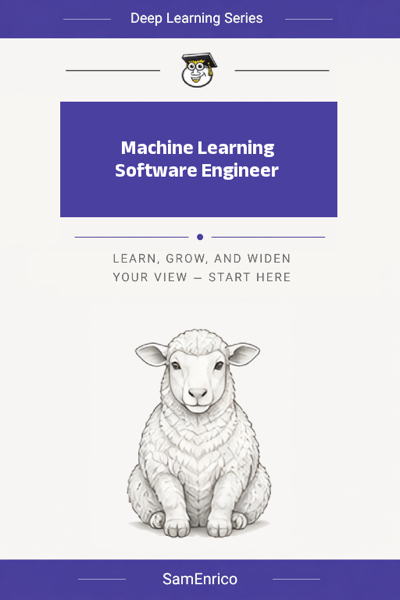
Machine Learning Software Engineer eBook
A Coursebook on Machine Learning Software Engineer
by Slocum Jona
A Coursebook on Machine Learning Software Engineer
Formats
Free sample
Chapter 1: The Probabilistic Trap...--The first time your model fails in production, it won't throw an exception. No stack trace. No red error message. No crash. It will simply start making worse predictions, slowly, quietly, while everyone continues believing everything is fine.
A dashboard will show green health checks. Logs will show 200 OK responses. Your manager will say "latency looks good." And yet, somewhere in the pipeline, the world has changed, and your model hasn't noticed.This is the fundamental difference between traditional software engineering and machine learning engineering. In traditional software, when something breaks, you know. The program crashes.
Tests fail. A null pointer exception screams for attention. In machine learning, when something breaks, the program keeps running. It happily produces wrong answers with high confidence. The failure is silent, gradual, and statistically invisible until someone notices that business metrics have quietly declined over the past three weeks.Welcome to the probabilistic trap.The Myth of "ML is Just Software"Let me be direct with you.
If you come to this book from a traditional software engineering background, you have been trained to think in certain ways. You think in if statements, for loops, and deterministic functions. You expect that add(2, 2) will always return 4. You expect that get_user(id) will either return a user or throw a User Not Found Exception. You expect that your unit tests, once passed, guarantee something about the system's behavior.Machine learning shatters every single one of those expectations.A trained model is not a function in the mathematical sense of "same input equals same output." A model produces a distribution of possible outputs.
Feed the same image to a computer vision model twice, and you might get the same classification both times—but the confidence scores might shift slightly due to non-determinism in GPU operations. Feed the same customer data to a fraud detection model, and today's prediction might differ from yesterday's because the model has been retrained, or because a feature pipeline changed, or because the statistical relationship between inputs and outputs has drifted.This non-determinism is not a bug. It is the entire point. We use machine learning precisely because the world is probabilistic, because the relationship between inputs and outputs is not a simple mathematical formula, because we want systems that can handle ambiguity and uncertainty.But this probabilistic nature creates a trap that catches almost every team that builds their first production ML system.Let me tell you about a real company. I'll call them Retail Recommends.
They had a team of brilliant data scientists who built a recommendation engine that increased click-through rates by 40% in offline validation. The CEO was thrilled. The engineering team containerized the model, deployed it on Kubernetes, set up monitoring for CPU and memory, and celebrated.Three weeks later, the product manager noticed that click-through rates had returned to baseline. Not below baseline. Just...
baseline. The model was still running. The servers were healthy. The API responded in 50 milliseconds. No one had changed any code.What happened?The model was trained on user behavior from desktop web browsers.
But in those three weeks, Retail Recommends launched a mobile app. Mobile users behaved differently. They scrolled faster, clicked on different types of products, and had shorter session lengths. The input distribution shifted. The model was now making predictions for a distribution it had never seen during training.
It wasn't "wrong" in any obvious way—it just wasn't as right as it used to be.No exception was thrown. No alert fired. The model just silently degraded.This is the probabilistic trap. You build a model that works perfectly in the artificial world of your test set, deploy it to the real world, and then the real world changes. Or your data pipeline changes.
Or your feature definitions change. The model keeps running, keeps returning predictions, keeps looking successful on infrastructure dashboards—while quietly failing at the only thing that matters: delivering value.What This Chapter Will Teach You By the end of this chapter, you will understand why ML engineering is fundamentally different from traditional software engineering, and you will never again assume that "if it works in the notebook, it'll work in production."Specifically, you will learn:The three types of hidden technical debt that plague ML systems and why they're invisible to traditional testing Why configuration management is exponentially harder in ML than in traditional software The feedback loop problem: how your model's predictions change the data it trains on, creating dangerous self-reinforcing cycles A framework for distinguishing between "code changes" and "world changes" as two distinct sources of system failure The five signs that your ML system is about to fail silently (and what to do about each)But most importantly, you will internalize the single most important principle in this entire book: In production, your model is not the star. It is a small, fragile component of a larger system, and that system is only as reliable as its weakest data dependency.Let me explain what that means.Traditional Code vs. ML Code: A Side-by-Side Comparison To understand why ML systems fail differently, we need to compare them directly to traditional systems.A traditional function looks like this:text Copy Downloaddef calculate_discount(customer_id, order_total): customer = database.get_customer(customer_id) if customer.is_premium: return order_total * 0.2 else: return order_total * 0.05This function is deterministic. Given the same customer_id and order_total, it will always return the same value, assuming the database doesn't change.
If the database does change, that's an explicit external dependency. You know it's there. You can mock it in tests.An ML inference function looks like this:text Copy Downloaddef predict_fraud(transaction): features = feature_store.get_features(transaction.user_id) probability = model.predict(features) return probability > 0.5Where is the non-determinism? It's everywhere.First, feature_store.get_features() might return different values today than yesterday because the feature definitions changed, or because the underlying source data was updated, or because a downstream ETL job ran late. Second, model.predict() might be non-deterministic depending on the framework and hardware (GPU operations on floating point numbers are not perfectly reproducible).
Third, the threshold 0.5 might be wrong for today's fraud patterns even though it was optimal during training.The difference is not just technical. It's philosophical.Traditional software treats the world as something to be read and written. ML treats the world as something to be predicted, and the world is always changing.The Three Types of Hidden Technical Debt In traditional software engineering, technical debt is visible. You see a tangled dependency graph. You see duplicated code.
You see a missing test. You can measure it with tools like Sonar Qube or Code Climate.In ML systems, the most dangerous technical debt is invisible. It hides in your data, your assumptions, and your feedback loops.Let me walk you through the three types.Type 1: Data Dependencies That Change Without Warning Your model depends on data. That data comes from somewhere. In a typical production ML system, that "somewhere" might be:A database table maintained by another team A Kafka topic populated by a streaming job An API endpoint owned by a third-party vendor A CSV file manually…
This is the end of the free sample. Get the eBook to keep going. Buy now
About this book
Details
- Author
- Slocum Jona
- Publisher
- SamEnrico
- Language
- English
- Genre
- Non-Fiction, Informative, Educational
- Released
- 2026-05-08
- Pages (approx.)
- 138
- Available as
- eBook, Audiobook

Read better in the ZLOADR app
Your eBooks on your phone or tablet. Sign in with your SamEnrico account and start reading.
More by Slocum Jona
 Shift Work Exercise Timing GuideSlocum Jona$11.99
 Self Esteem for Introverts WorkbookSlocum Jona$11.99
 Leading Hybrid Operations TeamsSlocum Jona$11.99
 Decluttering for Downsize ProfitSlocum Jona$11.99
 Gaslighting Recovery Self EsteemSlocum Jona$11.99
 The Sapphire Serpent: A Heist of Myth and MayhemSlocum Jona$11.99
 The Great London Zoo Panic of 1962: When Lions Roamed Regent’s ParkSlocum Jona$11.99
 Remote LinkedIn CoachSlocum Jona$12.99
 Mentoring Non Verbal DifferencesSlocum Jona$12.99
 Understanding Erythrokeratodermia AtaxiaSlocum Jona$17.99
 How to Become a Mop-handle AssemblerSlocum Jona$11.99