
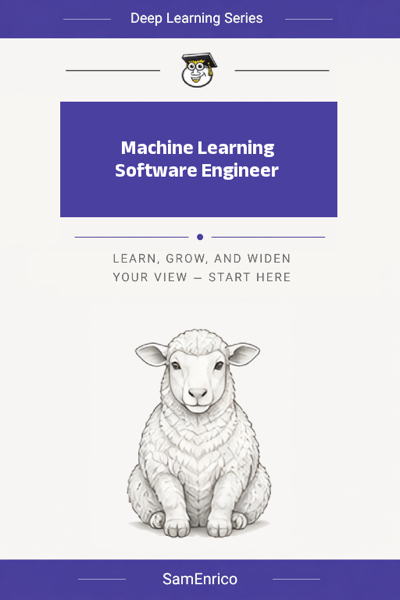
Machine Learning Software Engineer
A Coursebook on Machine Learning Software Engineer
by Slocum Jona
A Coursebook on Machine Learning Software Engineer
Formats
About this book
Free sample
Chapter 1: The Probabilistic Trap...--The first time your model fails in production, it won't throw an exception. No stack trace. No red error message. No crash. It will simply start making worse predictions, slowly, quietly, while everyone continues believing everything is fine.
A dashboard will show green health checks. Logs will show 200 OK responses. Your manager will say "latency looks good." And yet, somewhere in the pipeline, the world has changed, and your model hasn't noticed.This is the fundamental difference between traditional software engineering and machine learning engineering. In traditional software, when something breaks, you know. The program crashes.
Tests fail. A null pointer exception screams for attention. In machine learning, when something breaks, the program keeps running. It happily produces wrong answers with high confidence. The failure is silent, gradual, and statistically invisible until someone notices that business metrics have quietly declined over the past three weeks.Welcome to the probabilistic trap.The Myth of "ML is Just Software"Let me be direct with you.
If you come to this book from a traditional software engineering background, you have been trained to think in certain ways. You think in if statements, for loops, and deterministic functions. You expect that add(2, 2) will always return 4. You expect that get_user(id) will either return a user or throw a User Not Found Exception. You expect that your unit tests, once passed, guarantee something about the system's behavior.Machine learning shatters every single one of those expectations.A trained model is not a function in the mathematical sense of "same input equals same output." A model produces a distribution of possible outputs.
Feed the same image to a computer vision model twice, and you might get the same classification both times—but the confidence scores might shift slightly due to non-determinism in GPU operations. Feed the same customer data to a fraud detection model, and today's prediction might differ from yesterday's because the model has been retrained, or because a feature pipeline changed, or because the statistical relationship between inputs and outputs has drifted.This non-determinism is not a bug. It is the…
This is the end of the free sample. Get the eBook to keep going. Buy now
Contents
- Chapter 1
- Chapter 2
- Chapter 3
- Chapter 4
- Chapter 5
- Chapter 6
- Chapter 7
- Chapter 8
- Chapter 9
- Chapter 10
- Chapter 11
- Chapter 12
Details
- Author
- Slocum Jona
- Publisher
- SamEnrico
- Language
- English
- Genre
- Non-Fiction, Informative, Educational
- Released
- 2026-05-08
- Pages (approx.)
- 138
- Available as
- eBook, Audiobook

Read better in the ZLOADR app
Your eBooks on your phone or tablet. Sign in with your SamEnrico account and start reading.
More by Slocum Jona
 Shift Work Exercise Timing GuideSlocum Jona$11.99
 Self Esteem for Introverts WorkbookSlocum Jona$11.99
 Leading Hybrid Operations TeamsSlocum Jona$11.99
 Decluttering for Downsize ProfitSlocum Jona$11.99
 Gaslighting Recovery Self EsteemSlocum Jona$11.99
 The Sapphire Serpent: A Heist of Myth and MayhemSlocum Jona$11.99
 The Great London Zoo Panic of 1962: When Lions Roamed Regent’s ParkSlocum Jona$11.99
 Remote LinkedIn CoachSlocum Jona$12.99
 Mentoring Non Verbal DifferencesSlocum Jona$12.99
 Understanding Erythrokeratodermia AtaxiaSlocum Jona$17.99
 How to Become a Mop-handle AssemblerSlocum Jona$11.99