
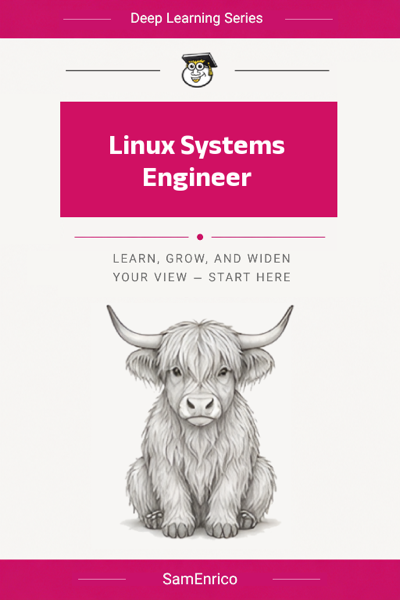
Non-FictionInformativeEducational
Linux Systems Engineer eBook
A Coursebook on Linux Systems Engineer
A Coursebook on Linux Systems Engineer
Formats
Free sample
Chapter 1: The 2:47 A.M. Epiphany...--The pager screams at 2:47 on a Tuesday morning. Your phone, set to "do not disturb" for everyone except the on-call routing system, vibrates across the nightstand with the specific arrhythmia of a critical alert. Thirty-four of forty-two API gateway nodes are returning HTTP 503s. The chat room, which you left quiet at midnight, now scrolls with the digital equivalent of screaming. Three junior engineers have already proposed six different fixes. One is restarting Nginx across the fleet. Another has opened a terminal and is grepping logs on a single node, convinced it's a memory leak. A third is arguing for a full rollback of the deployment from six hours ago.You've been here before. You will be here again. But in this moment, as you rub sleep from your eyes and open your laptop, you face a choice that defines your entire career. Are you going to SSH into those broken servers and start typing commands until things work? Or are you going to step back, look at the system as a whole, and apply engineering discipline to chaos?This book exists because too many Linux administrators never learn to make the second choice. They spend years becoming experts at typing the right incantations at the right moments. They can debug a kernel panic from memory. They know every flag to netstat and every column in /proc/meminfo. And yet they burn out, because they are fighting fires in a forest they set on fire themselves.The 2:47 a.m. epiphany is this: You are not being paid to run commands. You are being paid to design systems that do not need you at 2:47 a.m.Everything in this book flows from that realization. The kernel internals in Chapter 2. The storage stacks in Chapter 3. The shell mastery in Chapter 4. The security hardening in Chapters 6 and 7. Every line of code, every configuration file, every architecture decision points toward the same goal: systems that are predictable, recoverable, and ultimately boring.Boring is good. Boring means you sleep through the night.The Lie of the Disposable Command Let me tell you a story about a server I once inherited. It had been running for 1,247 days. Its hostname was "web01-prod." Its root filesystem was at 94 percent capacity. It had 847 unique packages installed, including three different versions of Open SSL, two competing init systems, and a custom kernel module compiled by a developer who had left the company six years earlier.No one knew what this server actually did. It served some web traffic, maybe. It also ran a cron job that emailed spreadsheets to an address that no longer existed. It had SSH keys for four different administrators, two of whom had also left the company. Its backup system had failed quietly, 412 days ago.This server was not a failure of technology. It was a failure of philosophy. Every administrator who touched it over nearly four years had treated it as a collection of disposable commands. They ran apt install here, sed -i there, systemctl restart whenever something stopped working. Each command seemed harmless in isolation. Each command was the right thing to do at that moment.But systems are not the sum of their commands. Systems are the product of their history. And the history of that server was a tragedy of good intentions.The alternative is to understand Linux as a coherent stack of primitives that interact in predictable, deterministic ways. Not a pile of tools. Not a collection of arcane commands. A stack. Like the OSI model for networking, but for the operating system itself.The Six Primitives of Coherent Linux Every Linux system, from a Raspberry Pi to a 128-core mainframe, is built from exactly six fundamental abstractions. Master these, and you master Linux. Ignore them, and you will always be running commands without understanding why.Primitive One: Processes. Every running program is a process. Processes have process IDs (PIDs), parent processes, file descriptors, environment variables, and address spaces. Processes can create other processes using the fork() system call, which creates an almost identical copy of the calling process. They can transform into other programs using exec(), which replaces a process's memory with a new program. The kernel's scheduler decides which process runs on which CPU core at any given moment, using algorithms like the Completely Fair Scheduler (CFS) for most workloads and real-time scheduling for latency-sensitive applications.Primitive Two: Files. Everything is a file. Not just documents and images, but directories, devices (/dev/sda), process information (/proc/$$/status), system settings (/sys/block/sda/queue/scheduler), sockets, and pipes. The Virtual File System (VFS) layer abstracts away the differences between ext4, XFS, Btrfs, tmpfs, and network filesystems like NFS. When you understand that opening /proc/self/fd/0 is just opening a file, you begin to see the elegance hiding beneath Linux's complexity.Primitive Three: Memory. Virtual memory, not physical. Each process has its own address space, isolated from every other process. The kernel maps physical RAM pages to virtual addresses, manages page tables, handles page faults, swaps pages to disk when memory runs low, and ultimately kills processes using the Out-Of-Memory (OOM) killer when no other options remain. The OOM killer is not a bug or a random event—it is a deterministic system that scores processes based on their memory usage, runtime, and oom_score_adj values. You can predict which process will die. You can control it.Primitive Four: Sockets and Networking. Communication between processes, whether on the same machine or across the planet, happens through sockets. TCP sockets provide reliable, ordered streams. UDP sockets provide datagrams. Unix domain sockets provide high-performance local communication. The socket(), bind(), listen(), accept(), connect(), send(), and recv() system calls are the entire API for network programming. Everything else—HTTP, database protocols, SSH, NFS—is just bytes sent and received through sockets.Primitive Five: Namespaces. Isolated views of system resources. PID namespaces make processes inside see only their own process tree, hiding host processes. Network namespaces provide complete isolation of network interfaces, routes, and firewall rules, as if each namespace had its own network stack. Mount namespaces isolate filesystem mount points. User namespaces isolate user and group IDs. These are not abstract curiosities—they are the building blocks of containers. Every Docker container, every LXC instance, every systemd-nspawn container is a carefully orchestrated set of namespaces.Primitive Six: Cgroups. Resource constraints, not isolation. Control groups (cgroups) limit how many CPU cycles a group of processes can consume, how much memory they can allocate, how fast they can read and write to disk, and how much network bandwidth they can use. Cgroups v2, the modern version, presents a unified hierarchy where every process belongs to exactly one cgroup. When you set memory limits on a container, you are writing values to files in /sys/fs/cgroup/. When you cap CPU usage, you are writing to other files. That is all cgroups are: files that control the kernel's resource allocation.Every command you type, every service you deploy, every container you run is a combination and orchestration of these six primitives. The Bash shell is a program that creates processes using fork() and exec(). Systemd is a process manager that organizes processes into cgroups and namespaces. Docker is a tool that creates namespaces and cgroups, then calls runc to execute processes inside them.When you understand this…
This is the end of the free sample. Get the eBook to keep going. Buy now
About this book
Details
- Author
- Donnelly Frankie
- Publisher
- SamEnrico
- Language
- English
- Genre
- Non-Fiction, Informative, Educational
- Released
- 2026-05-09
- Pages (approx.)
- 152
- Available as
- eBook, Audiobook

Read better in the ZLOADR app
Your eBooks on your phone or tablet. Sign in with your SamEnrico account and start reading.
More by Donnelly Frankie
 Mental Health During Job Loss GuideDonnelly Frankie$11.99
 Chunking Study Information GuideDonnelly Frankie$11.99
 Recovery Rituals For ProfessionalsDonnelly Frankie$11.99
 Amber Frey Book ComparisonDonnelly Frankie$11.99
 Fiverr Buyer Persona PrimerDonnelly Frankie$11.99
 UK VAT Registration Backdating Rules ManualDonnelly Frankie$11.99
 Journaling for Couple StressDonnelly Frankie$11.99
 Citation Rules Active Recall WorkbookDonnelly Frankie$11.99
 Resentment Journal MethodDonnelly Frankie$11.99
 Operation Quantum Dawn: The Forgotten Architects of Atomic ScienceDonnelly Frankie$11.99
 Icebound Innovators: The Robots That Conquered AntarcticaDonnelly Frankie$11.99
 The Great Escape: How a 12-Year-Old Outsmarted the NazisDonnelly Frankie$11.99
You may also like
 Hong Kong Handover 1997Dunn Johnnie$11.99
 Zumba For Postnatal Recovery CourseNeal Christian$11.99
 Zumba for BeginnersLadner Nikia$11.99
 YouTube Comment Mining GuideHumes Pandora$12.99
 Worry Box MeditationCarlin Rudy$11.99
 Workplace Stress MeditationNguyen Lynn$11.99
 Workplace Stress and Sleep RepairHawley Ivory$11.99
 Workplace Perfectionism CureDelaney Jeffry$11.99
 Workplace Injustice Anger GuideWallen Isabelle$11.99
 Work Addiction and Burnout LinkGreenwood Ester$11.99
 Women in Yoga and WellnessBeattie Galina$11.99
 Women in Stand Up ComedyChun Evangeline$11.99