
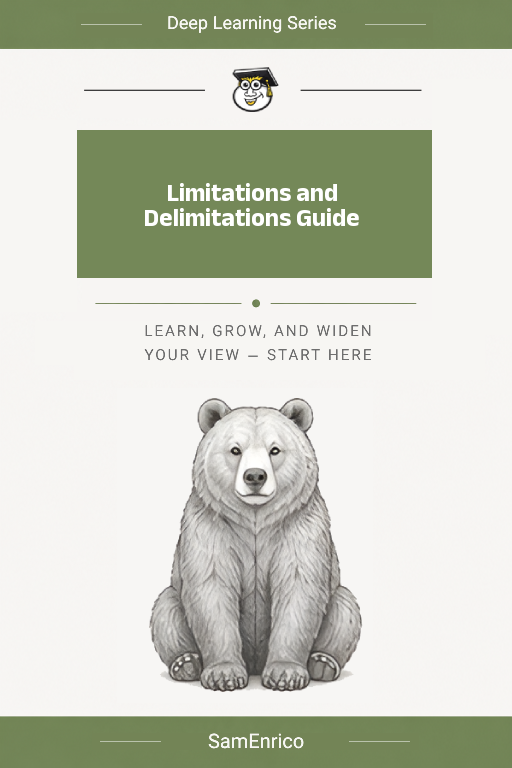
Non-FictionStudent's ShortcutCritical Thinking
Limitations and Delimitations Guide
Honestly address research constraints in grad prop
Honestly address research constraints in grad proposals without undermining credibility. Distinguish limitations from delimitations and show methodological awareness.
Formats
About this book
Free sample
Chapter 1: The Perfectionism Trap--–- Dr. Elena Vasquez had spent six months writing her dissertation proposal. She had run the pilot study twice, revised her literature review four times, and memorized every citation in her 147 references. When she finally submitted the 89-page document to her committee, she felt something she had not felt in years: pride.Three weeks later, the rejection arrived.The committee chair’s comments were brief but devastating. “The proposal is well-written and the research question is interesting,” the letter began—the academic equivalent of “I’m not racist, but…” Then came the kill shot: “However, the candidate does not seem to understand the boundaries of her own method.
The limitations section is missing entirely, and the delimitations are stated as if they were regrets rather than choices. We cannot approve a proposal from a researcher who does not know what she does not know.”Elena cried for three days. Then she got angry. Then she got curious. She pulled up the top five funded dissertations in her department over the past three years.
Every single one had a limitations section. Every single one acknowledged constraints—sometimes serious ones. One study had a response rate of 12 percent. Another had a sample of only eight participants. Another acknowledged that the primary instrument had known reliability issues.
And yet all three were approved, and all three authors had graduated.Elena’s proposal had claimed, in essence, that her methods were perfect. She had written, “This study has no significant limitations.” She thought this made her look competent. Instead, it made her look like someone who had never read a real research paper.This book exists because Elena’s story happens every day in graduate programs across the world. And it happens for a predictable reason: graduate students are taught that research is about finding the right answer, that proposals are about convincing reviewers you are right, and that admitting weakness is the same as losing. All three beliefs are wrong.
And all three will get your proposal rejected.This chapter will show you why perfectionism is the fastest path to rejection…
This is the end of the free sample. Get the eBook to keep going. Buy now
Contents
- Chapter 1
- Chapter 2
- Chapter 3
- Chapter 4
- Chapter 5
- Chapter 6
- Chapter 7
- Chapter 8
- Chapter 9
- Chapter 10
- Chapter 11
- Chapter 12
Details
- Author
- Kowalski Eugenie
- Publisher
- SamEnrico
- Language
- English
- Genre
- Non-Fiction, Student's Shortcut, Critical Thinking
- Released
- 2026-06-01
- Pages (approx.)
- 159
- Available as
- eBook, Audiobook

Read better in the ZLOADR app
Your eBooks on your phone or tablet. Sign in with your SamEnrico account and start reading.
More by Kowalski Eugenie
 London Economics Online Degree GuideKowalski Eugenie$11.99
 The Indoor Air GuideKowalski Eugenie$11.99
 Nonverbal in Dating GuideKowalski Eugenie$11.99
 Burnout Prevention for PilotsKowalski Eugenie$11.99
 The Baghdad Gold Heist: The Prohibition-Era Robbery That Shaped a NationKowalski Eugenie$11.99
 Production WorkerKowalski Eugenie$11.99
 How to Produce Bicycle Cleat BoltsKowalski Eugenie$11.99
 How to Become a Still-pump OperatorKowalski Eugenie$11.99
You may also like
 Hong Kong Handover 1997Dunn Johnnie$11.99
 Zumba For Postnatal Recovery CourseNeal Christian$11.99
 Zumba for BeginnersLadner Nikia$11.99
 YouTube Comment Mining GuideHumes Pandora$12.99
 Worry Box MeditationCarlin Rudy$11.99
 Workplace Stress MeditationNguyen Lynn$11.99
 Workplace Stress and Sleep RepairHawley Ivory$11.99
 Workplace Perfectionism CureDelaney Jeffry$11.99
 Workplace Injustice Anger GuideWallen Isabelle$11.99
 Work Addiction and Burnout LinkGreenwood Ester$11.99
 Women in Yoga and WellnessBeattie Galina$11.99
 Women in Stand Up ComedyChun Evangeline$11.99