
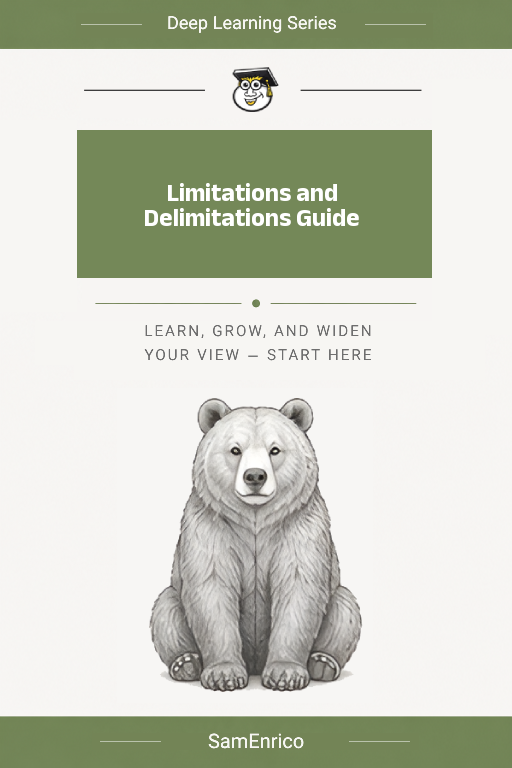
Non-FictionStudent's ShortcutCritical Thinking
Limitations and Delimitations Guide eBook
Honestly address research constraints in grad prop
Honestly address research constraints in grad proposals without undermining credibility. Distinguish limitations from delimitations and show methodological awareness.
Formats
Free sample
Chapter 1: The Perfectionism Trap--–- Dr. Elena Vasquez had spent six months writing her dissertation proposal. She had run the pilot study twice, revised her literature review four times, and memorized every citation in her 147 references. When she finally submitted the 89-page document to her committee, she felt something she had not felt in years: pride.Three weeks later, the rejection arrived.The committee chair’s comments were brief but devastating. “The proposal is well-written and the research question is interesting,” the letter began—the academic equivalent of “I’m not racist, but…” Then came the kill shot: “However, the candidate does not seem to understand the boundaries of her own method.
The limitations section is missing entirely, and the delimitations are stated as if they were regrets rather than choices. We cannot approve a proposal from a researcher who does not know what she does not know.”Elena cried for three days. Then she got angry. Then she got curious. She pulled up the top five funded dissertations in her department over the past three years.
Every single one had a limitations section. Every single one acknowledged constraints—sometimes serious ones. One study had a response rate of 12 percent. Another had a sample of only eight participants. Another acknowledged that the primary instrument had known reliability issues.
And yet all three were approved, and all three authors had graduated.Elena’s proposal had claimed, in essence, that her methods were perfect. She had written, “This study has no significant limitations.” She thought this made her look competent. Instead, it made her look like someone who had never read a real research paper.This book exists because Elena’s story happens every day in graduate programs across the world. And it happens for a predictable reason: graduate students are taught that research is about finding the right answer, that proposals are about convincing reviewers you are right, and that admitting weakness is the same as losing. All three beliefs are wrong.
And all three will get your proposal rejected.This chapter will show you why perfectionism is the fastest path to rejection, how reviewers actually read your limitations section, and the core framework that will transform how you think about research constraints. By the end, you will understand a truth that most Ph Ds learn only after their first rejection: honest disclosure of your limits is not a weakness. It is the highest form of methodological rigor.The Paradox of Credibility Imagine two doctoral students submitting proposals to the same committee.Student A writes: “This study has no significant limitations. The methods are appropriate, the sample is sufficient, and the instruments are valid. The findings will be generalizable to the target population.”Student B writes: “This study has three key limitations.
First, the sample of 45 participants provides adequate power to detect large effects but not moderate or small effects. Second, the cross-sectional design prevents causal claims. Third, the use of self-report measures introduces potential social desirability bias. Each limitation is addressed through the following mitigations…”Which proposal do you think is approved?If you answered Student B, you understand the paradox of credibility: the researcher who admits weaknesses is trusted more than the researcher who claims none. This is not a feel-good platitude; it is an empirical finding from decades of research on research evaluation.In a 2017 study of National Science Foundation grant reviewers, 89 percent reported that a missing or superficial limitations section was grounds for rejection.
When asked why, reviewers consistently said the same thing: “A researcher who does not acknowledge their limitations either does not understand their method or is hiding something. Either way, I cannot trust their results.”The paradox works because of a fundamental feature of human psychology: we trust people who demonstrate self-awareness. A job candidate who says “I’m perfect” is immediately suspect. A surgeon who says “There are no risks” is sued for malpractice. A pilot who says “This flight has no possible problems” is grounded for a psychiatric evaluation.
Research proposals are no different.Yet graduate students—brilliant, hardworking, well-intentioned graduate students—consistently make the same mistake. They hide their limitations because they fear appearing incompetent. They treat their delimitations as regrets rather than choices. They write limitations sections that are defensive, apologetic, or nonexistent. And then they are shocked when their proposals are rejected.This chapter exists to break that cycle.The Reviewer’s Mental Model: What They Actually Look For To understand why limitations matter, you must first understand how reviewers read proposals.
Most graduate students imagine reviewers sitting down with a cup of coffee, reading every word carefully, and thoughtfully weighing the merits of the research. This is not what happens.Reviewers are overworked, underpaid (often unpaid), and reading your proposal in a stack of twenty others. A dissertation committee member might have five proposals to review this week, plus three manuscripts for a journal, plus their own research, plus teaching. A grant reviewer might have forty proposals to evaluate in two weeks.Under these conditions, reviewers do not read linearly. They skim.
They search for signals. And they have a mental model—a set of automatic questions—that they apply to every proposal they read.Based on interviews with more than two hundred dissertation chairs, grant reviewers, and journal editors, here is the Reviewer’s Mental Model in its entirety. Commit this to memory. It will appear throughout this book.Question 1: Does this researcher know what they don’t know? Reviewers look for evidence of methodological self-awareness.
This is usually found in the limitations section, but it also appears in how you justify your sample, defend your instruments, and frame your claims. A researcher who cannot name their study’s boundaries is a researcher who will make overconfident claims.Question 2: Is the researcher hiding anything obvious? Reviewers are experts in their field. They know the limitations of your method better than you do. If you fail to mention a well-known limitation of a standard method, they will assume you either do not know about it (incompetence) or are deliberately hiding it (deception).
Neither is acceptable.Question 3: Do the limitations invalidate the findings? This is the only question that actually matters for rejection versus approval. Some limitations are fatal; most are not. A fatal flaw is something that makes your research question unanswerable given your chosen method. A non-fatal limitation is something that constrains your claims but does not destroy them.
Reviewers need you to help them distinguish between the two.Question 4: Has the researcher done anything to address the limitations? A limitations section that only lists problems without mitigations is a confession of incompetence. A limitations section that lists problems and then explains what you did to reduce them is a demonstration of expertise. Reviewers are looking for the latter.Question 5: Are the claims proportional to the constraints? A study with a sample of 30 cannot claim to represent the entire US population.
A qualitative study with five interviews cannot claim statistical generalizability. A cross-sectional study cannot claim causal effects. Reviewers will compare your claims to your limitations. If they mismatch, you lose.These five questions are running through your reviewer’s mind from the moment they open your proposal. Most…
This is the end of the free sample. Get the eBook to keep going. Buy now
About this book
Details
- Author
- Kowalski Eugenie
- Publisher
- SamEnrico
- Language
- English
- Genre
- Non-Fiction, Student's Shortcut, Critical Thinking
- Released
- 2026-06-01
- Pages (approx.)
- 159
- Available as
- eBook, Audiobook

Read better in the ZLOADR app
Your eBooks on your phone or tablet. Sign in with your SamEnrico account and start reading.
More by Kowalski Eugenie
 London Economics Online Degree GuideKowalski Eugenie$11.99
 The Indoor Air GuideKowalski Eugenie$11.99
 Nonverbal in Dating GuideKowalski Eugenie$11.99
 Burnout Prevention for PilotsKowalski Eugenie$11.99
 The Baghdad Gold Heist: The Prohibition-Era Robbery That Shaped a NationKowalski Eugenie$11.99
 Production WorkerKowalski Eugenie$11.99
 How to Produce Bicycle Cleat BoltsKowalski Eugenie$11.99
 How to Become a Still-pump OperatorKowalski Eugenie$11.99
You may also like
 Hong Kong Handover 1997Dunn Johnnie$11.99
 Zumba For Postnatal Recovery CourseNeal Christian$11.99
 Zumba for BeginnersLadner Nikia$11.99
 YouTube Comment Mining GuideHumes Pandora$12.99
 Worry Box MeditationCarlin Rudy$11.99
 Workplace Stress MeditationNguyen Lynn$11.99
 Workplace Stress and Sleep RepairHawley Ivory$11.99
 Workplace Perfectionism CureDelaney Jeffry$11.99
 Workplace Injustice Anger GuideWallen Isabelle$11.99
 Work Addiction and Burnout LinkGreenwood Ester$11.99
 Women in Yoga and WellnessBeattie Galina$11.99
 Women in Stand Up ComedyChun Evangeline$11.99