
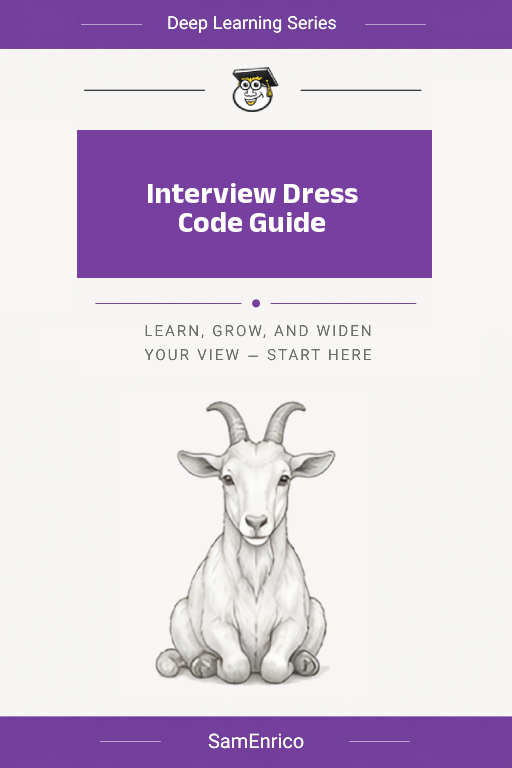
Interview Dress Code Guide eBook
Dress code for job interviews in France (formal),
by Kidd Mardell
Dress code for job interviews in France (formal), UAE (conservative), and Mexico (smart business).
Formats
Free sample
Chapter 1: The Seven-Second Verdict--–- The elevator doors open. You step out, smooth your jacket, and walk toward the reception desk. You have not yet said your name. You have not yet shaken a hand. But the interview has already begun.Seven seconds.
That is the average time a recruiter or hiring manager takes to form a first impression of you based solely on your appearance. Not your resume. Not your alma mater. Not your carefully rehearsed answer to “Tell me about yourself.” Your clothes, your grooming, your shoes, and the way you carry yourself have already transmitted a stream of data before a single word passes your lips.This chapter is not about vanity. It is not about fashion.
It is about the hard, uncomfortable, and enormously profitable truth that in international interviewing, your outfit is not self-expression. It is a cultural signal. And if you send the wrong signal, no amount of qualifications will save you.I have seen a brilliantly qualified supply chain director lose a role in Dubai because his shirttail came untucked after he sat down. I have watched a trilingual MBA candidate be eliminated from a Parisian finance interview because her lipstick was too red. I have listened to a Mexico City hiring manager explain, with genuine regret, that he could not hire an otherwise perfect sales director because the candidate’s shoes were scuffed.
“If he does not care for his own shoes,” the manager said, “how will he care for our clients?”These are not isolated anecdotes. They are the predictable consequences of ignoring the seven-second verdict.In this chapter, you will learn why first impressions carry disproportionate weight in cross-cultural hiring, how each of our three focus countries—France, the United Arab Emirates, and Mexico—interprets professional appearance through a completely different cultural lens, and why the “one perfect interview outfit” you might have worn successfully in New York or London will actively sabotage you in Paris, Dubai, or Mexico City. By the end of this chapter, you will understand the cost of getting it wrong, and you will be prepared to use the rest of this book to ensure that your seven seconds work for you, not against you.The Neuroscience of the First Impression Before we examine cultural differences, we must understand the human hardware that makes first impressions so stubbornly powerful. The neuroscience is unambiguous: the human brain processes visual information approximately sixty thousand times faster than it processes text. When you meet someone new, your amygdala and posterior cingulate cortex—regions associated with emotional processing and social judgment—activate within milliseconds.
You are not “deciding” whether to trust this person. Your brain is deciding for you, based entirely on pattern recognition from past experiences and cultural conditioning.Dr. Alexander Todorov, a Princeton University psychologist whose research on first impressions has been cited more than ten thousand times, demonstrated that people judge trustworthiness, competence, and likeability from faces alone in as little as one-tenth of a second. Longer exposure does not significantly alter the initial judgment; it merely confirms it. When applied to clothing and grooming, the effect is even more pronounced because attire is a conscious choice.
Unlike your bone structure, your suit was selected by you. Therefore, recruiters reason, your outfit reflects your judgment.Here is the critical insight for the international job seeker: your initial judgment is not absolute. It is relative to the observer’s cultural baseline. A French recruiter sees a candidate in a brightly colored tie and thinks, “This person does not understand discretion.” A UAE recruiter sees a candidate in a sleeveless dress and thinks, “This person does not understand respect.” A Mexican recruiter sees a candidate in an overly casual blazer and thinks, “This person does not understand hierarchy.” In each case, the candidate has been judged negatively not because they are sloppy, but because they have violated an unspoken cultural rule.The tragedy is that these violations are almost always unintentional. No candidate wakes up hoping to offend.
But intention does not matter. The seven-second verdict does not include a defense statement. By the time you open your mouth, the verdict has already been recorded.Why a Single “Best Interview Outfit” Is a Dangerous Myth The most common question I receive from professionals preparing for international interviews is some variation of: “Just tell me one outfit that works everywhere. I’ll buy it, wear it, and be done with it.”I understand the appeal. Certainty is comforting.
Simplicity is efficient. But in cross-cultural interviewing, the one-size-fits-all outfit does not exist. It is a myth, and like many myths, it persists because it feels true. After all, a navy suit is a navy suit, is it not? A white blouse is a white blouse.
What could possibly go wrong?Everything.Let us trace the fate of a single garment: the classic American navy suit. In New York or London, this suit is the gold standard of corporate interviewing. It signals seriousness, tradition, and reliability. It is so universally accepted in Anglo-American business culture that many candidates assume it works everywhere. It does not.In France: That same navy suit, especially if it has a boxy cut, wide lapels, or visible shoulder padding, reads as overly aggressive and distinctly American.
French business culture values a softer shoulder, a closer fit, and a slightly shorter jacket. More importantly, the French interviewer is likely to notice the brand of your suit. If you are wearing a visible logo—even a small one on a button or a discreet label on your sleeve—you have violated the French principle that quality speaks for itself and does not need advertisement. One French recruiter I interviewed described the feeling as: “It is as if the candidate is wearing a billboard. We hire minds, not billboards.”In the UAE: The navy suit itself is fine, but what you wear beneath it matters enormously.
If you are a woman wearing that suit without a blouse that covers your chest to the collarbone, you have violated modesty norms. If you are a man wearing that suit without a long-sleeved shirt—because you rolled up your sleeves in the heat—you have signaled casualness that reads as disrespect. Additionally, the fabric of your suit will be judged. In the UAE’s extreme heat, a heavy wool suit says, “I did not think about your climate.” A lightweight tropical wool or linen suit says, “I respect your environment.”In Mexico: The navy suit is closer to acceptable, but the context matters more than the garment. In Mexico City, a full suit and tie is expected for corporate roles.
In Monterrey or Guadalajara, you might be overdressed. More subtly, the color palette matters. A pure American navy reads as cold and impersonal to many Mexican hiring managers, who respond better to slightly warmer tones—charcoal with a brown undertone, navy with a hint of warmth, or even a dark olive in creative fields. One Mexican HR director told me: “The American candidates always look like they are going to a funeral. We want someone who looks like they are coming to work, not to mourn.”The lesson is not that the navy suit is…
This is the end of the free sample. Get the eBook to keep going. Buy now
About this book
Details
- Author
- Kidd Mardell
- Publisher
- SamEnrico
- Language
- English
- Genre
- Non-Fiction, Professional's Cheat Sheet, Cultural Interviewing
- Released
- 2026-05-29
- Pages (approx.)
- 138
- Available as
- eBook, Audiobook

Read better in the ZLOADR app
Your eBooks on your phone or tablet. Sign in with your SamEnrico account and start reading.
More by Kidd Mardell
 Dumbbell HIIT WorkoutsKidd Mardell$11.99
 Pareto Efficiency ExplainedKidd Mardell$11.99
 YouTube Lifestyle Comparison TrapKidd Mardell$11.99
 Binge Eating Trigger MappingKidd Mardell$11.99
 Charlemagne: The Hammer of the Carolingian RenaissanceKidd Mardell$11.99
 10 Ways to Use Great Northern Beans (Recipe Book)Kidd Mardell$11.99
 Photo RetoucherKidd Mardell$11.99
 Learn to Play the Concert ZitherKidd Mardell$11.99
You may also like
 Mexican Job Interview GuideSmalls Antonietta$12.99
 Interview Questions ComparisonFisk Fatimah$12.99
 Interview Mistakes GuideReinhardt Maurine$12.99
 Interview Follow Up GuideReaves Isobel$12.99
 Job Interviews France UAE Mexico GuideBarba Fausto$12.99
 UAE Job Interview GuideAlfaro Humberto$12.99
 French Job Interview GuideGuajardo Dalia$12.99
 Interview Salary Negotiation GuideMadrigal Calista$12.99