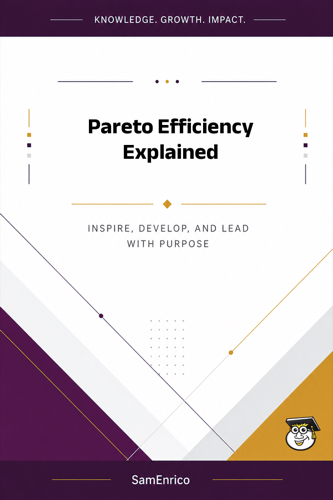
Pareto Efficiency Explained
Identify allocations where no one can be better of
by Kidd Mardell
Identify allocations where no one can be better off without harming others.
Formats
About this book
Free sample
Chapter 1: The Elegant Baseline--–- On a Tuesday afternoon in a crowded Chicago coffee shop, two friends sat across from each other with a problem. Maya had an extra chocolate croissant; Liam had an extra blueberry scone. Neither wanted what they had. Both wanted what the other possessed. After thirty seconds of negotiation, they swapped pastries.
Maya smiled. Liam smiled. No one else in the coffee shop noticed, cared, or was affected in any way.That simple swap was a perfect example of what economists call a Pareto improvement. And the final state—Maya happy with her scone, Liam happy with his croissant—was Pareto efficient.This chapter introduces the single most important baseline concept in welfare economics, negotiation theory, and policy design. It is a concept so simple that a child could grasp it, yet so powerful that it has shaped how we think about markets, laws, and even personal relationships for over a century.
It is called Pareto efficiency, named after the Italian economist and sociologist Vilfredo Pareto, who first formalized the idea in 1906.But here is what makes Pareto efficiency genuinely useful: it strips away all the noise. It does not ask you to measure happiness in numbers. It does not demand that you compare one person’s joy to another’s suffering. It does not require a calculator, a government agency, or a philosophy degree. Instead, it asks a single, disarmingly simple question: can anyone be made better off without making someone else worse off?If the answer is no, you have reached a Pareto efficient allocation.
If the answer is yes, you have not.This chapter will walk you through the definition, the intuition, the boundaries, and the hidden power of that simple question. By the end, you will see Pareto efficiency everywhere: in roommate disputes, office politics, political debates, and your own daily decisions. More importantly, you will know what it does and—equally critical—what it does not do.The One Sentence That Changes How You See Trade-offs Let us begin with the definition, stated plainly and precisely:An allocation of resources is Pareto efficient if there is…
This is the end of the free sample. Get the eBook to keep going. Buy now
Contents
- Chapter 1
- Chapter 2
- Chapter 3
- Chapter 4
- Chapter 5
- Chapter 6
- Chapter 7
- Chapter 8
- Chapter 9
- Chapter 10
- Chapter 11
- Chapter 12
Details
- Author
- Kidd Mardell
- Publisher
- SamEnrico
- Language
- English
- Genre
- Non-Fiction, Business Brief, Welfare Economics
- Released
- 2026-06-09
- Pages (approx.)
- 146
- Available as
- eBook, Audiobook

Read better in the ZLOADR app
Your eBooks on your phone or tablet. Sign in with your SamEnrico account and start reading.
More by Kidd Mardell
 Dumbbell HIIT WorkoutsKidd Mardell$11.99
 YouTube Lifestyle Comparison TrapKidd Mardell$11.99
 Binge Eating Trigger MappingKidd Mardell$11.99
 Charlemagne: The Hammer of the Carolingian RenaissanceKidd Mardell$11.99
 Interview Dress Code GuideKidd Mardell$12.99
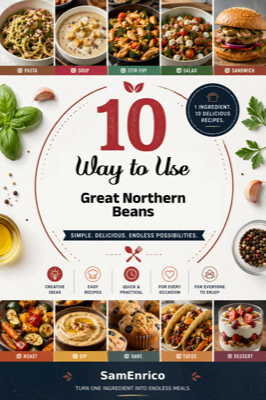 10 Ways to Use Great Northern Beans (Recipe Book)Kidd Mardell$11.99
 Photo RetoucherKidd Mardell$11.99
 Learn to Play the Concert ZitherKidd Mardell$11.99