
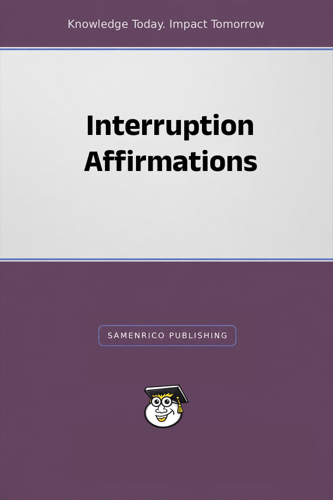
Free sample
Chapter 1: The Attention Heist--–- Every morning, before you have brushed your teeth or tasted your coffee, the heist begins. Not with a masked thief or a silent alarm, but with a ping. A buzz. A red notification badge that multiplies like digital bacteria. Your attention—the most valuable currency you own—is being extracted, packaged, and sold to the highest bidder.
And you have been trained to hand it over for free.This is not a metaphor. This is the economic reality of the twenty-first century. Your attention has become more precious than oil, more valuable than gold, because it is the only resource that cannot be manufactured, stored, or replicated. Every company that wants you to click, watch, buy, or subscribe must first capture a piece of your attention. And they have become extraordinarily good at taking it.The average person checks their phone 96 times per day.
That is once every ten waking minutes. Each time, they lose not only the seconds spent looking at the screen but the minutes required to resurface from wherever their mind had been swimming. The average office worker is interrupted every eleven minutes. And after each interruption, it takes twenty-three minutes to return to full, deep focus. Do the math: if you are interrupted five times in a morning, you may never enter deep focus at all.
You spend your day wading through a shallow stream of half-attention, mistaking the feeling of busyness for the reality of productivity.This book is about reclaiming what has been stolen from you. It is not a productivity manual in the traditional sense—you will find no complicated systems, no color-coded calendars, no guilt-inducing morning routines that require waking at 4 AM. Instead, this book offers something simpler and harder: a set of affirmations, rooted in neuroscience and tested in the chaos of real life, that will help you pause, choose, and return. The goal is not to eliminate interruptions—that is impossible, and frankly, undesirable, because some interruptions are emergencies, opportunities, or the face of someone you love. The goal is to change your relationship to interruptions so that they no longer own you.Before we build that skill, you must understand what you are up against.
This chapter diagnoses the disease. It names the forces that have hijacked your attention, explains the psychological cost of constant switching, and dismantles the comforting myth that willpower alone can save you. By the end, you will see your interruptions clearly for the first time—not as personal failings but as predictable responses to a world designed to distract you. And you will receive your first affirmation: My attention is an asset I choose to protect.Let us begin.The Architecture of Distraction Imagine you are a miner in the nineteenth century. You carry a pickaxe into a dark tunnel.
The rock is hard. The work is slow. But every swing brings you closer to a vein of gold that will feed your family for a year. Now imagine you are a knowledge worker in the twenty-first century. You sit before a glowing screen.
The work is not physical, but it requires concentration—the mental equivalent of swinging a pickaxe into the same problem until it cracks open. And just as you wind up for the swing, a notification appears. Someone liked your photo. Your inbox has a new message. A colleague has a quick question.What do you do?If you are like most people, you drop the pickaxe.
You glance at the notification. You answer the message. You scroll for a moment. And then, twenty minutes later, you try to remember where you left off. This is not a moral failing.
This is the natural response of a brain that has been shaped by millions of years of evolution to notice novelty, to prioritize immediate threats and rewards, and to conserve energy whenever possible. The problem is that the modern world has weaponized those ancient instincts against you.Tech companies spend billions of dollars studying how to capture and hold your attention. They employ neuroscientists, behavioral psychologists, and former video game designers to engineer apps that exploit your brain's vulnerability to variable rewards—the same psychological mechanism that makes slot machines addictive. Every time you pull down to refresh your email or social media feed, you are pulling a digital slot machine lever. Sometimes you find something interesting.
Sometimes you find nothing. The not knowing is what keeps you pulling.This is the architecture of distraction. It is not accidental. It is not benign. It is a multi-trillion-dollar industry built on the systematic extraction of human attention.
And you are not a customer of these products. You are the product being sold to advertisers.Consider the economics of your attention. Facebook (now Meta) generated approximately $134 billion in advertising revenue in 2024. That money came from selling access to your eyeballs, your clicks, your scrolls, and your micro-moments of engagement. Google made even more.
Tik Tok, Instagram, Snapchat, and a thousand smaller platforms complete the ecosystem. They compete for your attention the way oil companies competed for drilling rights a century ago. And they have become extraordinarily efficient at winning.The average person spends nearly seven hours per day looking at screens outside of work. Seven hours. That is more than forty hours per week—a full-time job of being distracted.
And unlike a job, you do not get paid for it. You pay for it with your focus, your presence, your relationships, and your peace of mind.The Hidden Tax of Context Switching Now let us talk about what happens inside your brain when you switch from one task to another. The term for this is context switching, and it is the single greatest drain on modern productivity that almost no one accounts for.Your brain does not process tasks like a computer. A computer can open dozens of applications simultaneously, allocating a slice of processing power to each. Your brain cannot do this.
When you believe you are multitasking, you are actually rapid switching—toggling your attention back and forth between tasks so quickly that it feels simultaneous. But each toggle carries a cost.Research from the University of California, Irvine, found that after an interruption, it takes an average of twenty-three minutes to return to the original task with the same depth of focus. Twenty-three minutes. That means a single three-second interruption—a ping, a tap on the shoulder, a sudden thought—can cost you nearly half an hour of productive time. Not because the interruption itself takes time, but because your brain must re-establish the mental context you had built before the interruption.Imagine you are building a house of cards.
You place each card with care, balancing one against the next. After twenty minutes, you have constructed something fragile but real. Then someone sneezes. The cards scatter. You start over.
This is context switching. Every time you are interrupted, your mental house of cards collapses, and you must begin rebuilding from scratch.The research on this is overwhelming. One study of 1,000 office workers found that they spent only eleven minutes on any given task before being interrupted. Another study found that people who frequently…
This is the end of the free sample. Get the eBook to keep going. Buy now
About this book
Details
- Author
- Brunner Alysa
- Publisher
- SamEnrico
- Language
- English
- Genre
- Non-Fiction, Self-Help / Affirmations
- Released
- 2026-06-10
- Pages (approx.)
- 139
- Available as
- eBook, Audiobook

Read better in the ZLOADR app
Your eBooks on your phone or tablet. Sign in with your SamEnrico account and start reading.
More by Brunner Alysa
 Union Collective Bargaining GuideBrunner Alysa$11.99
 Child Loss and Step ParentingBrunner Alysa$11.99
 Asana Rules Engine WorkflowsBrunner Alysa$11.99
 Dual N Back Training ManualBrunner Alysa$11.99
 Living Legacy Interview GuideBrunner Alysa$11.99
 Gambling Addiction and Fantasy SportsBrunner Alysa$11.99
 Divorce and Social LifeBrunner Alysa$11.99
 The Silk Road Whisperers: Spies, Merchants, and the Unseen Diplomacy of Ancient TradeBrunner Alysa$11.99
 Hippocrates: The Father of Western MedicineBrunner Alysa$11.99
 How to Produce Home Product Making Machinery PartsBrunner Alysa$11.99
 Remote Co Founder CommunicationBrunner Alysa$12.99
 AI Content Production HandbookBrunner Alysa$12.99
You may also like
 Habit AffirmationsSanderson Belkis$11.99
 Goal Setting AffirmationsAviles Pattie$11.99
 Spending Affirmations GuideBrandt Zelda$11.99
 Divorce Affirmations AudioMccarter Gianna$11.99
 Child Loss AffirmationsYu Tori$11.99
 Remote Work AffirmationsSegura Lina$11.99
 Pain AffirmationsHoff Connie$11.99
 Anticipatory Grief AffirmationsKirby Catarina$11.99
 Job Loss AffirmationsHarden Ayesha$11.99
 Gratitude AffirmationsLenz Amira$11.99
 Financial Stress Audio AffirmationsYarbrough Flor$11.99
 Anger Affirmations for CouplesLockwood Lynwood$11.99