
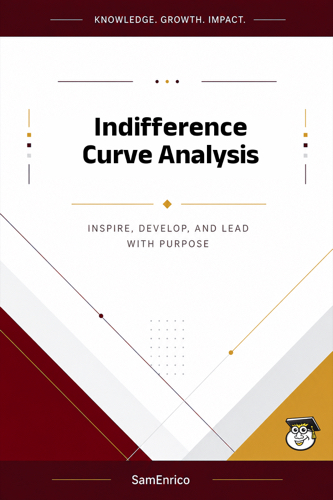
Indifference Curve Analysis
Map consumer preferences and find optimal consumpt
Map consumer preferences and find optimal consumption bundles.
Formats
About this book
Free sample
Chapter 1: The Rationality Myth--–- Every morning, millions of people make choices they will later regret. The extra latte that blows the weekly budget. The gym membership that goes unused. The smartphone upgrade that brings no real joy. These are not anomalies.
They are the rule. And yet, for nearly a century, the most powerful framework in economics has been built on the assumption that you – the consumer – are a perfectly rational decision-making machine.This book is not here to mock that assumption. It is here to explain why it works anyway.Welcome to indifference curve analysis – the single most elegant tool ever devised to map the invisible landscape of human desire. Before we can understand why people buy what they buy, before we can find the optimal consumption bundle that maximizes satisfaction, we must first confront a disturbing question: What does it even mean to be rational?The answer, it turns out, is both simpler and more provocative than you might think. Rationality in economics has almost nothing to do with intelligence, wisdom, or good judgment.
It has everything to do with consistency. A rational consumer, in the technical sense, is not someone who makes wise choices. It is someone whose choices follow four basic logical rules – rules so minimal that even a mildly confused goldfish might satisfy them.These four rules are the axioms of rational choice. They are the foundation upon which the entire cathedral of indifference curve analysis is built. And once you understand them, you will never look at your own shopping cart the same way again.The Four Pillars of Rationality Let us begin with the first axiom, completeness.
This sounds terrifyingly abstract, but it is actually quite simple. Completeness means that for any two bundles of goods – say, bundle A containing an apple and a banana, and bundle B containing two apples – the consumer can always state a preference. They prefer A to B, they prefer B to A, or they are indifferent between them. That is it. No sitting on the fence.
No saying "it depends." No pleading the fifth.Why does this matter? Because without completeness, we could never predict what a…
This is the end of the free sample. Get the eBook to keep going. Buy now
Contents
- Chapter 1
- Chapter 2
- Chapter 3
- Chapter 4
- Chapter 5
- Chapter 6
- Chapter 7
- Chapter 8
- Chapter 9
- Chapter 10
- Chapter 11
- Chapter 12
Details
- Author
- Farnsworth Milan
- Publisher
- SamEnrico
- Language
- English
- Genre
- Non-Fiction, Business Brief, Indifference Curves, Preferences
- Released
- 2026-06-09
- Pages (approx.)
- 138
- Available as
- eBook, Audiobook

Read better in the ZLOADR app
Your eBooks on your phone or tablet. Sign in with your SamEnrico account and start reading.
More by Farnsworth Milan
 The Real Housewives ReunionFarnsworth Milan$11.99
 Menopause Instagram AccountsFarnsworth Milan$11.99
 Body Scan for CaregiversFarnsworth Milan$11.99
 The Vanishing Prince: The Unresolved Kidnapping of a Royal Heir in Ottoman SyriaFarnsworth Milan$11.99
 Quantum Turing Machine OperatorFarnsworth Milan$11.99
 How to Produce Activity Monitor AccessoriesFarnsworth Milan$11.99
 Learning Resources for DevelopmentFarnsworth Milan$12.99
 How to Start a Billets Made of Aluminium Business (Beginners Guide)Farnsworth Milan$11.99