
Non-FictionBusiness BriefIndifference CurvesPreferences
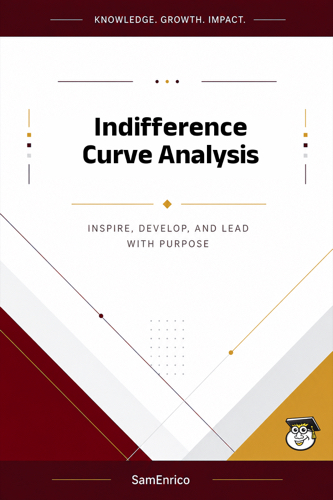
Indifference Curve Analysis eBook
Map consumer preferences and find optimal consumpt
Map consumer preferences and find optimal consumption bundles.
Formats
Free sample
Chapter 1: The Rationality Myth--–- Every morning, millions of people make choices they will later regret. The extra latte that blows the weekly budget. The gym membership that goes unused. The smartphone upgrade that brings no real joy. These are not anomalies.
They are the rule. And yet, for nearly a century, the most powerful framework in economics has been built on the assumption that you – the consumer – are a perfectly rational decision-making machine.This book is not here to mock that assumption. It is here to explain why it works anyway.Welcome to indifference curve analysis – the single most elegant tool ever devised to map the invisible landscape of human desire. Before we can understand why people buy what they buy, before we can find the optimal consumption bundle that maximizes satisfaction, we must first confront a disturbing question: What does it even mean to be rational?The answer, it turns out, is both simpler and more provocative than you might think. Rationality in economics has almost nothing to do with intelligence, wisdom, or good judgment.
It has everything to do with consistency. A rational consumer, in the technical sense, is not someone who makes wise choices. It is someone whose choices follow four basic logical rules – rules so minimal that even a mildly confused goldfish might satisfy them.These four rules are the axioms of rational choice. They are the foundation upon which the entire cathedral of indifference curve analysis is built. And once you understand them, you will never look at your own shopping cart the same way again.The Four Pillars of Rationality Let us begin with the first axiom, completeness.
This sounds terrifyingly abstract, but it is actually quite simple. Completeness means that for any two bundles of goods – say, bundle A containing an apple and a banana, and bundle B containing two apples – the consumer can always state a preference. They prefer A to B, they prefer B to A, or they are indifferent between them. That is it. No sitting on the fence.
No saying "it depends." No pleading the fifth.Why does this matter? Because without completeness, we could never predict what a consumer would do. If a person cannot compare two options, then when placed in front of a shelf, they might freeze like a deer in headlights. Completeness is the assumption that consumers have well-defined preferences, even if those preferences are not always conscious or articulate. In reality, of course, people often struggle to compare complex bundles.
Would you prefer a job with a higher salary but a longer commute, or a lower salary with a shorter commute? Many people cannot answer instantly. The axiom of completeness does not claim that you have these comparisons memorized. It claims that, given enough time and reflection, you could state a preference. It is a logical starting point, not a psychological description.The second axiom is transitivity.
This is the most famous and most frequently violated rule in all of consumer theory. Transitivity states that if you prefer A to B, and you prefer B to C, then you must prefer A to C. No cycles. No rock-paper-scissors preferences where you prefer apples to bananas, bananas to cherries, and cherries back to apples.Why is transitivity so important? Imagine a consumer who violates it.
Such a person could be turned into a perpetual money pump. Offer them a chance to trade A for B for a small fee (since they prefer B to A), then B for C for another small fee (since they prefer C to B), then C back to A for another small fee (since they prefer A to C). They would cycle forever, losing money each time, without ever settling on a final bundle. That is not rational by any definition. Transitivity is the shield against such absurdity.In real life, transitivity violations are surprisingly common, especially when choices involve multiple attributes.
A consumer might prefer a cheap phone with long battery life over an expensive phone with short battery life, prefer the expensive phone with a better camera over the cheap phone with long battery life, and then turn around and prefer the cheap phone over the expensive phone when considering all three attributes together. This is not necessarily irrational – it may simply reflect that preferences are multidimensional and context-dependent. But for the purposes of building a clean model, we will assume transitivity holds. Later, in Chapter 12, we will return to the messy reality of context dependence and framing effects.The third axiom is reflexivity. This one is almost too obvious to mention.
Reflexivity says that any bundle is at least as good as itself. A is at least as good as A. That is it. You might wonder why this needs to be stated at all. The reason is technical: reflexivity ensures that indifference curves are well-defined and that utility functions can be constructed.
Without reflexivity, we could not say that a bundle lies on its own indifference curve. So we include it, nod politely, and move on.The fourth axiom is the workhorse of basic consumer theory: non-satiation, also called monotonicity. This is the famous "more is better" assumption. It states that if bundle A contains at least as much of every good as bundle B, and strictly more of at least one good, then the consumer strictly prefers A to B. In plain English: you would never throw away free, useful goods.
You would never refuse a free upgrade. More is always better.Non-satiation is what gives indifference curves their downward slope. If more were not always better, you could imagine an indifference curve that bent backward, where having more of both goods left you on the same level of satisfaction. That would imply that you had reached a point of absolute satiation – a "bliss point" beyond which additional goods actually reduce your happiness. While such bliss points exist for specific goods (few people want a tenth bowl of ice cream), non-satiation assumes that for the goods we are modeling, you have not yet reached that point.A Critical Caveat: Assumptions vs.
Truth Before we go any further, a crucial confession is necessary. The four axioms described above are simplifying assumptions, not universal truths about human nature. They are the scaffolding that allows us to build a clean, tractable model of consumer choice. They are not meant to be literally true. In fact, we know they are often false.Chapter 12 of this book will be devoted to behavioral anomalies: framing effects, loss aversion, hyperbolic discounting, and other ways that real human beings violate the rational choice axioms.
When you read that chapter, you might be tempted to throw this book across the room and declare all of economics a sham. Please resist that temptation. The rational choice model is not valuable because it is true. It is valuable because it is useful – like a map that simplifies a complex terrain into straight lines and simple shapes so you can navigate without being overwhelmed.The axioms are the straight lines. The real world is the winding path.
The trick is knowing when to trust the map and when to look at the ground. We will return to…
This is the end of the free sample. Get the eBook to keep going. Buy now
About this book
Details
- Author
- Farnsworth Milan
- Publisher
- SamEnrico
- Language
- English
- Genre
- Non-Fiction, Business Brief, Indifference Curves, Preferences
- Released
- 2026-06-09
- Pages (approx.)
- 138
- Available as
- eBook, Audiobook

Read better in the ZLOADR app
Your eBooks on your phone or tablet. Sign in with your SamEnrico account and start reading.
More by Farnsworth Milan
 The Real Housewives ReunionFarnsworth Milan$11.99
 Menopause Instagram AccountsFarnsworth Milan$11.99
 Body Scan for CaregiversFarnsworth Milan$11.99
 The Vanishing Prince: The Unresolved Kidnapping of a Royal Heir in Ottoman SyriaFarnsworth Milan$11.99
 Quantum Turing Machine OperatorFarnsworth Milan$11.99
 How to Produce Activity Monitor AccessoriesFarnsworth Milan$11.99
 Learning Resources for DevelopmentFarnsworth Milan$12.99
 How to Start a Billets Made of Aluminium Business (Beginners Guide)Farnsworth Milan$11.99
You may also like
 Hong Kong Handover 1997Dunn Johnnie$11.99
 Zumba For Postnatal Recovery CourseNeal Christian$11.99
 Zumba for BeginnersLadner Nikia$11.99
 YouTube Comment Mining GuideHumes Pandora$12.99
 Worry Box MeditationCarlin Rudy$11.99
 Workplace Stress MeditationNguyen Lynn$11.99
 Workplace Stress and Sleep RepairHawley Ivory$11.99
 Workplace Perfectionism CureDelaney Jeffry$11.99
 Workplace Injustice Anger GuideWallen Isabelle$11.99
 Work Addiction and Burnout LinkGreenwood Ester$11.99
 Women in Yoga and WellnessBeattie Galina$11.99
 Women in Stand Up ComedyChun Evangeline$11.99