
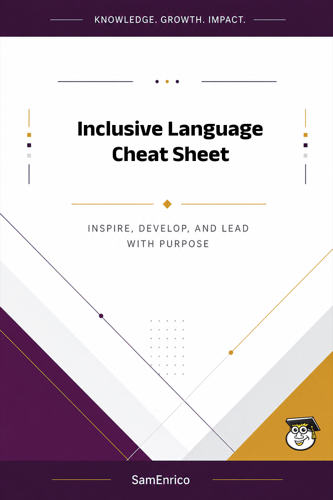
Non-FictionProfessional's Cheat SheetDEI
Inclusive Language Cheat Sheet eBook
Avoid bias and promote belonging with gender neutr
Avoid bias and promote belonging with gender neutral and accessible terms.
Formats
Free sample
Chapter 1: The Platinum Rule--–- Most people believe they are kind. They hold doors open. They say please and thank you. They would never intentionally hurt someone with their words. And yet, every single day, well-intentioned professionals cause harm not because they are malicious, but because they are operating on the wrong rule.
They have been taught the Golden Rule: Treat others the way you want to be treated. On its surface, this seems irreproachable. Why wouldn't you want to extend your own preferences to someone else? The problem is that your preferences are not universal. What feels respectful to you might feel dismissive to someone else.
What sounds neutral in your ear might carry generations of pain in theirs. The Golden Rule, for all its wisdom, assumes that you are the standard. You are not.This chapter introduces a more powerful framework: the Platinum Rule. Treat others the way they wish to be treated. This single shift transforms inclusive language from a minefield of potential mistakes into a practice of curiosity, respect, and continuous learning.
The Platinum Rule does not require you to memorize every possible offensive term before opening your mouth. It requires something simpler and harder: the willingness to listen, to ask, and to adjust when you learn something new. This chapter lays the foundation for every substitution list, every script, and every audit in this book. Without the Platinum Rule, the rest is just vocabulary. With it, you gain a compass.The Hidden Cost of Getting It Wrong Before we build the solution, we need to understand the problem in concrete terms.
Exclusionary language is not merely impolite. It is expensive. A 2022 study of over 3,000 employees across five industries found that workers who reported hearing exclusionary language from managers or peers were 2.7 times more likely to be actively seeking new employment. The cost of replacing a single employee ranges from 50% to 200% of their annual salary. For a team of twenty, that adds up quickly.
But the costs go deeper than turnover.When people feel erased or dismissed by language, they stop speaking up. They withhold ideas. They disengage from meetings. A Harvard Business Review analysis of innovation teams found that psychological safety was the single strongest predictor of team performance, outstripping raw talent, resources, and leadership quality. And nothing erodes psychological safety faster than repeated, small exclusions.
The manager who says "hey guys" to a room of women and nonbinary people. The email that opens with "Dear Sirs." The interview question that asks about a "wife" or "husband" without leaving room for other possibilities. None of these are fireable offenses. None are malicious. But their cumulative weight is devastating.The opportunity cost is equally real.
Companies that score in the top quartile for inclusive practices are 36% more likely to outperform their peers financially, according to Mc Kinsey's ongoing diversity research. Brands that adopt gender-neutral language in customer communications see higher trust scores across all demographics, not just marginalized groups. And individuals who consistently use inclusive language are perceived as more competent, more trustworthy, and more promotable. This is not speculation. It is measurement.The Platinum Rule is not about guilt.
It is not about perfection. It is about recognizing that language is a tool, and like any tool, it can be used well or poorly. The difference between the two is not intention. It is impact.Why the Golden Rule Fails Let us examine the Golden Rule more closely. "Treat others the way you want to be treated." This assumes three things that are rarely true.
First, it assumes that you know what you would want in any given situation. Most people do not. We are notoriously bad at predicting our own emotional responses, let alone someone else's. Second, it assumes that the other person shares your values, your history, and your sensitivities. A phrase that sounds harmless to you might be the exact phrase a colleague heard before being fired, harassed, or disowned.
You cannot know their history. Third, it assumes that treating someone the way you want to be treated is always kind. But if you prefer direct criticism and your colleague prefers gentle suggestions, your directness will feel like an attack to them. You are not being kind. You are being you.The Golden Rule also has a darker history.
In many contexts, it has been used to justify forcing one group's norms onto another. "I would want someone to correct my grammar, so I will correct theirs." "I would want someone to tell me if I was using the wrong term, so I will interrupt them publicly." These are not acts of service. They are acts of dominance dressed in good intentions.The Platinum Rule dismantles this entirely. It shifts the center of gravity from you to the other person. Instead of asking "What would I want?" you ask "What do they want?" This requires a different set of skills.
Not assumption, but inquiry. Not projection, but listening. Not confidence, but humility.The Platinum Rule in Practice: Three Core Skills The Platinum Rule is a principle, not a script. But principles need practices. Here are the three core skills that turn the Platinum Rule from an idea into an action.Skill One: Ask Before Assuming Most language mistakes come from assumptions.
You assume someone uses he/him pronouns because of how they look. You assume someone is married to a person of the opposite gender. You assume that "guys" is neutral because you have never been bothered by it. The Platinum Rule replaces each assumption with a simple question, asked at the right time in the right way.For pronouns: "Hi, I'm Jordan. I use he/him.
What about you?" This is not an interrogation. It is an offering. You go first, which takes the pressure off the other person. You make it normal, not special. You leave room for them to share or not share as they choose.For relationships: Instead of asking "Do you have a husband?" ask "Are you seeing anyone?" or "What's your family like?" Or better yet, wait for them to volunteer the information.
Not every conversation requires you to know someone's relationship status.For accommodations: Instead of assuming what a colleague with a disability needs, ask. "What would make this meeting accessible for you?" This is not intrusive. It is respectful. It acknowledges that you do not know their body better than they do.The key is timing. Do not ask a room full of people to state their pronouns if someone might be closeted.
Do not ask about accommodations in a public setting if the answer might be private. Ask one-on-one. Ask in writing. Ask with an opt-out. The Platinum Rule is not about forcing disclosure.
It is about creating space for it.Skill Two: Listen for Correction Without Defensiveness You will make mistakes. This is not a failure of the Platinum Rule. It is a feature. Every mistake is an opportunity to learn. The problem is not the mistake.
The problem is what you do next.When someone corrects you, your first instinct will be to defend yourself. "I didn't mean it that way." "Everyone says that." "You're being too sensitive." These responses are natural.…
This is the end of the free sample. Get the eBook to keep going. Buy now
About this book
Details
- Author
- Lowell Jaymie
- Publisher
- SamEnrico
- Language
- English
- Genre
- Non-Fiction, Professional's Cheat Sheet, DEI
- Released
- 2026-06-09
- Pages (approx.)
- 137
- Available as
- eBook, Audiobook

Read better in the ZLOADR app
Your eBooks on your phone or tablet. Sign in with your SamEnrico account and start reading.
More by Lowell Jaymie
 Financial Literacy LegacyLowell Jaymie$11.99
 Celebrating Longevity MilestonesLowell Jaymie$11.99
 Walking Program for SeniorsLowell Jaymie$11.99
 The Postpartum Depression GuideLowell Jaymie$11.99
 The Serpent’s Gambit: How the Trickster Stole the World’s SecretsLowell Jaymie$11.99
 Web Authentication EngineerLowell Jaymie$11.99
 Nonprofit Climate InsuranceLowell Jaymie$12.99
 Estate Tax Payment PlansLowell Jaymie$12.99
 How to Become a Continuous-absorption-process OperatorLowell Jaymie$11.99
You may also like
 Hong Kong Handover 1997Dunn Johnnie$11.99
 Zumba For Postnatal Recovery CourseNeal Christian$11.99
 Zumba for BeginnersLadner Nikia$11.99
 YouTube Comment Mining GuideHumes Pandora$12.99
 Worry Box MeditationCarlin Rudy$11.99
 Workplace Stress MeditationNguyen Lynn$11.99
 Workplace Stress and Sleep RepairHawley Ivory$11.99
 Workplace Perfectionism CureDelaney Jeffry$11.99
 Workplace Injustice Anger GuideWallen Isabelle$11.99
 Work Addiction and Burnout LinkGreenwood Ester$11.99
 Women in Yoga and WellnessBeattie Galina$11.99
 Women in Stand Up ComedyChun Evangeline$11.99