
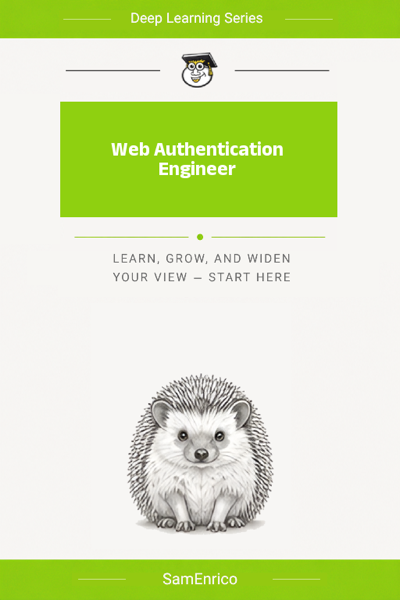
Web Authentication Engineer
A Coursebook on Web Authentication Engineer
A Coursebook on Web Authentication Engineer
Formats
About this book
Free sample
Chapter 1: The $10 Million Cookie--–- The breach report landed in my inbox at 11:47 PM on a Tuesday. Forty-seven million user records exposed. A publicly traded company's stock dropped 31 percent before the markets opened the next morning. The root cause, buried on page fourteen of the forensic analysis, was a single line of code: Http Only: false. One missing flag on a session cookie.
That is all it took.This chapter is not an introduction. It is an intervention. If you take nothing else from this book, understand this: authentication failures are rarely sophisticated. They are not the work of nation-state actors deploying zero-day exploits against your carefully crafted cryptography. They are, overwhelmingly, the result of basic misunderstandings about how the web actually works.
Engineers forget that HTTP has no memory. They assume that once a user logs in, the system will somehow "just know" who they are. They reach for libraries without understanding what those libraries do. And then, at 2:00 AM, the phone rings.I have been that engineer. I have answered that phone call.
I have explained to a room full of executives why a missing flag, a misconfigured header, or a misplaced token cost their company millions. This book exists to ensure you never have to make that same call.Before we can build secure authentication, we must understand the battlefield. The web is stateless by design. Every HTTP request is a blank slate, carrying no memory of the request that came before it. This statelessness is what makes the web scalable—a server can handle billions of requests without maintaining persistent connections—but it also creates the fundamental problem of authentication: how does a system remember who you are across multiple requests?The answer, for the first twenty years of the web, was sessions.
You would log in with a username and password. The server would verify your credentials, generate a random session identifier, store that identifier in a database or Redis cache alongside your user ID, and send the identifier back to your browser as a cookie. On every subsequent request, your browser would present that…
This is the end of the free sample. Get the eBook to keep going. Buy now
Contents
- Chapter 1
- Chapter 2
- Chapter 3
- Chapter 4
- Chapter 5
- Chapter 6
- Chapter 7
- Chapter 8
- Chapter 9
- Chapter 10
- Chapter 11
- Chapter 12
Details
- Author
- Lowell Jaymie
- Publisher
- SamEnrico
- Language
- English
- Genre
- Non-Fiction, Informative, Educational
- Released
- 2026-06-02
- Pages (approx.)
- 159
- Available as
- eBook, Audiobook

Read better in the ZLOADR app
Your eBooks on your phone or tablet. Sign in with your SamEnrico account and start reading.
More by Lowell Jaymie
 Inclusive Language Cheat SheetLowell Jaymie$11.99
 Financial Literacy LegacyLowell Jaymie$11.99
 Celebrating Longevity MilestonesLowell Jaymie$11.99
 Walking Program for SeniorsLowell Jaymie$11.99
 The Postpartum Depression GuideLowell Jaymie$11.99
 The Serpent’s Gambit: How the Trickster Stole the World’s SecretsLowell Jaymie$11.99
 Nonprofit Climate InsuranceLowell Jaymie$12.99
 Estate Tax Payment PlansLowell Jaymie$12.99
 How to Become a Continuous-absorption-process OperatorLowell Jaymie$11.99