
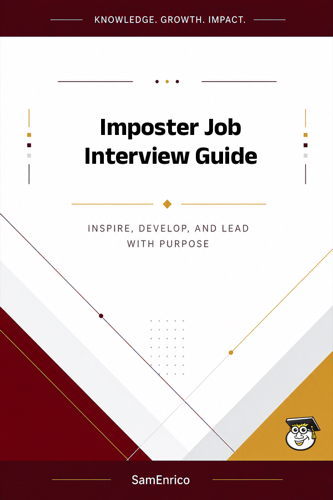
Non-FictionSelf-HelpInterview Skills
Imposter Job Interview Guide eBook
Sell yourself confidently without feeling like you
Sell yourself confidently without feeling like you're lying about your abilities.
Formats
Free sample
Chapter 1: The Voice That Lies--–- You are reading this book for a reason. Maybe you have an interview next week for a job that feels like a stretch. Maybe you are stuck in a role beneath your abilities because you cannot bring yourself to apply for anything bigger. Maybe you have been promoted recently and are waiting for someone to tap you on the shoulder and inform you it was all a clerical error.Whatever brought you here, you know the feeling. It is the voice that whispers, "They are going to find out." It is the knot in your stomach when someone praises your work.
It is the certainty that your success has been a fluke, your resume a creative writing exercise, your reputation a house of cards waiting to collapse.This voice has been with you for years. Perhaps it started in school, when you worried that your good grades were a mistake. Perhaps it began at your first job, when you looked around at your colleagues and wondered how you had fooled the hiring manager. Perhaps it intensified with each promotion, each award, each moment of external validation that somehow made you feel more like a fraud, not less.I have sat across from hundreds of people who describe this voice. They are not failures.
They are not imposters. They are senior executives, award-winning scientists, decorated veterans, and creative directors with portfolios that would make anyone envious. And every single one of them has looked me in the eye and said some version of the same thing: "I don't belong here. Someone is going to find me out."This chapter is about that voice. It is about understanding where it comes from, why it speaks to you so convincingly, and why the usual advice—"just be more confident," "fake it until you make it"—not only fails but often makes things worse.
Because you cannot defeat an enemy you do not understand. And the voice inside your head has been studying you your entire life.The Discovery That Changed Everything In 1978, two clinical psychologists named Pauline Clance and Suzanne Imes published a paper that would eventually change how millions of people understand their own anxiety. They had noticed something puzzling in their therapy practices. They were working with high-achieving women—Ph D candidates, tenured professors, award-winning professionals—who seemed to share a peculiar delusion. Despite overwhelming evidence of their competence, these women were secretly convinced they were frauds.Clance and Imes called this pattern the "imposter phenomenon." The rest of the world calls it imposter syndrome.
And here is what the research has found in the decades since: between 70 and 80 percent of people experience imposter syndrome at some point in their careers. It affects men and women across every industry, every level of seniority, every measure of objective success.The most surprising finding is this: the more accomplished you are, the more likely you are to feel like an imposter. High achievers do not experience imposter syndrome despite their success. They experience it because of their success. Each new achievement creates more evidence that they feel compelled to discount.
Each promotion raises the stakes of being exposed. Each award adds weight to the fear that someday, someone will tap them on the shoulder and say, "We've made a terrible mistake."This is not false modesty. This is not performative humility. This is a genuine psychological pattern that causes measurable harm: burnout, anxiety, depression, stalled careers, and missed opportunities. And it is the single biggest obstacle between you and the job you deserve.What Imposter Syndrome Is (And What It Is Not)Before we go any further, let us be precise about what we are talking about.
Imposter syndrome is not ordinary nervousness before an interview. It is not healthy humility about your limitations. It is not the normal anxiety that accompanies any evaluation of your worth.Ordinary nervousness sounds like this: "I am qualified for this role, but I am nervous about the interview. I hope I answer the questions well." The anxiety is about performance. It is temporary.
It responds to preparation and practice.Imposter syndrome sounds like this: "I am not qualified for this role. If I get the job, it will be because I tricked them. If I do not get the job, it will be because they finally saw through me." The anxiety is about identity. It is persistent. It does not respond to preparation because no amount of preparation feels like enough.The difference is everything.
Performance anxiety can be managed with rehearsal and breathing exercises. Identity anxiety cannot, because the problem is not the interview. The problem is the story you are telling yourself about who you are.People with imposter syndrome share three core beliefs. First, they believe they have fooled others into overestimating their abilities. Second, they live in fear of being discovered as frauds.
Third, they attribute their success to external factors—luck, timing, charm, effort, mistakes by others—rather than to their own competence.If you recognize yourself in those three beliefs, you are in the right place. This book is for you.The Five Faces of Imposter Syndrome Not everyone experiences imposter syndrome the same way. Researcher Valerie Young, author of "The Secret Thoughts of Successful Women," identified five distinct types. Each type has its own pattern of thinking, its own vulnerabilities, and its own path to freedom.Recognizing your type is the first step toward disarming the voice. Throughout this book, each chapter will include a "Type-Specific Tip" box that applies the chapter's strategies to your particular pattern.Type One: The Perfectionist.
This is the most common type. Perfectionists set impossibly high goals for themselves. When they fail to meet those goals—and they always fail, because the goals are impossible—they feel shame and self-doubt. They focus on what they did wrong rather than what they did right. They cannot celebrate success because they are already cataloging their errors.
In interviews, Perfectionists struggle to give examples of their achievements because they remember every mistake they made along the way.Type Two: The Superwoman or Superhero. This type feels compelled to work harder than everyone else to prove they are not frauds. They volunteer for extra assignments. They stay late. They answer emails at midnight.
They never say no. The exhaustion is relentless, but they believe that if they slow down, they will be exposed. In job searches, the Superwoman applies to dozens of roles, customizes every application obsessively, and burns out before she ever gets an interview.Type Three: The Natural Genius. This type believes that competence should come effortlessly. If they have to work hard at something, they conclude they must not be naturally good at it.
They measure their worth by how quickly and easily they master new skills. When they struggle—as everyone does—they feel like failures. In interviews, Natural Geniuses avoid roles that require skills they have not already mastered. They stay in their comfort zone. Their careers stagnate not because they lack ability but because they fear the discomfort of learning.Type Four: The Rugged Individualist.
This type believes that asking for help is a sign of weakness. They must accomplish everything on their own. They…
This is the end of the free sample. Get the eBook to keep going. Buy now
About this book
Details
- Author
- Holloway Violet
- Publisher
- SamEnrico
- Language
- English
- Genre
- Non-Fiction, Self-Help, Interview Skills
- Released
- 2026-06-10
- Pages (approx.)
- 114
- Available as
- eBook, Audiobook

Read better in the ZLOADR app
Your eBooks on your phone or tablet. Sign in with your SamEnrico account and start reading.
More by Holloway Violet
 Mobile Therapy For Remote Communities PrimerHolloway Violet$11.99
 LTC Home Care Benefits GuideHolloway Violet$11.99
 Breath Awareness While EatingHolloway Violet$11.99
 Stone People Spiritual TeachingsHolloway Violet$11.99
 Bedtime Review TechniqueHolloway Violet$11.99
 TM Vs Mindfulness ComparisonHolloway Violet$11.99
 Parent Time QuizHolloway Violet$11.99
 Affirmations For Artist DoubtHolloway Violet$11.99
 The Siege of Nicaea: A Clash of Empires at the GatesHolloway Violet$11.99
 The Last Echoes of the Old Tongues: Rediscovering Asia's Vanishing LanguagesHolloway Violet$11.99
 Growing Plumeria (Frangipani)Holloway Violet$11.99
 The Dancer's Guide to DiscoHolloway Violet$11.99
You may also like
 Hong Kong Handover 1997Dunn Johnnie$11.99
 Zumba For Postnatal Recovery CourseNeal Christian$11.99
 Zumba for BeginnersLadner Nikia$11.99
 YouTube Comment Mining GuideHumes Pandora$12.99
 Worry Box MeditationCarlin Rudy$11.99
 Workplace Stress MeditationNguyen Lynn$11.99
 Workplace Stress and Sleep RepairHawley Ivory$11.99
 Workplace Perfectionism CureDelaney Jeffry$11.99
 Workplace Injustice Anger GuideWallen Isabelle$11.99
 Work Addiction and Burnout LinkGreenwood Ester$11.99
 Women in Yoga and WellnessBeattie Galina$11.99
 Women in Stand Up ComedyChun Evangeline$11.99