
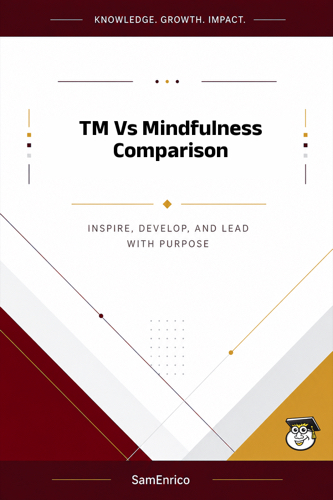
TM Vs Mindfulness Comparison
Understand how effortless transcendence differs fr
Understand how effortless transcendence differs from focused attention meditation.
Formats
About this book
Free sample
Chapter 1: The Hidden Map–- In 1971, a Harvard-trained cardiologist named Herbert Benson published a small book called The Relaxation Response. In it, he described how a simple mental technique—the repetition of a word or sound—could produce a measurable physiological state opposite to the stress response. Heart rate slowed. Breathing deepened. Oxygen consumption decreased.
Brain waves shifted toward alpha frequencies. Benson had studied practitioners of Transcendental Meditation to reach these conclusions, and his book became a surprise bestseller, introducing millions of Americans to the idea that meditation was not just for monks and hippies but for anyone seeking better health.Twenty years later, in 1990, another book appeared. Jon Kabat-Zinn's Full Catastrophe Living described a different approach: mindfulness meditation, drawn from Buddhist traditions, stripped of religious language, and delivered to chronic pain patients at the University of Massachusetts Medical Center. Unlike Benson's technique, which involved effortless repetition of a mantra, Kabat-Zinn's method required sustained, effortful attention to the breath and body. His book also became a bestseller.
Within a decade, "mindfulness" would eclipse "transcendental meditation" as the dominant term in the popular imagination.Here is the question that has never been adequately answered: Are these two approaches different paths to the same destination, or do they lead to fundamentally different places?The answer, as this book will show, is both. They overlap in some outcomes—both reduce stress, both improve mood, both enhance well-being. But they achieve these outcomes through radically different mechanisms, they produce distinct subjective experiences, and they are suited for different people with different nervous systems. The confusion between them has led to wasted effort, unnecessary suffering, and a profound misunderstanding of what the human mind is capable of.This chapter lays the foundation for everything that follows. It introduces the map that will guide us through the terrain of meditation science, distinguishes between the major families of practice, and explains why the distinction between effort and effortlessness is the most important and most overlooked variable in contemplative practice.The Problem with a One-Size-Fits-All Approach Imagine going to a doctor and being told, "I have a medication that works for most people.…
This is the end of the free sample. Get the eBook to keep going. Buy now
Contents
- Chapter 1
- Chapter 2
- Chapter 3
- Chapter 4
- Chapter 5
- Chapter 6
- Chapter 7
- Chapter 8
- Chapter 9
- Chapter 10
- Chapter 11
- Chapter 12
Details
- Author
- Holloway Violet
- Publisher
- SamEnrico
- Language
- English
- Genre
- Non-Fiction, Self-Help, Comparison
- Released
- 2026-06-06
- Pages (approx.)
- 122
- Available as
- eBook, Audiobook

Read better in the ZLOADR app
Your eBooks on your phone or tablet. Sign in with your SamEnrico account and start reading.
More by Holloway Violet
 Mobile Therapy For Remote Communities PrimerHolloway Violet$11.99
 Imposter Job Interview GuideHolloway Violet$11.99
 LTC Home Care Benefits GuideHolloway Violet$11.99
 Breath Awareness While EatingHolloway Violet$11.99
 Stone People Spiritual TeachingsHolloway Violet$11.99
 Bedtime Review TechniqueHolloway Violet$11.99
 Parent Time QuizHolloway Violet$11.99
 Affirmations For Artist DoubtHolloway Violet$11.99
 The Siege of Nicaea: A Clash of Empires at the GatesHolloway Violet$11.99
 The Last Echoes of the Old Tongues: Rediscovering Asia's Vanishing LanguagesHolloway Violet$11.99
 Growing Plumeria (Frangipani)Holloway Violet$11.99
 The Dancer's Guide to DiscoHolloway Violet$11.99
You may also like
 The Parent Comparison Trap GuideJanes Jaleesa$11.99
 The Senior Comparison TrapLehman Elwanda$11.99
 Comparison at Work GuideMccracken Hulda$11.99
 Student Comparison Trap EscapeDurr Gertrud$11.99
 Letting Go Of Comparison TrapAshby Criselda$11.99
 Comparative Thinking Anger GuideEverhart Cherish$11.99
 Teen Self Esteem and ComparisonManson Yuonne$11.99
 Self Esteem And Partner SuccessTennant Armandina$11.99
 The Teen Comparison Trap GuideBurchfield Allie$11.99
 The Comparison To OthersDelong Taylor$11.99
 The Comparison Creative BlockHorvath Wai$11.99
 Goal Comparison TrapMontero Warner$11.99