
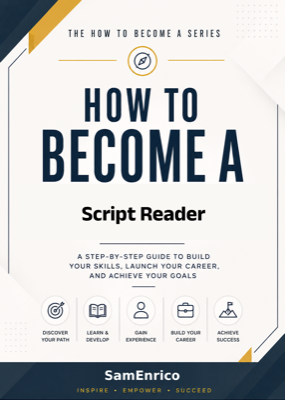
Non-FictionInformativeEducational
How to Become a Script Reader Paperback
How to Become a Script Reader
How to Become a Script Reader
Formats
Free sample
Chapter 1: The $100 Million Blindspot--Every year, approximately fifty thousand screenplays are registered with the Writers Guild of America. Of those, perhaps five hundred will be optioned. Around fifty will be produced. And maybe three will become profitable hits that anyone remembers a decade later. The other forty-nine thousand nine hundred and fifty scripts vanish into a digital graveyard, read by no one except the writers themselves, their mothers, and the invisible army of script readers who rejected them in silence.You are about to join that army.
But not for the reasons you think.If you are reading this book, you probably love movies. You might even love writing. You have opinions about plot holes, character arcs, and why the third act of that superhero movie fell apart. You suspect that Hollywood is run by lucky idiots who wouldn't know a good script if it hit them in the face. And you believe—deep down—that you have better taste than half the people getting paid to make decisions.Here is the first and most important truth this book will teach you: Your taste does not matter.Not in the way you think, anyway.
Your personal preferences—what makes you laugh, cry, or cheer—are irrelevant to the job of a professional script reader. You are not being hired to be a critic. You are not being hired to be a fan. You are being hired to be a filter. A human sieve.
A pair of eyes that can process one hundred and twenty pages in ninety minutes and produce a three-page document that determines whether a script lives or dies.This chapter is called "The $100 Million Blindspot" because that is precisely what the film industry is trying to avoid: a misjudged script that costs a studio nine figures to produce and another nine figures to market, only to bomb opening weekend. Every script reader sits at the intersection of art and commerce, but the commerce side is heavier. Much heavier. A single bad "Recommend" from a reader can trigger a chain of events that ends with a producer losing their job, a studio shutting down a development slate, and a hundred crew members being laid off.That is not hyperbole. That is the economics of modern Hollywood.The Myth of the Cozy Reader Let us first kill a romantic myth.
When most people imagine a script reader, they picture someone curled up on a leather couch in a sunlit Los Angeles office, a latte in one hand and a screenplay in the other, offering witty observations about character motivation while an appreciative executive nods along.That person does not exist.The real script reader sits in a cramped home office—often a converted bedroom or a corner of a living room—wearing noise-canceling headphones to block out the neighbors' barking dog. They have two monitors: one displaying a PDF of a script, the other displaying a coverage template. They have a stack of twelve scripts to finish by Friday. They have carpal tunnel syndrome from typing "the protagonist lacks agency" for the fourth time today. They have read three hundred pages since breakfast and cannot remember what they ate for lunch.This is not a glamour job.
It is a volume job.A major studio receives between fifty and one hundred script submissions every week. These come from agents, managers, producers, writers with existing deals, and occasionally the infamous "slush pile" of unsolicited submissions that somehow got past legal. Each of those scripts needs coverage within forty-eight hours. That means a single reader—or more realistically, a rotating team of freelance readers—must…
This is the end of the free sample. Get the Paperback to keep going. Buy now
About this book
Details
- Author
- Leighton Jerica
- Publisher
- SamEnrico
- Language
- English
- ISBN
- 9781506056265
- Genre
- Non-Fiction, Informative, Educational
- Released
- 2026-06-02
- Pages (approx.)
- 143
- Available as
- eBook, Paperback, Audiobook

Read better in the ZLOADR app
Your eBooks on your phone or tablet. Sign in with your SamEnrico account and start reading.
More by Leighton Jerica
 Thunberg Greenwashing Exposé Technique GuideLeighton Jerica$11.99
 Failure Fear for High AchieversLeighton Jerica$11.99
 Women In Science DNA Race GuideLeighton Jerica$11.99
 Willie Nelson Outlaw Country GuideLeighton Jerica$11.99
 Blue Zone Brain Longevity GuideLeighton Jerica$11.99
 The Last Unbroken: The Myth of the Perfect MarathonLeighton Jerica$11.99
 The Velvet Conspiracy: How a Secret Society of Spies Shaped the Cold WarLeighton Jerica$11.99
 Wash Bay AttendantLeighton Jerica$11.99
 Understanding Fowler's SyndromeLeighton Jerica$17.99
 AI Presentation Design HandbookLeighton Jerica$12.99
 AI Vendor Payment GuideLeighton Jerica$12.99
You may also like
 Hong Kong Handover 1997Dunn Johnnie$11.99
 Zumba For Postnatal Recovery CourseNeal Christian$11.99
 Zumba for BeginnersLadner Nikia$11.99
 YouTube Comment Mining GuideHumes Pandora$12.99
 Worry Box MeditationCarlin Rudy$11.99
 Workplace Stress MeditationNguyen Lynn$11.99
 Workplace Stress and Sleep RepairHawley Ivory$11.99
 Workplace Perfectionism CureDelaney Jeffry$11.99
 Workplace Injustice Anger GuideWallen Isabelle$11.99
 Work Addiction and Burnout LinkGreenwood Ester$11.99
 Women in Yoga and WellnessBeattie Galina$11.99
 Women in Stand Up ComedyChun Evangeline$11.99