
Non-FictionInformativeEducational
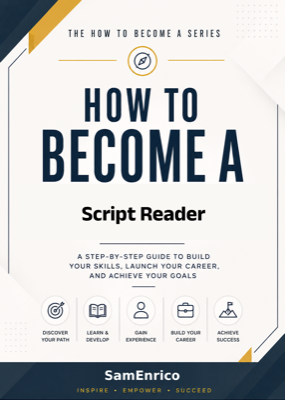
How to Become a Script Reader eBook
How to Become a Script Reader
How to Become a Script Reader
Formats
Free sample
Chapter 1: The $100 Million Blindspot--Every year, approximately fifty thousand screenplays are registered with the Writers Guild of America. Of those, perhaps five hundred will be optioned. Around fifty will be produced. And maybe three will become profitable hits that anyone remembers a decade later. The other forty-nine thousand nine hundred and fifty scripts vanish into a digital graveyard, read by no one except the writers themselves, their mothers, and the invisible army of script readers who rejected them in silence.You are about to join that army.
But not for the reasons you think.If you are reading this book, you probably love movies. You might even love writing. You have opinions about plot holes, character arcs, and why the third act of that superhero movie fell apart. You suspect that Hollywood is run by lucky idiots who wouldn't know a good script if it hit them in the face. And you believe—deep down—that you have better taste than half the people getting paid to make decisions.Here is the first and most important truth this book will teach you: Your taste does not matter.Not in the way you think, anyway.
Your personal preferences—what makes you laugh, cry, or cheer—are irrelevant to the job of a professional script reader. You are not being hired to be a critic. You are not being hired to be a fan. You are being hired to be a filter. A human sieve.
A pair of eyes that can process one hundred and twenty pages in ninety minutes and produce a three-page document that determines whether a script lives or dies.This chapter is called "The $100 Million Blindspot" because that is precisely what the film industry is trying to avoid: a misjudged script that costs a studio nine figures to produce and another nine figures to market, only to bomb opening weekend. Every script reader sits at the intersection of art and commerce, but the commerce side is heavier. Much heavier. A single bad "Recommend" from a reader can trigger a chain of events that ends with a producer losing their job, a studio shutting down a development slate, and a hundred crew members being laid off.That is not hyperbole. That is the economics of modern Hollywood.The Myth of the Cozy Reader Let us first kill a romantic myth.
When most people imagine a script reader, they picture someone curled up on a leather couch in a sunlit Los Angeles office, a latte in one hand and a screenplay in the other, offering witty observations about character motivation while an appreciative executive nods along.That person does not exist.The real script reader sits in a cramped home office—often a converted bedroom or a corner of a living room—wearing noise-canceling headphones to block out the neighbors' barking dog. They have two monitors: one displaying a PDF of a script, the other displaying a coverage template. They have a stack of twelve scripts to finish by Friday. They have carpal tunnel syndrome from typing "the protagonist lacks agency" for the fourth time today. They have read three hundred pages since breakfast and cannot remember what they ate for lunch.This is not a glamour job.
It is a volume job.A major studio receives between fifty and one hundred script submissions every week. These come from agents, managers, producers, writers with existing deals, and occasionally the infamous "slush pile" of unsolicited submissions that somehow got past legal. Each of those scripts needs coverage within forty-eight hours. That means a single reader—or more realistically, a rotating team of freelance readers—must process five to ten scripts per week, every week, with no breaks for inspiration or burnout.The math is brutal. At ten scripts per week, a full-time reader covers five hundred scripts per year.
Over a two-year period, that is one thousand scripts. This is where the famous "1,000 Script Rule" comes from: after reading one thousand scripts, you have seen every mistake a writer can make, every structural failure possible, and every clever solution that actually works. You have earned a Ph D in story—not from a university, but from the trenches.But here is what no one tells you: most readers never make it to one thousand scripts. They burn out by script three hundred, because they cannot handle the combination of volume, repetition, and emotional weight of rejecting ninety-eight out of every hundred scripts they read.The survivors are not the ones with the best taste. The survivors are the ones who learn to turn off their taste and turn on their utility.The Five Competencies of a Hireable Reader Every aspiring reader asks the same question: "What do I need to be good at to get hired?" The answer is not "loving movies" or "being a good writer" or "having connections." The answer is five specific, trainable competencies that every professional reader must master.
Let us examine each one in detail.Competency One: Speed You must read between two and three pages per minute while retaining full comprehension. That means a one-hundred-and-twenty-page script takes between forty and sixty minutes of pure reading time. Add another thirty minutes for writing coverage, and you have a ninety-minute turnaround per script.Speed is not about skimming. It is about pattern recognition. An experienced reader does not read every word; they read for structure, dialogue rhythm, scene transitions, and character decisions.
They know that a page of action lines takes less time than a page of dense dialogue. They know that a script with excessive camera directions or parentheticals is probably written by an amateur, and they can spot that within the first three pages.You cannot fake speed. You can only develop it through practice—hundreds of scripts worth of practice. But you can develop it. Speed is a muscle, not a gift.Competency Two: Objectivity This is the hardest competency to learn because it requires killing a part of yourself that you probably value.
Objectivity means reading a Christian drama about forgiveness and judging it against the standards of Christian dramas, not against your personal atheism. It means reading a gory horror film and assessing its kill count and dread escalation, not recoiling because you hate blood. It means reading a romantic comedy and recognizing a well-executed meet-cute even if you find the entire genre nauseating.Objectivity is not the absence of opinion. It is the ability to hold your opinion in abeyance while you assess the script on its own terms. You are not the audience.
You are the audience's representative. Your job is to predict whether someone else—the target demographic for this genre—would enjoy this script.The easiest way to develop objectivity is the Genre Contract Test. Every genre has an implicit contract with its audience. Horror promises escalating dread and a final confrontation. Rom-com promises a meet-cute, a breakup, and a grand gesture.
Thriller promises a ticking clock and a reversal. Your job is to ask: does this script fulfill its genre contract? Not "do I like this script?" but "does it do what it promised to do?"Competency Three: Structure Structure is the invisible skeleton that holds a script together.…
This is the end of the free sample. Get the eBook to keep going. Buy now
About this book
Details
- Author
- Leighton Jerica
- Publisher
- SamEnrico
- Language
- English
- ISBN
- 9781506056265
- Genre
- Non-Fiction, Informative, Educational
- Released
- 2026-06-02
- Pages (approx.)
- 143
- Available as
- eBook, Paperback, Audiobook

Read better in the ZLOADR app
Your eBooks on your phone or tablet. Sign in with your SamEnrico account and start reading.
More by Leighton Jerica
 Thunberg Greenwashing Exposé Technique GuideLeighton Jerica$11.99
 Failure Fear for High AchieversLeighton Jerica$11.99
 Women In Science DNA Race GuideLeighton Jerica$11.99
 Willie Nelson Outlaw Country GuideLeighton Jerica$11.99
 Blue Zone Brain Longevity GuideLeighton Jerica$11.99
 The Last Unbroken: The Myth of the Perfect MarathonLeighton Jerica$11.99
 The Velvet Conspiracy: How a Secret Society of Spies Shaped the Cold WarLeighton Jerica$11.99
 Wash Bay AttendantLeighton Jerica$11.99
 Understanding Fowler's SyndromeLeighton Jerica$17.99
 AI Presentation Design HandbookLeighton Jerica$12.99
 AI Vendor Payment GuideLeighton Jerica$12.99
You may also like
 Hong Kong Handover 1997Dunn Johnnie$11.99
 Zumba For Postnatal Recovery CourseNeal Christian$11.99
 Zumba for BeginnersLadner Nikia$11.99
 YouTube Comment Mining GuideHumes Pandora$12.99
 Worry Box MeditationCarlin Rudy$11.99
 Workplace Stress MeditationNguyen Lynn$11.99
 Workplace Stress and Sleep RepairHawley Ivory$11.99
 Workplace Perfectionism CureDelaney Jeffry$11.99
 Workplace Injustice Anger GuideWallen Isabelle$11.99
 Work Addiction and Burnout LinkGreenwood Ester$11.99
 Women in Yoga and WellnessBeattie Galina$11.99
 Women in Stand Up ComedyChun Evangeline$11.99