
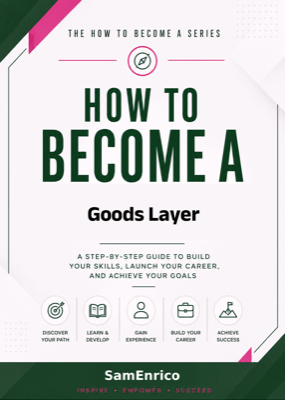
How to Become a Goods Layer Paperback
How to Become a Goods Layer
How to Become a Goods Layer
Formats
Free sample
Chapter 1: Beyond the Box--Every morning, you wake up, make coffee, check your phone, and drive to work. You do not think about the container ship that carried that phone from a factory in Zhengzhou to a port in Los Angeles. You do not wonder how the coffee beans from Ethiopia arrived at your local roaster. You do not calculate the miles that your car's brake pads traveled from a foundry in India to a distribution center in Ohio. And why would you?
The goods simply appear. This is the greatest magic trick of modern civilization—the invisibility of the goods layer.Most people go their entire lives without seeing the massive, fragile, beautiful infrastructure that brings everything they own from raw material to front door. They see the truck on the highway, yes. They see the Amazon van on their street. But they do not see the interconnected system: the container terminal operating twenty-four hours a day, the warehouse management system directing ten thousand picks per hour, the customs broker clearing a shipment in four hours instead of four days, the freight forwarder consolidating twenty small shipments into one cost-effective load.
They do not see the layer.This invisibility is by design. A well-functioning goods layer is like a healthy circulatory system: you only notice it when something goes wrong. And recently, many things went wrong. Empty shelves during the COVID-19 pandemic. The Ever Given stuck in the Suez Canal, holding nine billion dollars in trade hostage for six days.
A semiconductor factory in Taiwan shutting down for three weeks and paralyzing global auto production for six months. Trade wars that turned tariffs from boring paperwork into billion-dollar weapons.The invisibility ended. Suddenly, everyone wanted to understand the goods layer. But most people, even those working inside logistics and supply chain functions, see only fragments. They see a truck but not the routing algorithm.
They see a warehouse but not the theory of constraints. They see a shipping container but not the century of innovation that made it stackable, lockable, and transferable across three modes of transport without being opened.This book is for those who want to stop seeing fragments and start seeing the whole. This chapter is for those who want to stop moving boxes and start mastering the layer.The Great Misunderstanding Walk into any company and ask ten employees what logistics means. You will hear ten variations of the same answer. "Shipping stuff." "Moving products." "Trucks and warehouses." "Getting orders out the door." None of these answers are wrong, but all of them are incomplete.
They describe the visible tip of an invisible iceberg.The goods layer is the entire interface between production and consumption. It consists of three simultaneous flows, each as important as the physical movement of boxes.Physical flows. This is what most people imagine: raw materials moving from mines and farms to factories, components moving between suppliers, finished goods moving to distribution centers, then to retailers, then to customers, then—increasingly—back again as returns. Physical flows include the container ship crossing the Pacific, the train hauling fifty double-stacked containers through the Midwest, the diesel truck making the final delivery, the warehouse worker picking items from a shelf. Physical flows are tangible.
They are also only one-third of the story.Informational flows. Before a single box moves, data moves. Purchase orders travel from buyer to supplier. Advance ship notices tell the warehouse what is coming, on which truck, at what time. Bills of lading serve as contracts between shippers and carriers.
Customs declarations list every item, its value, its country of origin. Tracking events ping from scanners, global positioning system devices…
This is the end of the free sample. Get the Paperback to keep going. Buy now
About this book
Details
- Author
- Houle Merilyn
- Publisher
- SamEnrico
- Language
- English
- ISBN
- 9781505769050
- Genre
- Non-Fiction, Informative, Educational
- Released
- 2026-05-02
- Pages (approx.)
- 126
- Available as
- eBook, Paperback, Audiobook

Read better in the ZLOADR app
Your eBooks on your phone or tablet. Sign in with your SamEnrico account and start reading.
More by Houle Merilyn
 Tiger Woods Father ImpactHoule Merilyn$11.99
 HVAC Service Precedent GuideHoule Merilyn$11.99
 Nomad Friendly Banks AccountHoule Merilyn$11.99
 Creative Strategy for Business AnalystsHoule Merilyn$11.99
 The Diamond Mine SurvivorHoule Merilyn$11.99
 Sobriety Skin Recovery GuideHoule Merilyn$11.99
 Intrusive Thoughts OCDHoule Merilyn$11.99
 Filler Selection in Lineup FairnessHoule Merilyn$11.99
 The Phantom Passenger: The DEA’s Undercover Sting on the High SeasHoule Merilyn$11.99
 Oscar Niemeyer: The Architect Who Defied Gravity in ConcreteHoule Merilyn$11.99
 How to Produce a ThinnerHoule Merilyn$11.99
 How to Produce Hot SauceHoule Merilyn$11.99