
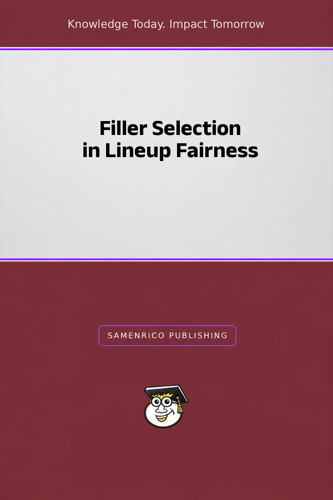
Filler Selection in Lineup Fairness
Details how choosing fillers who resemble suspects
Details how choosing fillers who resemble suspects reduces false picks and why police often fail at this.
Formats
About this book
Free sample
Chapter 1: The 400-Pound Tell--–- On a humid July evening in 1994, a convenience store clerk in Tulsa, Oklahoma, was shown a photo array that would send an innocent man to prison for three years. The clerk had been robbed at gunpoint three days earlier. She told police the suspect was "a very large man." That was the entirety of her description. No facial features, no hair color, no clothing details—just size. The police arrested Eric Kenley, a 400‑pound father of three, based on a tip from an informant with a grudge.
When they constructed the lineup, they placed Eric's photograph alongside five men who weighed, on average, 170 pounds. The clerk picked Eric in under four seconds. "I just knew it was him," she testified. "He was the only one who looked like he could have done it."She was right about one thing: he was the only one who looked like he could have done it. But looking like a perpetrator is not the same as being one.
Eric Kenley spent three years in prison before DNA evidence proved his innocence. The real robber, a man of similar size but different face, was never caught. When asked how she had been so certain, the clerk replied, "He stood out." That phrase—"he stood out"—is the single most dangerous phrase in the American criminal justice system.This book is about why that phrase is so dangerous, and what we can do about it. It is about a hidden variable in every police lineup, a variable so seemingly mundane that for decades it has been treated as an administrative afterthought. That variable is the selection of fillers—the known‑innocent people placed alongside a suspect in a photo array or live lineup.
How police choose those fillers determines whether a lineup tests memory or merely tests plausibility. Get it right, and eyewitness identification becomes a powerful tool for justice. Get it wrong, and you send innocent people to prison with the full confidence of the state behind you.This chapter introduces the core problem, the stakes involved, and the roadmap for…
This is the end of the free sample. Get the eBook to keep going. Buy now
Contents
- Chapter 1
- Chapter 2
- Chapter 3
- Chapter 4
- Chapter 5
- Chapter 6
- Chapter 7
- Chapter 8
- Chapter 9
- Chapter 10
- Chapter 11
- Chapter 12
Details
- Author
- Houle Merilyn
- Publisher
- SamEnrico
- Language
- English
- Genre
- Non-Fiction, True Crime, Lineup Construction
- Released
- 2026-06-05
- Pages (approx.)
- 138
- Available as
- eBook, Audiobook

Read better in the ZLOADR app
Your eBooks on your phone or tablet. Sign in with your SamEnrico account and start reading.
More by Houle Merilyn
 Tiger Woods Father ImpactHoule Merilyn$11.99
 HVAC Service Precedent GuideHoule Merilyn$11.99
 Nomad Friendly Banks AccountHoule Merilyn$11.99
 Creative Strategy for Business AnalystsHoule Merilyn$11.99
 The Diamond Mine SurvivorHoule Merilyn$11.99
 Sobriety Skin Recovery GuideHoule Merilyn$11.99
 Intrusive Thoughts OCDHoule Merilyn$11.99
 The Phantom Passenger: The DEA’s Undercover Sting on the High SeasHoule Merilyn$11.99
 Oscar Niemeyer: The Architect Who Defied Gravity in ConcreteHoule Merilyn$11.99
 How to Produce a ThinnerHoule Merilyn$11.99
 How to Produce Hot SauceHoule Merilyn$11.99
 UK Forced Labor Export Due DiligenceHoule Merilyn$12.99