
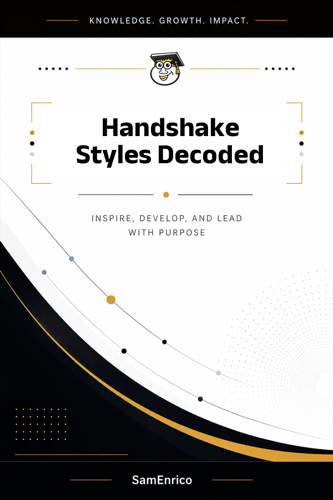
Handshake Styles Decoded eBook
Firmness, duration, and palm position signal inten
by Bayer Haley
Firmness, duration, and palm position signal intent.
Formats
Free sample
Chapter 1: The Five‑Second Verdict--–- The moment your palms touch, a verdict is reached. Not a conscious verdict—you won't hear words in your head like “I trust this person” or “Stay away.” But deep in the oldest part of your brain, the amygdala, a calculation has already run to completion. It took less than a second. And it will shape everything that follows.You have likely experienced this without realizing it. Think back to a recent first meeting—a job interview, a networking event, a blind date.
Within the first few seconds of shaking hands, you felt something: ease or unease, warmth or coldness, respect or condescension. You probably could not articulate why. But the feeling was real, and it colored every word exchanged afterward. If the handshake felt right, you found yourself leaning in, smiling more, assuming the best intentions. If it felt wrong, you held back, crossed your arms, looked for an exit.This is not superstition.
It is neuroscience.The handshake is the most information‑dense nonverbal transaction humans engage in. In the first three to five seconds of contact, your brain processes more social data than in a full minute of spoken small talk. Touch bypasses the verbal filters we so carefully construct. You can rehearse your opening line, control your facial expressions, and monitor your posture. But the handshake happens in real time, a live transmission of intent, confidence, and emotional state.This chapter is about why that moment matters more than you think, and what the five core variables of handshake analysis reveal about the person on the other end of that grip.The Anthropology of the Handshake Before we decode individual handshakes, we must understand why we shake hands at all.
The gesture is ancient. Historians have traced handshakes back to the 5th century BCE in Greece, where carved reliefs show soldiers clasping forearms. But the modern handshake—palm to palm, fingers wrapped—likely emerged in medieval Europe. Knights would extend their empty right hand to show they carried no weapon. The up‑and‑down motion was believed to dislodge any hidden dagger from a sleeve.The handshake was, from its origin, a signal of peaceful intent.
I come unarmed. I trust you to do the same.Over centuries, the practical function faded, but the psychological function deepened. The handshake became a ritual of bonding, agreement, and mutual recognition. In many cultures, a handshake still seals a deal more powerfully than a signed contract. The contract is a legal instrument; the handshake is a human one.Today, the handshake remains one of the few universally recognized gestures of greeting and farewell across Western and Western‑influenced cultures.
It is used in business, politics, social settings, and even sports. It is so common that we rarely think about it—which is precisely why it is so revealing. When people stop monitoring their behavior, their true signals leak through.The Amygdala Handshake Why is touch so powerful? The answer lies in brain architecture.Touch is the first sense to develop in the human fetus. Long before you could see or hear, you could feel.
The skin is the body’s largest sensory organ, and the palms of the hands are among the most densely innervated areas. When you touch another person’s hand, you are not performing a social nicety. You are conducting a neurological event.The sensation travels from the mechanoreceptors in your palm up the spinal cord to the brainstem, then rapidly to the thalamus, and finally to the somatosensory cortex. But another, faster pathway bypasses conscious processing entirely: a direct route from the thalamus to the amygdala. The amygdala is the brain’s threat detector, a small almond‑shaped cluster of nuclei that evaluates every incoming stimulus for potential danger.This is why you cannot “decide” to like someone based on their handshake.
The amygdala decides before you have time to think.Research using functional MRI has shown that the amygdala activates within milliseconds of skin‑to‑skin contact. It scans for pressure, temperature, moisture, and duration. It compares these inputs to stored memories of past handshakes—good and bad. And it generates a feeling: safe or unsafe, trustworthy or suspicious, dominant or submissive.That feeling is not a suggestion. It is a verdict.
And it is remarkably sticky.One study found that handshake quality predicted hiring decisions even when interviewers watched video recordings of the same candidates with the handshake edited out. The interviewers could not explain their preferences. But the candidates with firm, confident handshakes were rated as more hirable, more confident, and more intelligent—even when their qualifications and interview answers were identical to those with weak handshakes.The handshake, in other words, is a shortcut. It is your brain’s way of answering a complex question—“Should I trust this person?”—without the burden of conscious deliberation.The Four Core Factors (Plus One Modifier)Throughout this book, we will analyze handshakes using a systematic framework. Earlier drafts of this book proposed five primary factors, but careful research and field testing have refined that list.
The Four Core Factors are the essential variables that most strongly predict how a handshake will be interpreted. A fifth modifier—left‑hand use—is important but context‑dependent and will be treated separately.Here are the Four Core Factors:1. Firmness – The amount of lateral pressure applied during the grip. Too little signals weakness or disinterest. Too much signals aggression or insecurity.
The sweet spot signals equality and presence.2. Duration – How long the hands remain in contact. Too short signals coldness or rejection. Too long signals intimacy or power play. The ideal varies by context (opening vs.
closing, culture vs. culture).3. Palm Position – The orientation of your palm relative to the other person’s. Palm down signals dominance. Palm up signals submission.
Vertical palms signal equality.4. Texture and Moisture – The physical condition of the hand. Sweaty or cold palms signal anxiety (often misinterpreted as dishonesty). Calloused or soft hands signal lifestyle and profession.The modifier is Left‑Hand Use – touching the other person’s hand, wrist, elbow, or shoulder with your left hand during the shake. This intensifies the signal but carries significant social risk if used inappropriately.
We will cover it in depth in Chapter 6.Why is eye contact not a core factor? Because eye contact is a separate nonverbal channel. It is critically important—a handshake without eye contact is like a sentence without a verb—but it operates independently. You can have perfect eye contact and a terrible handshake, or vice versa. Throughout this book, we will discuss eye contact where relevant (see especially the sincerity checklist in Chapter 6), but it is not baked into the handshake itself.Similarly, pumping frequency (vigor) is a secondary variable.
A slow, solemn pump vs. rapid, enthusiastic pumps can modify meaning, but it rarely overrides the four core factors. We will address it in Chapter 3.The Cost of a Bad Shake What happens when a handshake goes wrong? The data are sobering.A landmark study by researchers at the University of Iowa found that handshake quality accounted for significant variance in first‑impression ratings even after controlling for attractiveness, grooming, and verbal skills. Weak handshakes…
This is the end of the free sample. Get the eBook to keep going. Buy now
About this book
Details
- Author
- Bayer Haley
- Publisher
- SamEnrico
- Language
- English
- Genre
- Non-Fiction, Self-Help, Handshake
- Released
- 2026-06-10
- Pages (approx.)
- 146
- Available as
- eBook, Audiobook

Read better in the ZLOADR app
Your eBooks on your phone or tablet. Sign in with your SamEnrico account and start reading.
More by Bayer Haley
 Foster Care Immigrant ChildhoodBayer Haley$11.99
 Remote Work Meeting GuideBayer Haley$11.99
 Anger at Childs Drug UseBayer Haley$11.99
 World Cafe Method GuideBayer Haley$11.99
 Design Thinking for ManagersBayer Haley$11.99
 Dream Falling JournalBayer Haley$11.99
 Small Talk for Family GatheringsBayer Haley$11.99
 The Unseen Crown: The Rise and Fall of the World's First Supermodel, Lisa FonssagrivesBayer Haley$11.99
 The Axeman of New Orleans: The Cipher That Waited a CenturyBayer Haley$11.99
 Water Sport Assembler WorkerBayer Haley$11.99
 How to Produce Cocoa BeansBayer Haley$11.99
 DAAD Scholarship Germany GuideBayer Haley$12.99
You may also like
 Hong Kong Handover 1997Dunn Johnnie$11.99
 Zumba For Postnatal Recovery CourseNeal Christian$11.99
 Zumba for BeginnersLadner Nikia$11.99
 YouTube Comment Mining GuideHumes Pandora$12.99
 Worry Box MeditationCarlin Rudy$11.99
 Workplace Stress MeditationNguyen Lynn$11.99
 Workplace Stress and Sleep RepairHawley Ivory$11.99
 Workplace Perfectionism CureDelaney Jeffry$11.99
 Workplace Injustice Anger GuideWallen Isabelle$11.99
 Work Addiction and Burnout LinkGreenwood Ester$11.99
 Women in Yoga and WellnessBeattie Galina$11.99
 Women in Stand Up ComedyChun Evangeline$11.99