
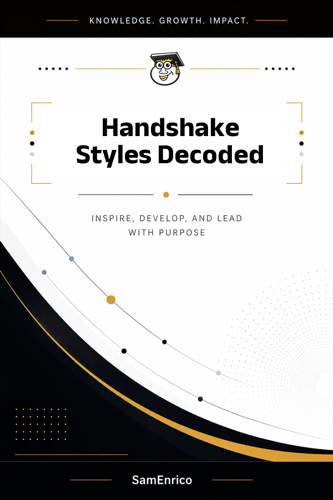
Handshake Styles Decoded Audiobook
Firmness, duration, and palm position signal inten
by Bayer Haley
Firmness, duration, and palm position signal intent.
Formats
Free sample
Chapter 1: The Five‑Second Verdict--–- The moment your palms touch, a verdict is reached. Not a conscious verdict—you won't hear words in your head like “I trust this person” or “Stay away.” But deep in the oldest part of your brain, the amygdala, a calculation has already run to completion. It took less than a second. And it will shape everything that follows.You have likely experienced this without realizing it. Think back to a recent first meeting—a job interview, a networking event, a blind date.
Within the first few seconds of shaking hands, you felt something: ease or unease, warmth or coldness, respect or condescension. You probably could not articulate why. But the feeling was real, and it colored every word exchanged afterward. If the handshake felt right, you found yourself leaning in, smiling more, assuming the best intentions. If it felt wrong, you held back, crossed your arms, looked for an exit.This is not superstition.
It is neuroscience.The handshake is the most information‑dense nonverbal transaction humans engage in. In the first three to five seconds of contact, your brain processes more social data than in a full minute of spoken small talk. Touch bypasses the verbal filters we so carefully construct. You can rehearse your opening line, control your facial expressions, and monitor your posture. But the handshake happens in real time, a live transmission of intent, confidence, and emotional state.This chapter is about why that moment matters more than you think, and what the five core variables of handshake analysis reveal about the person on the other end of that grip.The Anthropology of the Handshake Before we decode individual handshakes, we must understand why we shake hands at all.
The gesture is ancient. Historians have traced handshakes back to the 5th century BCE in Greece, where carved reliefs show soldiers clasping forearms. But the modern handshake—palm to palm, fingers wrapped—likely emerged in medieval Europe. Knights would extend their empty right hand to show they carried no weapon. The up‑and‑down motion was believed to dislodge any hidden dagger from a sleeve.The handshake was, from its origin, a signal of peaceful intent.
I come unarmed. I trust you to do the same.Over centuries, the practical function faded, but the psychological function deepened. The handshake became a ritual of bonding, agreement, and mutual recognition. In many cultures…
This is the end of the free sample. Get the Audiobook to keep going. Buy now
About this book
Details
- Author
- Bayer Haley
- Publisher
- SamEnrico
- Language
- English
- Genre
- Non-Fiction, Self-Help, Handshake
- Released
- 2026-06-10
- Pages (approx.)
- 146
- Available as
- eBook, Audiobook

Listen in the VoxFlicks app
Audiobooks and audio dramas wherever you go. Sign in with your SamEnrico account and press play.
More by Bayer Haley
 Foster Care Immigrant ChildhoodBayer Haley$11.99
 Remote Work Meeting GuideBayer Haley$11.99
 Anger at Childs Drug UseBayer Haley$11.99
 World Cafe Method GuideBayer Haley$11.99
 Design Thinking for ManagersBayer Haley$11.99
 Dream Falling JournalBayer Haley$11.99
 Small Talk for Family GatheringsBayer Haley$11.99
 The Unseen Crown: The Rise and Fall of the World's First Supermodel, Lisa FonssagrivesBayer Haley$11.99
 The Axeman of New Orleans: The Cipher That Waited a CenturyBayer Haley$11.99
 Water Sport Assembler WorkerBayer Haley$11.99
 How to Produce Cocoa BeansBayer Haley$11.99
 DAAD Scholarship Germany GuideBayer Haley$12.99