
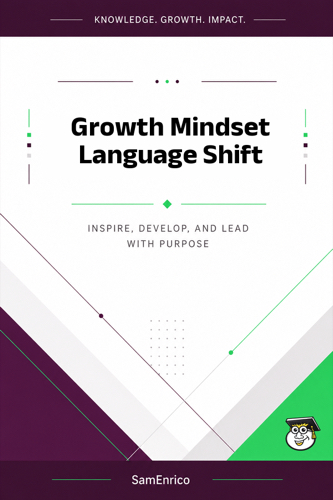
Growth Mindset Language Shift Audiobook
Changes I can't to I can't yet vocabulary.
by Gilson Dara
Changes I can't to I can't yet vocabulary.
Formats
Free sample
Chapter 1: The Linguistic Trap--–- Maria had said the word aloud at least forty-seven times before breakfast. "I can't cook." She wasn't being dramatic or self-deprecating for sympathy. She was simply stating what she believed to be a fact, as immutable as her height or the color of her eyes. At thirty-four years old, after a decade of burnt rice, under-salted soups, and one memorable incident involving a smoke alarm and a frozen pizza, Maria had filed "cooking" under the permanent category of things she would never do. She ordered takeout, relied on her husband for weekend meals, and felt a small wave of shame whenever colleagues at work discussed their sourdough starters.
But the shame was manageable. What was less manageable was the creeping realization that the same linguistic pattern—"I can't"—had begun leaking into other domains. "I can't learn new software at work." "I can't sustain an exercise routine." "I can't have difficult conversations with my mother." Each statement felt as solid and true as the last. Maria was not aware that she had made a quiet but devastating agreement with herself: that the person she was today was the person she would always be. She had mistaken a snapshot for a biography.This chapter is about why Maria is wrong—and why you might be making the same mistake without knowing it.The Ordinary Word That Functions Like a Lock Let us begin with a simple experiment.
Complete the following sentence aloud or in your mind: "I can't..."What came next? Perhaps it was something trivial ("I can't parallel park"). Perhaps it was something profound ("I can't trust people after what happened"). Perhaps it was something you have said so many times that you no longer hear yourself say it ("I can't catch a break").The word "can't" is among the most common in the English language. It appears in everyday conversation so frequently that we barely register it.
We use it as a shortcut, a convenience, a way to communicate limitation without having to explain the messy specifics of why. But beneath its ordinary exterior lies something far more consequential. The word "can't" is not a neutral descriptor of reality. It is an active psychological mechanism that shuts down possibility. When you say "I can't," your brain does not hear a statement about a specific skill at a specific moment.
It hears a permanent verdict on your identity.This is not metaphor. This is neurology.The Neuroscience of Finality In the 1960s…
This is the end of the free sample. Get the Audiobook to keep going. Buy now
About this book
Details
- Author
- Gilson Dara
- Publisher
- SamEnrico
- Language
- English
- Genre
- Non-Fiction, Self-Help, Language
- Released
- 2026-06-10
- Pages (approx.)
- 138
- Available as
- eBook, Audiobook

Listen in the VoxFlicks app
Audiobooks and audio dramas wherever you go. Sign in with your SamEnrico account and press play.
More by Gilson Dara
 Road Rage Breathing TechniquesGilson Dara$11.99
 Collaborative Problem SolvingGilson Dara$11.99
 The Wage Garnishment GuideGilson Dara$11.99
 Blockchain in Supply ChainsGilson Dara$11.99
 The OKR for Startups GuideGilson Dara$11.99
 Mindfulness for Insomnia BeginnersGilson Dara$11.99
 Outsourcing for Data ScientistsGilson Dara$11.99
 Lutfi Hashim: Iraq's Forgotten Olympic PioneerGilson Dara$11.99
 Embers of the Forgotten: The Last Pyromancers of PompeiiGilson Dara$11.99
 The Essential Guide to Gangsta RapGilson Dara$11.99
 Satsuma: Seedless MandarinGilson Dara$11.99
 How to Produce Electronics ManualsGilson Dara$11.99
You may also like
 Hong Kong Handover 1997Dunn Johnnie$11.99
 Zumba For Postnatal Recovery CourseNeal Christian$11.99
 Zumba for BeginnersLadner Nikia$11.99
 YouTube Comment Mining GuideHumes Pandora$12.99
 Worry Box MeditationCarlin Rudy$11.99
 Workplace Stress MeditationNguyen Lynn$11.99
 Workplace Stress and Sleep RepairHawley Ivory$11.99
 Workplace Perfectionism CureDelaney Jeffry$11.99
 Workplace Injustice Anger GuideWallen Isabelle$11.99
 Work Addiction and Burnout LinkGreenwood Ester$11.99
 Women in Yoga and WellnessBeattie Galina$11.99
 Women in Stand Up ComedyChun Evangeline$11.99