
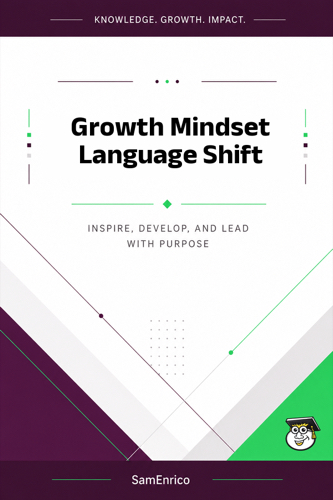
Growth Mindset Language Shift eBook
Changes I can't to I can't yet vocabulary.
by Gilson Dara
Changes I can't to I can't yet vocabulary.
Formats
Free sample
Chapter 1: The Linguistic Trap--–- Maria had said the word aloud at least forty-seven times before breakfast. "I can't cook." She wasn't being dramatic or self-deprecating for sympathy. She was simply stating what she believed to be a fact, as immutable as her height or the color of her eyes. At thirty-four years old, after a decade of burnt rice, under-salted soups, and one memorable incident involving a smoke alarm and a frozen pizza, Maria had filed "cooking" under the permanent category of things she would never do. She ordered takeout, relied on her husband for weekend meals, and felt a small wave of shame whenever colleagues at work discussed their sourdough starters.
But the shame was manageable. What was less manageable was the creeping realization that the same linguistic pattern—"I can't"—had begun leaking into other domains. "I can't learn new software at work." "I can't sustain an exercise routine." "I can't have difficult conversations with my mother." Each statement felt as solid and true as the last. Maria was not aware that she had made a quiet but devastating agreement with herself: that the person she was today was the person she would always be. She had mistaken a snapshot for a biography.This chapter is about why Maria is wrong—and why you might be making the same mistake without knowing it.The Ordinary Word That Functions Like a Lock Let us begin with a simple experiment.
Complete the following sentence aloud or in your mind: "I can't..."What came next? Perhaps it was something trivial ("I can't parallel park"). Perhaps it was something profound ("I can't trust people after what happened"). Perhaps it was something you have said so many times that you no longer hear yourself say it ("I can't catch a break").The word "can't" is among the most common in the English language. It appears in everyday conversation so frequently that we barely register it.
We use it as a shortcut, a convenience, a way to communicate limitation without having to explain the messy specifics of why. But beneath its ordinary exterior lies something far more consequential. The word "can't" is not a neutral descriptor of reality. It is an active psychological mechanism that shuts down possibility. When you say "I can't," your brain does not hear a statement about a specific skill at a specific moment.
It hears a permanent verdict on your identity.This is not metaphor. This is neurology.The Neuroscience of Finality In the 1960s, psychologist Martin Seligman conducted a series of experiments that would fundamentally change our understanding of human limitation. Dogs were placed in a chamber and exposed to mild electric shocks. One group could stop the shocks by pressing a panel. Another group could not—no matter what they did, the shocks continued.
When both groups were later placed in a new chamber where escape was possible simply by jumping over a low barrier, the first group learned to escape immediately. The second group did something remarkable: they lay down and whimpered. They did not attempt to jump. They did not search for the exit. They had learned, in the most profound sense, that nothing they did mattered.
Seligman called this phenomenon "learned helplessness."Here is what Seligman's research revealed about language: the brain generalizes from specific experiences to global beliefs. A dog that cannot escape shocks in one context concludes that it cannot escape anywhere. A human who fails at cooking concludes that she "can't cook" anywhere, ever, for any reason. The word "can't" is the linguistic vehicle for this generalization. It takes a specific failure—"I burned the rice three times"—and transforms it into a permanent identity—"I am not a cook." Once that transformation occurs, the brain stops searching for solutions.
Why would it search? The case is closed. The verdict is in.Modern neuroimaging studies have confirmed what Seligman suspected. When people encounter problems they believe they cannot solve, the prefrontal cortex—the region responsible for planning, problem-solving, and goal-directed behavior—shows reduced activation. Meanwhile, the amygdala, the brain's alarm system, shows increased activity.
In other words, saying "I can't" triggers a mild threat response. The brain perceives limitation as danger and responds by shutting down the very cognitive processes that might find a way around that limitation. The word "can't" does not describe a closed door. It locks the door and throws away the key.The Linguistic Period: A Mental Full Stop To understand how this works in real time, consider the difference between two punctuation marks. A period ends a sentence.
It signals completion, finality, no further discussion. A comma, by contrast, signals a pause—a temporary stop within a longer flow. When you say "I can't," you are placing a mental period at the end of that thought. The sentence is over. The matter is settled.
When you say "I can't yet," you are placing a comma. The sentence continues. Something else is coming. The story is not finished.Here is the critical insight that will guide this entire book: every "I can't" is a snapshot of a single moment in time, not a biography of a lifetime. When Maria said "I can't cook," she was describing the results of her previous attempts.
She was not describing her potential. She was not describing her capacity to learn. She was not describing the version of herself who might take a cooking class, watch You Tube tutorials, or simply practice with a more forgiving recipe. She was describing a handful of past failures as if they were prophesies of all future ones. This is the linguistic trap: using the past to predict the future as if the future has no vote in the matter.The philosopher Søren Kierkegaard once observed that "life can only be understood backwards, but it must be lived forwards." The linguistic trap reverses this wisdom.
It takes the backward understanding and treats it as a forward constraint. "I couldn't do it before" becomes "I can't do it now or ever." The word "can't" collapses time. It erases the possibility that learning, practice, new strategies, or simply a different day might produce a different outcome.The Four Domains Where "Can't" Does Its Damage The linguistic trap is not limited to one area of life. It spreads. Maria's "I can't cook" was connected to an "I can't exercise" and an "I can't learn software" and an "I can't talk to my mother." The pattern had metastasized.
To help readers identify where the trap has taken hold in their own lives, this chapter introduces the first practical tool of the book: the Pause & Play Audit.The audit operates across four domains:Domain One: Work. What tasks, skills, or responsibilities at your job have you labeled with "I can't"? Common examples include public speaking, learning new software, managing people, negotiating salaries, or saying no to additional projects. Write down every "I can't" you have said about work in the past month. Do not censor yourself.Domain Two: Relationships.
What interpersonal skills or patterns have you decided are beyond you? "I can't have difficult conversations." "I can't set boundaries with my parents." "I can't express my needs without feeling…
This is the end of the free sample. Get the eBook to keep going. Buy now
About this book
Details
- Author
- Gilson Dara
- Publisher
- SamEnrico
- Language
- English
- Genre
- Non-Fiction, Self-Help, Language
- Released
- 2026-06-10
- Pages (approx.)
- 138
- Available as
- eBook, Audiobook

Read better in the ZLOADR app
Your eBooks on your phone or tablet. Sign in with your SamEnrico account and start reading.
More by Gilson Dara
 Road Rage Breathing TechniquesGilson Dara$11.99
 Collaborative Problem SolvingGilson Dara$11.99
 The Wage Garnishment GuideGilson Dara$11.99
 Blockchain in Supply ChainsGilson Dara$11.99
 The OKR for Startups GuideGilson Dara$11.99
 Mindfulness for Insomnia BeginnersGilson Dara$11.99
 Outsourcing for Data ScientistsGilson Dara$11.99
 Lutfi Hashim: Iraq's Forgotten Olympic PioneerGilson Dara$11.99
 Embers of the Forgotten: The Last Pyromancers of PompeiiGilson Dara$11.99
 The Essential Guide to Gangsta RapGilson Dara$11.99
 Satsuma: Seedless MandarinGilson Dara$11.99
 How to Produce Electronics ManualsGilson Dara$11.99
You may also like
 The Power Of Yet Mindset GuideGamble Breanna$11.99
 The Verbal Aggression DetectorForsyth Corene$11.99
 The Growth Mindset for Language LearningRowland Alyse$11.99
 Active Listening For ESL SpeakersHoppe Jackeline$11.99
 The Power of YetAustin Carol$11.99
 Goal Setting for Language LearningGetz Yolonda$11.99
 Embedded Commands in ScriptsWhiting Mavis$11.99
 Vocabulary Memorization GuideGoss Phoebe$11.99
 The Emotional Vocabulary BuilderCausey Janiece$11.99
 Word Finding Difficulty GuideBrumfield Chanda$11.99
 The Multilingual Speaker GuideOdonnell Bertie$11.99
 The Blame Free Vocabulary GuideConnell Agripina$11.99