
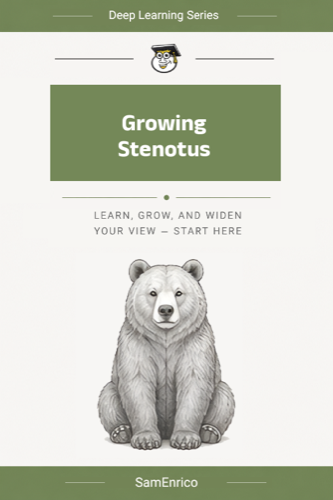
Growing Stenotus
This publication, published by SamEnrico, covers G
This publication, published by SamEnrico, covers Growing Stenotus
Formats
About this book
Free sample
Chapter 1: The Hidden Architecture...-- For the first-time observer, a healthy Stenotus cushion appears as little more than a pleasing golden mound – a botanical beanbag chair draped in sunshine. But beneath that unassuming exterior lies one of the most brilliantly engineered survival machines in the plant kingdom. To grow Stenotus successfully, you must first understand not what the plant looks like, but how it works. This chapter dissects the hidden architecture that allows a plant barely four inches tall to outlive its gardener, thrive on bare rock, and explode into a constellation of gold each spring. We will explore five interconnected systems: the taproot, the cushion, the foliage, the bloom, and the remarkable genetic plasticity that separates Stenotus from ordinary perennials.
By the end, you will see mock goldenweed not as a plant, but as a living masterclass in adaptation.The Taproot: Depth as a Survival Strategy Most gardeners think of roots as spreading networks that hunt for water near the surface. For Stenotus, nothing could be further from the truth. The taproot system of a mature Stenotus acaulis can penetrate twelve inches or more into the soil – a remarkable depth for a plant whose entire above-ground structure stands just two to four inches tall. This ratio of depth to height (approximately 3:1) is one of the defining characteristics of the genus and the single most important fact for anyone who wishes to cultivate it successfully.Why such depth? The answer lies in the plant's native habitat.
In the Rocky Mountain alpine zone and the high deserts of the Great Basin, surface moisture evaporates within hours of a rainfall. A shallow-rooted plant would experience drought stress by mid-morning. But Stenotus taps into moisture reserves that linger deeper in the soil profile, where temperatures are cooler and evaporation is negligible. In practical terms, this means that an established Stenotus can survive weeks – sometimes months – without surface moisture while a shallow-rooted succulent in the same pot would be dead within days.The anatomy of the taproot itself is equally remarkable. It is not a simple, carrot-like taper but rather a woody, branching…
This is the end of the free sample. Get the eBook to keep going. Buy now
Contents
- Chapter 1
- Chapter 2
- Chapter 3
- Chapter 4
- Chapter 5
- Chapter 6
- Chapter 7
- Chapter 8
- Chapter 9
- Chapter 10
- Chapter 11
- Chapter 12
Details
- Author
- Martindale Letha
- Publisher
- SamEnrico
- Language
- English
- Genre
- Non-Fiction, Informative, Educational
- Released
- 2026-06-02
- Pages (approx.)
- 148
- Available as
- eBook, Audiobook

Read better in the ZLOADR app
Your eBooks on your phone or tablet. Sign in with your SamEnrico account and start reading.
More by Martindale Letha
 The Affirmation App MethodMartindale Letha$11.99
 Breath for InsomniaMartindale Letha$11.99
 Tidal Pool GuideMartindale Letha$11.99
 Comparison Culture and MindfulnessMartindale Letha$11.99
 Mindful Breathing For StressMartindale Letha$11.99
 Rockefeller Oil RefiningMartindale Letha$11.99
 Adoption After Loss GuideMartindale Letha$11.99
 Marilyn Sheppard Forensic FileMartindale Letha$11.99
 Oliver Wendell HolmesMartindale Letha$11.99
 The Silent Storm: The Untold Story of the USS Scorpion's Last MissionMartindale Letha$11.99
 The Silent Saboteurs: Poland’s Shadow War Against the Soviets (1944-1945)Martindale Letha$11.99
 Neon Mirage: The Rise and Fall of the First AI Pop StarMartindale Letha$11.99