
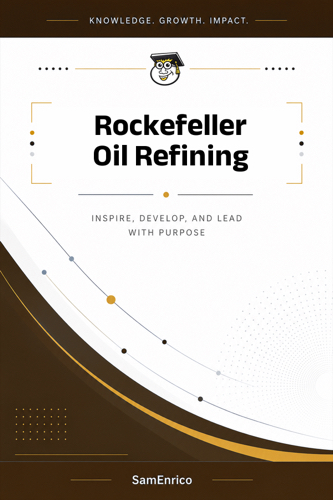
About this book
Free sample
Chapter 1: The Creeks of Chaos--–- In the summer of 1859, a retired railroad conductor named Edwin Drake stood on the muddy banks of Oil Creek in Venango County, Pennsylvania, watching a contraption of his own design pound slowly into the earth. The local farmers called him crazy. The well drillers called him an amateur. And for weeks, the ground yielded nothing but brine water and frustration. But on August 27, at a depth of just sixty-nine and a half feet, Drake’s drill bit hit a crack in the bedrock, and then it happened: a thick, greenish-black liquid began oozing up the pipe, bubbling over the sides of the derrick, and spilling into the creek.
Within days, the smell of crude oil hung over the valley like a curse. Within weeks, the creek ran black. And within a year, the greatest industrial transformation in American history had begun—not with a plan, not with a system, but with a mess.This is not a story about the romance of discovery. It is a story about waste.The popular imagination pictures the early oil industry as a heroic age of wildcatters striking it rich, of black gold shooting a hundred feet into the air, of men in wide-brimmed hats lighting cigars with hundred-dollar bills. That image is not wrong, exactly, but it is profoundly incomplete.
The same gushers that made a few men overnight millionaires also flooded the countryside with millions of barrels of oil that no one could store, no one could transport, and no one could refine fast enough to keep from spoiling. For every barrel that reached a refinery and became kerosene for a lamp, at least one more barrel—often two or three more—simply disappeared into the mud, evaporated into the air, or burned in a catastrophic fire that consumed an entire refinery district.The villain of this story is not greed. Greed is predictable, and in the oil business, greed at least had the virtue of motivating production. The true villain is waste—waste so colossal, so pervasive, and so accepted as normal that no one in the early 1860s…
This is the end of the free sample. Get the eBook to keep going. Buy now
Contents
- Chapter 1
- Chapter 2
- Chapter 3
- Chapter 4
- Chapter 5
- Chapter 6
- Chapter 7
- Chapter 8
- Chapter 9
- Chapter 10
- Chapter 11
- Chapter 12
Details
- Author
- Martindale Letha
- Publisher
- SamEnrico
- Language
- English
- Genre
- Non-Fiction, Biography / Efficiency
- Released
- 2026-06-08
- Pages (approx.)
- 142
- Available as
- eBook, Audiobook

Read better in the ZLOADR app
Your eBooks on your phone or tablet. Sign in with your SamEnrico account and start reading.
More by Martindale Letha
 The Affirmation App MethodMartindale Letha$11.99
 Breath for InsomniaMartindale Letha$11.99
 Tidal Pool GuideMartindale Letha$11.99
 Comparison Culture and MindfulnessMartindale Letha$11.99
 Mindful Breathing For StressMartindale Letha$11.99
 Adoption After Loss GuideMartindale Letha$11.99
 Marilyn Sheppard Forensic FileMartindale Letha$11.99
 Oliver Wendell HolmesMartindale Letha$11.99
 The Silent Storm: The Untold Story of the USS Scorpion's Last MissionMartindale Letha$11.99
 The Silent Saboteurs: Poland’s Shadow War Against the Soviets (1944-1945)Martindale Letha$11.99
 Neon Mirage: The Rise and Fall of the First AI Pop StarMartindale Letha$11.99
 How to Start a False Beard Business (Beginners Guide)Martindale Letha$11.99