
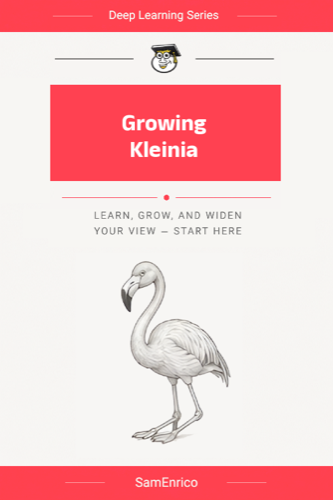
Growing Kleinia
This publication, published by SamEnrico, covers G
This publication, published by SamEnrico, covers Growing Kleinia
Formats
About this book
Free sample
Chapter 1: Beyond the Pickle--–- The first time I killed a Kleinia, I was trying to save it. The second time, I was showing off. The third time—well, that was the charm, because by then I had finally learned to listen instead of guess. This book exists because those three deaths taught me more than twenty years of easy succulents ever did. If you are holding this book, you have likely seen something strange at a nursery or in a friend’s collection: a plant that looks like a pickle standing on end, or a trailing vine that seems to inchworm its way across the soil surface, or a silver-blue candelabra with joints like a skeleton.
You did not know what to call it, but you knew you wanted one. That plant is a Kleinia, and this chapter is your first real introduction to a genus that horticulture has largely forgotten, mislabeled, and misunderstood.Before we talk about soil, water, or light, you need to know what a Kleinia actually is—and perhaps more importantly, what it is not. For decades, these plants have been hidden in plain sight under the wrong name. Walk into almost any succulent nursery, and you will find a plant labeled Senecio stapeliiformis or Senecio articulatus or Senecio pendulus. Those labels are not technically wrong, but they are outdated.
Botanists have spent the last thirty years untangling a taxonomic knot that began in 1753 when Carl Linnaeus first described the genus Senecio as a catch-all for thousands of plants with daisy-like flowers. The problem is that Senecio became a junk drawer. If a plant had small brush-like flowers and succulent stems, into Senecio it went, regardless of its actual evolutionary relationships.The Great Divorce: Why Kleinia Left Senecio The separation began in earnest during the 1970s and 1980s when botanists started looking beyond flower morphology and into leaf anatomy, stem structure, and eventually DNA. What they found was a shock. The plants we now call Kleinia share a common ancestor that is distinct from true Senecio.
The differences are subtle to the untrained eye but profound to the plant itself. True Senecio species typically have flat…
This is the end of the free sample. Get the eBook to keep going. Buy now
Contents
- Chapter 1
- Chapter 2
- Chapter 3
- Chapter 4
- Chapter 5
- Chapter 6
- Chapter 7
- Chapter 8
- Chapter 9
- Chapter 10
- Chapter 11
- Chapter 12
Details
- Author
- Rodriguez Edward
- Publisher
- SamEnrico
- Language
- English
- Genre
- Non-Fiction, Informative, Educational
- Released
- 2026-06-02
- Pages (approx.)
- 143
- Available as
- eBook, Audiobook

Read better in the ZLOADR app
Your eBooks on your phone or tablet. Sign in with your SamEnrico account and start reading.
More by Rodriguez Edward
 User Co Creation GuideRodriguez Edward$11.99
 Migraine and Essential OilsRodriguez Edward$11.99
 NVC for GriefRodriguez Edward$11.99
 Blue Zone Home DesignRodriguez Edward$11.99
 Attention Residue CleanupRodriguez Edward$11.99
 Stress and Cold Sores OutbreaksRodriguez Edward$11.99
 Childhood Cancer SurvivorRodriguez Edward$11.99
 Carbohydrate Addiction GuideRodriguez Edward$11.99
 Nap for Presentation DayRodriguez Edward$11.99
 The Silk Road Cyclist: The Forgotten Race That Connected EmpiresRodriguez Edward$11.99
 The Day the Sky Split: The Great Molten River DisasterRodriguez Edward$11.99
 Silent Skies: The Untold Story of the Berlin Drone WarRodriguez Edward$11.99