
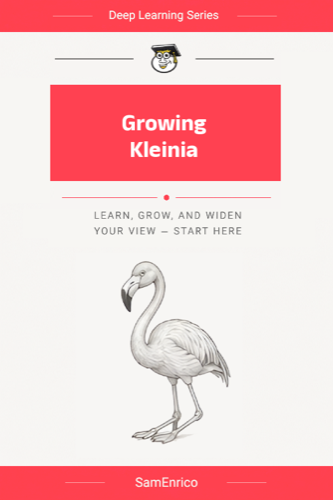
Non-FictionInformativeEducational
Growing Kleinia Audiobook
This publication, published by SamEnrico, covers G
This publication, published by SamEnrico, covers Growing Kleinia
Formats
Free sample
Chapter 1: Beyond the Pickle--–- The first time I killed a Kleinia, I was trying to save it. The second time, I was showing off. The third time—well, that was the charm, because by then I had finally learned to listen instead of guess. This book exists because those three deaths taught me more than twenty years of easy succulents ever did. If you are holding this book, you have likely seen something strange at a nursery or in a friend’s collection: a plant that looks like a pickle standing on end, or a trailing vine that seems to inchworm its way across the soil surface, or a silver-blue candelabra with joints like a skeleton.
You did not know what to call it, but you knew you wanted one. That plant is a Kleinia, and this chapter is your first real introduction to a genus that horticulture has largely forgotten, mislabeled, and misunderstood.Before we talk about soil, water, or light, you need to know what a Kleinia actually is—and perhaps more importantly, what it is not. For decades, these plants have been hidden in plain sight under the wrong name. Walk into almost any succulent nursery, and you will find a plant labeled Senecio stapeliiformis or Senecio articulatus or Senecio pendulus. Those labels are not technically wrong, but they are outdated.
Botanists have spent the last thirty years untangling a taxonomic knot that began in 1753 when Carl Linnaeus first described the genus Senecio as a catch-all for thousands of plants with daisy-like flowers. The problem is that Senecio became a junk drawer. If a plant had small brush-like flowers and succulent stems, into Senecio it went, regardless of its actual evolutionary relationships.The Great Divorce: Why Kleinia Left Senecio The separation began in earnest during the 1970s and 1980s when botanists started looking beyond flower morphology and into leaf anatomy, stem structure, and eventually DNA. What they found was a shock. The plants we now call Kleinia share a common ancestor that is distinct from true Senecio.
The differences are subtle to the untrained eye but profound to the plant itself. True Senecio species typically have flat, thin leaves and herbaceous stems that die back after flowering. Kleinia, by contrast, are almost universally succulent. Their stems are thickened with water storage tissue. Their leaves, when present, are often reduced to small scales or ephemeral growths that…
This is the end of the free sample. Get the Audiobook to keep going. Buy now
About this book
Details
- Author
- Rodriguez Edward
- Publisher
- SamEnrico
- Language
- English
- Genre
- Non-Fiction, Informative, Educational
- Released
- 2026-06-02
- Pages (approx.)
- 143
- Available as
- eBook, Audiobook

Listen in the VoxFlicks app
Audiobooks and audio dramas wherever you go. Sign in with your SamEnrico account and press play.
More by Rodriguez Edward
 User Co Creation GuideRodriguez Edward$11.99
 Migraine and Essential OilsRodriguez Edward$11.99
 NVC for GriefRodriguez Edward$11.99
 Blue Zone Home DesignRodriguez Edward$11.99
 Attention Residue CleanupRodriguez Edward$11.99
 Stress and Cold Sores OutbreaksRodriguez Edward$11.99
 Childhood Cancer SurvivorRodriguez Edward$11.99
 Carbohydrate Addiction GuideRodriguez Edward$11.99
 Nap for Presentation DayRodriguez Edward$11.99
 The Silk Road Cyclist: The Forgotten Race That Connected EmpiresRodriguez Edward$11.99
 The Day the Sky Split: The Great Molten River DisasterRodriguez Edward$11.99
 Silent Skies: The Untold Story of the Berlin Drone WarRodriguez Edward$11.99
You may also like
 Hong Kong Handover 1997Dunn Johnnie$11.99
 Zumba For Postnatal Recovery CourseNeal Christian$11.99
 Zumba for BeginnersLadner Nikia$11.99
 YouTube Comment Mining GuideHumes Pandora$12.99
 Worry Box MeditationCarlin Rudy$11.99
 Workplace Stress MeditationNguyen Lynn$11.99
 Workplace Stress and Sleep RepairHawley Ivory$11.99
 Workplace Perfectionism CureDelaney Jeffry$11.99
 Workplace Injustice Anger GuideWallen Isabelle$11.99
 Work Addiction and Burnout LinkGreenwood Ester$11.99
 Women in Yoga and WellnessBeattie Galina$11.99
 Women in Stand Up ComedyChun Evangeline$11.99