
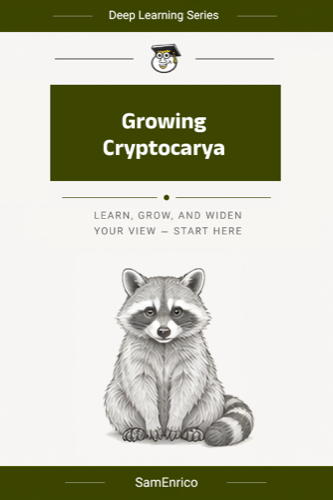
Non-FictionInformativeEducational
Growing Cryptocarya eBook
This publication, published by SamEnrico, covers G
This publication, published by SamEnrico, covers Growing Cryptocarya
Formats
Free sample
Chapter 1: The Hidden Laurel...–- On a steep hillside in central Chile, where summer rains haven’t fallen in four months and the cracked earth resembles dried riverbeds, a farmer named Cristóbal does something that would seem irrational to most commercial growers. He walks past his wilting avocado saplings—each one a thirty-dollar investment turning yellow despite his irrigation—and stops in front of a tree his grandfather planted fifty years ago. Its canopy casts a dense, cool shadow. Its leaves are glossy, dark green, and utterly untroubled. Beneath it, the soil remains moist without any recent watering.
And in the branches, thousands of small pinkish-red fruits hang like ornaments, untouched by the drought that has bankrupted neighbors who bet everything on avocados.That tree is Cryptocarya alba. In the local Mapuche language, it is called Peumo. And it is the most underrated, overlooked, and potentially valuable tree most gardeners have never heard of.This book exists because that tree—and its 200-plus relatives across the tropics of South America, Southeast Asia, and Australia—deserves a place in every climate-resilient food forest, every native habitat restoration project, and every nursery owner’s catalog. But before we dig into germination protocols, pruning techniques, or harvest schedules, we need to answer a more fundamental question: What exactly is Cryptocarya, and why has it remained hidden in plain sight for so long?The Genus You’ve Never Heard Of (But Should)Cryptocarya belongs to the Lauraceae family—the same botanical clan that gives us cinnamon, camphor, bay laurel, and the beloved avocado. This kinship explains many of the genus’s most desirable traits: aromatic leaves, durable wood, and a remarkable ability to thrive in challenging conditions where lesser plants fail.
But unlike its famous cousins, Cryptocarya has never been domesticated at scale, never been the subject of billion-dollar breeding programs, and never appeared on the shelves of big-box garden centers.That neglect is not a reflection of the plant’s merit. It is a reflection of history.The genus was first described in the early nineteenth century by European botanists who encountered these trees in the rainforests of Java and the cloud forests of the Andes. They named it Cryptocarya from the Greek words kryptos (hidden) and karyon (nut)—a reference to the fruit’s hard, woody endocarp that conceals the seed within. Unlike an avocado, where the large seed sits in a soft, edible matrix, Cryptocarya fruits are more enigmatic. In some species, the thin outer skin is edible and sweet.
In others, the entire fruit is bitter or toxic. And in all cases, the seed itself is protected by a shell so dense that early naturalists assumed the tree was sterile until they cracked one open by accident.That hidden nut, it turns out, is the tree’s evolutionary masterpiece. The hard seed coat allows Cryptocarya seeds to remain viable for extended periods, survive passage through animal digestive tracts, and germinate erratically over weeks or months—a survival strategy that ensures at least some seedlings emerge no matter how unpredictable the weather. This same trait, however, has frustrated generations of growers who expected neat, uniform germination like tomatoes or beans.Three Continents, One Genus One of the most remarkable aspects of Cryptocarya is its distribution. Unlike many plant genera that are confined to a single continent or island chain, Cryptocarya has established itself across three distinct regions: South America, Southeast Asia, and Australia.
Each region has produced its own suite of species, adapted to local conditions and shaped by separate evolutionary pressures.In South America, the center of diversity is Chile and Argentina, where the Mediterranean climate of the Andean foothills has given rise to several Cryptocarya species, most notably C. alba. These trees have evolved to withstand long, dry summers, mild winter frosts, and periodic wildfires. They are sclerophyllous—a term that means “hard-leaved”—an adaptation that reduces water loss and deters herbivores. If you live in California, southern Europe, South Africa, or any region with hot, dry summers and cool, wet winters, the Chilean Cryptocarya species are your most promising candidates.In Southeast Asia, particularly Malaysia, Indonesia, and southern China, Cryptocarya species occupy a very different ecological niche.
Here, in the humid tropical rainforests, these trees are canopy emergents—towering specimens that punch through the dense overhead foliage to reach full sunlight. They require high humidity year-round, rich organic soils, and protection from any hint of frost. The tropical species, such as C. chrysea, are grown primarily for their timber, which is fine-grained, moderately hard, and highly prized for cabinetry and tool handles in local markets.In Australia, Cryptocarya species occupy an intermediate position. The continent’s east coast, from Queensland to New South Wales, hosts several species adapted to subtropical conditions—warm, humid summers with reliable rainfall, and mild, frost-free winters.
Australian Cryptocarya species are increasingly popular in native habitat restoration projects, where they provide food and shelter for wildlife while stabilizing soils along creek banks and forest edges.For the purposes of this book—and to spare you the overwhelm of trying to master 200 species at once—we will focus on the two most cultivated and best-documented species: C. alba (the Mediterranean choice) and C. chrysea (the tropical choice). The techniques described here apply broadly across the genus, but if you are cultivating a rare or ornamental-only species, I encourage you to verify species-specific requirements with specialty nurseries or botanical gardens. Throughout each chapter, where the needs of these two primary species diverge, I will flag those differences explicitly.
Mediterranean growers: your path is C. alba. Tropical growers: your path is C. chrysea. Everyone else: read both, then adapt.The Morphology of a Survivor Before you can grow Cryptocarya successfully, you need to recognize it.
And before you can recognize it, you need to understand what makes a Cryptocarya a Cryptocarya—not just botanically, but functionally.Let’s start with the leaves. In most species, Cryptocarya leaves are simple, alternate, and leathery to the touch. The margins are entire (smooth, not toothed), and the venation is pinnate—a central vein with smaller veins branching outward like a feather. But the real identification markers are more subtle. Hold a mature Cryptocarya leaf up to the light, and you may notice tiny translucent dots.
These are oil glands, and they are responsible for the leaf’s aromatic compounds. Crush a leaf between your fingers, and you might detect notes of cinnamon, camphor, or something entirely unfamiliar depending on the species.New growth is where Cryptocarya puts on a show. On C. alba, the fresh leaves emerge in a striking coppery-red, gradually fading to deep green over several weeks. This flush of color is not just ornamental—it is a defense mechanism.
The red pigments (anthocyanins) protect young, tender tissues from ultraviolet damage and deter leaf-eating insects that associate green with food. If you see a Cryptocarya with a canopy of red-tipped branches in spring, you are looking at a healthy, actively growing tree.Now look at the bark. On mature specimens, Cryptocarya bark ranges from smooth and gray to rough and fissured, depending on age and species. Under that bark lies a cambium layer that produces the tree’s secondary…
This is the end of the free sample. Get the eBook to keep going. Buy now
About this book
Details
- Author
- Thornton Holly
- Publisher
- SamEnrico
- Language
- English
- Genre
- Non-Fiction, Informative, Educational
- Released
- 2026-05-25
- Pages (approx.)
- 158
- Available as
- eBook, Audiobook

Read better in the ZLOADR app
Your eBooks on your phone or tablet. Sign in with your SamEnrico account and start reading.
More by Thornton Holly
 Body Image In The Workplace Confidence GuideThornton Holly$11.99
 Helplessness Anger GuideThornton Holly$11.99
 Funeral Preplanning GuideThornton Holly$11.99
 Radiologist Interpretation FatigueThornton Holly$11.99
 Redwood National Park VanishedThornton Holly$11.99
 Andes Crossing on MulebackThornton Holly$11.99
 Medical Resident Work LimitsThornton Holly$11.99
 Beginner Mindfulness Of AgingThornton Holly$11.99
 The Underground Canvas: How Early 20th Century Graffiti Pioneers Rewrote the StreetsThornton Holly$11.99
 Icarus: The Boy Who Touched the SunThornton Holly$11.99
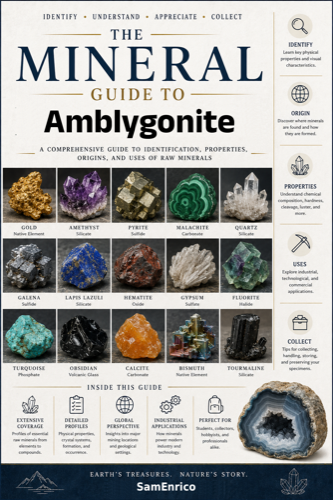 The Mineral Guide to AmblygoniteThornton Holly$11.99
 Chinese Visa Interview PreparationThornton Holly$12.99
You may also like
 Hong Kong Handover 1997Dunn Johnnie$11.99
 Zumba For Postnatal Recovery CourseNeal Christian$11.99
 Zumba for BeginnersLadner Nikia$11.99
 YouTube Comment Mining GuideHumes Pandora$12.99
 Worry Box MeditationCarlin Rudy$11.99
 Workplace Stress MeditationNguyen Lynn$11.99
 Workplace Stress and Sleep RepairHawley Ivory$11.99
 Workplace Perfectionism CureDelaney Jeffry$11.99
 Workplace Injustice Anger GuideWallen Isabelle$11.99
 Work Addiction and Burnout LinkGreenwood Ester$11.99
 Women in Yoga and WellnessBeattie Galina$11.99
 Women in Stand Up ComedyChun Evangeline$11.99