
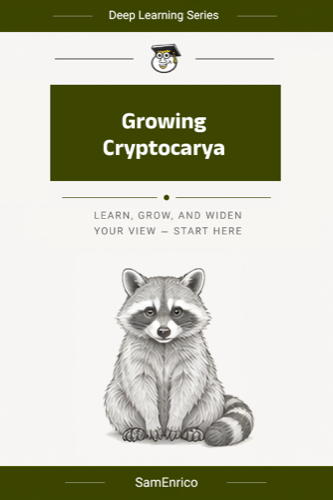
Growing Cryptocarya Audiobook
This publication, published by SamEnrico, covers G
This publication, published by SamEnrico, covers Growing Cryptocarya
Formats
Free sample
Chapter 1: The Hidden Laurel...–- On a steep hillside in central Chile, where summer rains haven’t fallen in four months and the cracked earth resembles dried riverbeds, a farmer named Cristóbal does something that would seem irrational to most commercial growers. He walks past his wilting avocado saplings—each one a thirty-dollar investment turning yellow despite his irrigation—and stops in front of a tree his grandfather planted fifty years ago. Its canopy casts a dense, cool shadow. Its leaves are glossy, dark green, and utterly untroubled. Beneath it, the soil remains moist without any recent watering.
And in the branches, thousands of small pinkish-red fruits hang like ornaments, untouched by the drought that has bankrupted neighbors who bet everything on avocados.That tree is Cryptocarya alba. In the local Mapuche language, it is called Peumo. And it is the most underrated, overlooked, and potentially valuable tree most gardeners have never heard of.This book exists because that tree—and its 200-plus relatives across the tropics of South America, Southeast Asia, and Australia—deserves a place in every climate-resilient food forest, every native habitat restoration project, and every nursery owner’s catalog. But before we dig into germination protocols, pruning techniques, or harvest schedules, we need to answer a more fundamental question: What exactly is Cryptocarya, and why has it remained hidden in plain sight for so long?The Genus You’ve Never Heard Of (But Should)Cryptocarya belongs to the Lauraceae family—the same botanical clan that gives us cinnamon, camphor, bay laurel, and the beloved avocado. This kinship explains many of the genus’s most desirable traits: aromatic leaves, durable wood, and a remarkable ability to thrive in challenging conditions where lesser plants fail.
But unlike its famous cousins, Cryptocarya has never been domesticated at scale, never been the subject of billion-dollar breeding programs, and never appeared on the shelves of big-box garden centers.That neglect is not a reflection of the plant’s merit. It is a reflection of history.The genus was first described in the early nineteenth century by European botanists who encountered these trees in the rainforests of Java and the cloud forests of the Andes. They named it Cryptocarya from the Greek words kryptos (hidden) and karyon (nut)—a reference to the fruit’s hard, woody endocarp that conceals the seed within. Unlike an avocado, where the large seed sits in a soft, edible matrix, Cryptocarya…
This is the end of the free sample. Get the Audiobook to keep going. Buy now
About this book
Details
- Author
- Thornton Holly
- Publisher
- SamEnrico
- Language
- English
- Genre
- Non-Fiction, Informative, Educational
- Released
- 2026-05-25
- Pages (approx.)
- 158
- Available as
- eBook, Audiobook

Listen in the VoxFlicks app
Audiobooks and audio dramas wherever you go. Sign in with your SamEnrico account and press play.
More by Thornton Holly
 Body Image In The Workplace Confidence GuideThornton Holly$11.99
 Helplessness Anger GuideThornton Holly$11.99
 Funeral Preplanning GuideThornton Holly$11.99
 Radiologist Interpretation FatigueThornton Holly$11.99
 Redwood National Park VanishedThornton Holly$11.99
 Andes Crossing on MulebackThornton Holly$11.99
 Medical Resident Work LimitsThornton Holly$11.99
 Beginner Mindfulness Of AgingThornton Holly$11.99
 The Underground Canvas: How Early 20th Century Graffiti Pioneers Rewrote the StreetsThornton Holly$11.99
 Icarus: The Boy Who Touched the SunThornton Holly$11.99
 The Mineral Guide to AmblygoniteThornton Holly$11.99
 Chinese Visa Interview PreparationThornton Holly$12.99